
Artificial Intelligence & Machine Learning in the UK 2026 | Courses, Jobs & Salaries
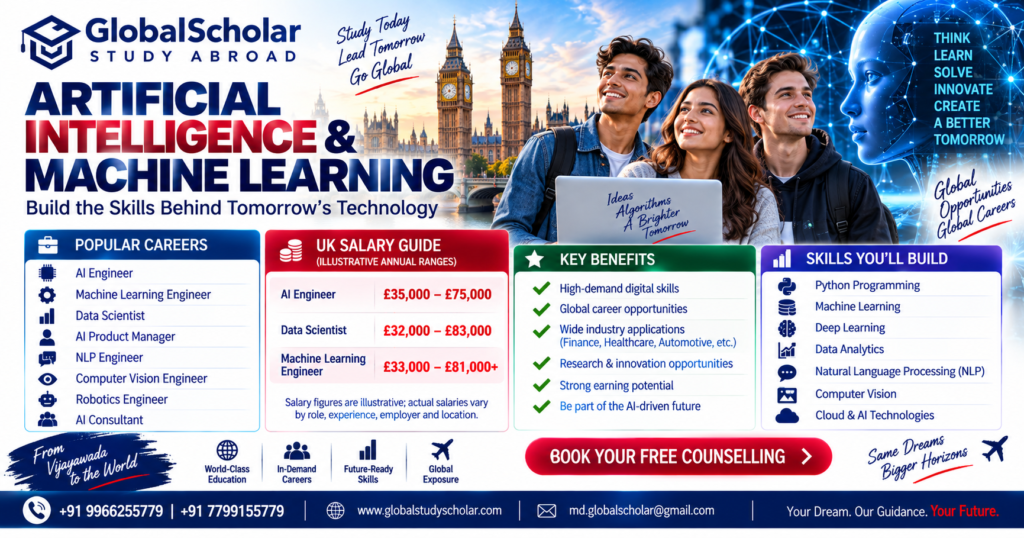
Artificial Intelligence & Machine Learning in the UK 2026 Artificial Intelligence (AI) and Machine Learning (ML) are transforming the way organisations develop products, analyse information, automate processes and make decisions. For students interested in technology, programming, data and innovation, studying Artificial Intelligence and Machine Learning in the UK can provide an opportunity to develop technical and analytical skills while studying in a major international education and technology market. UK government research published in 2026 identified significant AI skills gaps. In the 2025 AI Labour Market Survey, 97% of surveyed organisations identified at least one AI skills gap, with gaps particularly evident in understanding AI concepts and algorithms, data management, programming and data analytics. This makes AI and Machine Learning an important area for students considering technology-focused careers. Why Study AI & Machine Learning in the UK? 1. Growing Demand for AI Skills AI adoption is changing job roles and the skills employers need. Skills England’s 2026 assessment says demand is increasingly shifting toward AI-related capabilities, alongside skills such as judgement, problem-solving, collaboration and responsible use of AI. Students who develop both technical AI skills and broader problem-solving abilities can be better positioned to adapt as technology evolves. 2. International Education Experience Studying AI in the UK can provide exposure to: Students can explore how AI is applied across different industries rather than studying technology in isolation. 3. Multiple Industry Applications AI and Machine Learning are used across sectors including: This means an AI qualification does not necessarily limit graduates to one industry. Popular AI & Machine Learning Courses in the UK Students can choose different programmes depending on their academic background and career goals. Artificial Intelligence Covers areas such as: Machine Learning Focuses more deeply on: Artificial Intelligence & Machine Learning A combined pathway covering both AI theory and practical machine-learning applications. Data Science & AI Combines: Computer Science with AI Can be suitable for students wanting a broader computing foundation alongside AI specialisation. AI & Robotics Combines AI with robotics, automation, perception and intelligent systems. Skills You Can Build A strong AI and Machine Learning programme can help students develop skills in several areas. Python Programming Python is widely used for: Machine Learning Students can learn how algorithms identify patterns and make predictions from data. Deep Learning Deep learning involves neural-network approaches used in areas such as computer vision, language processing and other AI applications. Data Analytics Students learn to analyse and interpret data to support decisions and build models. Natural Language Processing NLP enables computers to process and work with human language. Applications include: Computer Vision Computer vision enables systems to interpret images and video. Applications include: Cloud & AI Technologies Modern AI systems often rely on cloud infrastructure for: Popular AI Career Opportunities An AI and Machine Learning qualification can lead to different technology and business roles. AI Engineer AI engineers develop and deploy artificial-intelligence systems. Typical areas include: Machine Learning Engineer Machine Learning Engineers develop, train and deploy machine-learning models. Data Scientist Data Scientists use statistics, programming and analytical techniques to extract insights from data. AI Product Manager AI Product Managers connect technology, business requirements and user needs to develop AI-enabled products. NLP Engineer NLP professionals work on systems that process and understand human language. Computer Vision Engineer Computer Vision Engineers develop systems that analyse and interpret visual information. Robotics Engineer Robotics professionals combine software, AI, sensors and engineering to develop intelligent machines. AI Consultant AI consultants can help organisations identify opportunities to implement AI and improve processes. AI Jobs in the UK The UK AI labour market is developing rapidly, but students should understand that high demand does not mean every graduate is guaranteed a job. The UK’s 2026 AI Labour Market Survey reported substantial skills shortages, including gaps in AI concepts and algorithms, programming, data analytics and data management. The report also found that 57% of surveyed organisations planned to adopt agentic AI within the following three years, suggesting that AI capabilities will continue to evolve. At the same time, Skills England notes that the effect of AI on future employment remains uncertain and that roles are changing rather than simply disappearing. For students, this means the best approach is to build strong fundamentals + practical experience + adaptable skills. AI Salary Guide in the UK Your flyer provides the following illustrative annual salary ranges: Career Illustrative Salary AI Engineer £35,000 – £75,000 Data Scientist £32,000 – £83,000 Machine Learning Engineer £33,000 – £81,000+ These are illustrative ranges, not guaranteed salaries. Actual salary can vary depending on: Students should check current salary information for their specific occupation before making financial or career decisions. AI & Machine Learning Across Industries One of the biggest advantages of AI is its wide range of applications. Finance AI can support: Healthcare AI applications can include: Automotive AI is used in: Retail AI can support: Cybersecurity AI can help identify: AI & Machine Learning Eligibility Eligibility depends on the university and course. For many postgraduate AI or Machine Learning programmes, applicants may need a relevant bachelor’s degree in areas such as: Some universities may accept students from other academic backgrounds if they can demonstrate appropriate mathematical, programming or analytical preparation. For undergraduate programmes, students generally apply after completing their secondary or higher-secondary education, subject to the university’s specific requirements. Always check the exact entry requirements for the selected university and course. English Language Requirements International students normally need to meet the university’s English-language requirements. Depending on the university, accepted evidence may include: Requirements and minimum scores vary by university and programme. Students should verify the current English-language requirements before applying. Tuition Fees and Living Costs The cost of studying AI in the UK varies significantly. Your overall budget can include: Tuition Fees Fees depend on: Living Costs Students should budget for: Additional Costs You may also need to consider: Do not assume that all UK AI programmes have the same tuition fees. Is Artificial Intelligence a Good Career Choice? AI can be an attractive career field for students