
Study in the UK with Employment Promise 2026 | Get a Job Within 9 Months or Fees Back

Study in the UK with GlobalScholar Study Abroad For international students, studying in the UK is not only about earning a globally recognised qualification. Students increasingly want career-focused education, employability support, practical learning and opportunities to build a professional career after graduation. One programme opportunity attracting attention is the Employment Promise offered by The University of Law. According to the University’s current official information, eligible students who do not obtain a job within nine months after successfully completing their course can receive 100% of their course fees back, consisting of 50% cashback and 50% credit towards another course, subject to the official terms and conditions. This makes selected UK postgraduate courses particularly interesting for students looking for a combination of UK Master’s study and career support. GlobalScholar Study Abroad, Vijayawada helps students explore suitable UK courses, understand eligibility and prepare their admission and visa applications. What Is the UK Employment Promise? The Employment Promise is a specific initiative from The University of Law designed around graduate employability. The University’s current policy states that if an eligible student does not obtain a job within nine months after completing their course, the student can receive 100% of their fees back, structured as: The scheme is subject to the University’s eligibility requirements and terms and conditions. Therefore, students should understand that this is not a blanket guarantee that every student will automatically receive a job. Instead, it is a conditional Employment Promise for eligible courses and students. Why Study in the UK? The UK remains a popular destination for Indian students looking for international postgraduate education. Some of the major reasons students consider the UK include: For students choosing a Master’s programme, it is important to look beyond the university name and compare course content, employability support, location, tuition fees, living expenses and career outcomes. UK Postgraduate Courses with Employment Promise The University of Law currently lists an Employment Promise across specified postgraduate courses. Its official Employment Promise page includes postgraduate law courses and selected postgraduate business courses. The courses promoted in the GlobalScholar campaign include areas such as: Business & Management Technology Law Important: Course availability and Employment Promise eligibility can change, so students should verify the specific course and current terms before applying. MBA in the UK with Employment Support An MBA in the UK can be an attractive option for students interested in business and management careers. An MBA can develop skills in areas such as: Possible career areas include: Students should check the individual MBA’s entry requirements, curriculum and Employment Promise eligibility. MBA with Artificial Intelligence The combination of business management and artificial intelligence is becoming increasingly relevant as businesses adopt AI-powered technologies. An MBA with AI can combine management education with areas such as: Potential career areas include: MSc Business Analytics in the UK MSc Business Analytics in the UK can be suitable for students who want to combine business knowledge with data-driven decision-making. Students may develop knowledge of: Possible career roles include: MSc Cyber Security Management in the UK Cyber security is another postgraduate study area available within the promoted course options. An MSc Cyber Security Management can cover areas related to: Potential career paths include: Students should understand that a degree does not itself guarantee employment. Relevant technical skills, experience and professional development can be important when competing for UK jobs. MSc Healthcare Management in the UK Healthcare management is another popular postgraduate field for international students. An MSc Healthcare Management may cover: Potential career areas include: MSc Marketing in the UK Marketing continues to evolve through digital platforms, data and technology. An MSc Marketing can help students explore: Possible career paths include: MSc Project Management in the UK Project management skills are relevant across industries such as: An MSc Project Management may cover: Potential career roles include: Law Courses in the UK The University of Law specialises in legal education and offers a range of postgraduate law programmes. Students can explore areas such as: For students considering legal careers, it is important to understand that an LLM or other postgraduate law qualification does not automatically qualify someone as a solicitor or barrister. Professional qualification requirements depend on the intended legal profession and current UK regulations. Is the Employment Promise a Job Guarantee? No — students should understand the difference. The flyer uses the message: “Get a job within 9 months or get 100% of your fees back.” However, the official University information makes clear that the Employment Promise is subject to its terms and conditions. The safest way to understand the offer is: Eligible course + eligible student + completion of the applicable requirements + no qualifying employment within the specified period = potential eligibility for the University’s fees-back arrangement. It should not be interpreted as: Every student is guaranteed a job. Students should read the official terms before enrolling. What Does 100% Fees Back Mean? This is another important point for students and parents. The University’s current information explains the 100% fees-back arrangement as: 50% cashback + 50% credit towards another course. Therefore, students should not assume that the entire tuition fee will necessarily be returned as cash. Always check the current official Employment Promise terms before making a financial commitment. Career & Employability Support The University of Law states that it has a dedicated careers and employability service with more than 30 experts, providing personalised guidance and career-related support. Support can include areas such as: This type of support can be valuable because finding employment in the UK requires more than simply completing a degree. UK Graduate Visa After Master’s The UK’s Graduate visa is an important consideration for international students. Current GOV.UK guidance states that eligible graduates can apply to stay in the UK after successfully completing an eligible course. For applications: This is especially important for students starting a one-year Master’s in 2026, because many may complete their course and apply for the Graduate visa in 2027. The Graduate visa allows eligible graduates to stay and work or look for
Study Hotel Management in France 2026: Courses, Internships, Careers & Opportunities for Indian Students
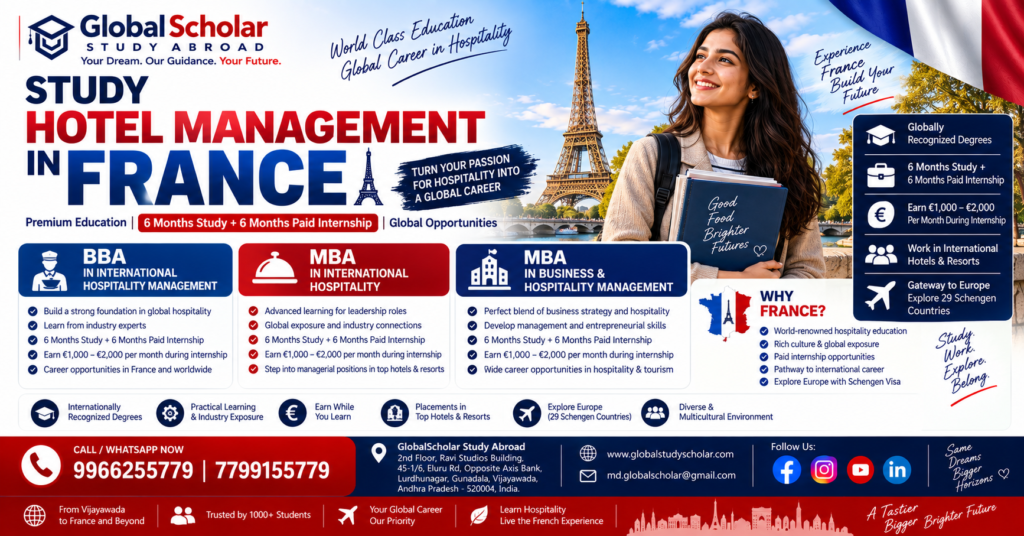
Are you planning to build an international career in hotel management, hospitality, tourism or luxury services? France can be an attractive study destination for students who want to combine hospitality education with international exposure, practical learning and European experience. With its globally recognised hospitality and tourism ecosystem, France offers a wide range of programmes in hospitality management, hotel management, tourism, gastronomy and business management. Campus France notes that French institutions offer hospitality and tourism programmes at both undergraduate and master’s levels, in French as well as English. For students from India, particularly those searching for Hotel Management in France, the country can provide an opportunity to study in an internationally oriented environment while developing practical skills relevant to hotels, resorts, restaurants, tourism companies and luxury brands. GlobalScholar Study Abroad, Vijayawada helps students explore suitable France hospitality programmes, understand admission requirements and prepare their study-abroad applications. Why Study Hotel Management in France? France is particularly interesting for hospitality students because tourism, hotels, gastronomy and luxury services are deeply connected with the country’s economy and international identity. Studying Hospitality Management in France can give students exposure to: Campus France highlights tourism, hospitality, catering and gastronomy as established areas of French educational excellence and lists specialised institutions offering programmes ranging from Bachelor’s degrees to MBA and MSc-level programmes. France also has institutions offering practical hospitality education. For example, Campus France has highlighted Institut Lyfe’s international hospitality and restaurant management programmes, including practical learning and internships in France or abroad. Hotel Management Courses in France Depending on your academic background and career goals, you may find different types of hospitality programmes in France. 1. BBA in International Hospitality Management A BBA in International Hospitality Management can be suitable for students looking to build their foundation in hotel and hospitality management. Typical areas of study may include: A hospitality BBA can help students develop both business and operational knowledge for careers in hotels, resorts, restaurants, tourism companies and related businesses. 2. MBA in International Hospitality An MBA in International Hospitality is generally designed for students who already have a bachelor’s degree and want to develop advanced management and leadership skills. Possible areas include: This type of programme can be particularly relevant for graduates who want to move towards management and leadership positions in the hospitality industry. 3. MBA in Business & Hospitality Management Another option shown in the GlobalScholar programme promotion is an MBA in Business & Hospitality Management. This type of programme can combine general business management with hospitality specialisation. Students may develop knowledge in: The exact curriculum, qualification level and recognition should always be checked with the specific institution before applying. 6 Months Study + 6 Months Paid Internship in France One of the major features promoted in this GlobalScholar campaign is the opportunity for 6 months of study followed by 6 months of paid internship. This structure can be attractive because students get the opportunity to combine academic learning with professional exposure. However, the exact study duration, internship duration, remuneration, visa requirements and work authorisation depend on the university, programme and internship arrangement. Students should not assume that every Hotel Management programme in France automatically includes a six-month paid internship. For internships exceeding four months, France has a specific long-stay internship visa framework in certain circumstances, and the internship must form part of professional training and meet the applicable requirements. Therefore, GlobalScholar Study Abroad recommends verifying the internship structure and immigration requirements for the exact programme before making financial or travel decisions. Can Students Earn During a Hospitality Internship in France? The promotional flyer for this campaign mentions potential internship earnings of approximately €1,000–€2,000 per month. However, this should be treated as an indicative promotional figure and not a guaranteed salary. Actual internship compensation can depend on: Students should obtain the actual internship terms and compensation details in writing before accepting an offer. Popular Hospitality Specialisations in France Students interested in Hotel Management in France can explore different specialisations depending on their career plans. Hotel & Resort Management Learn about hotel operations, guest services, rooms division, food and beverage and management. International Hospitality Management Focus on international hotel businesses, multicultural management and global hospitality operations. Tourism Management Suitable for students interested in tourism companies, destination management and travel businesses. Luxury Hospitality France’s strong luxury ecosystem makes luxury hotels, resorts and guest experience an interesting area of study. Food & Beverage Management Suitable for students interested in restaurants, hotels, food service and hospitality operations. Hospitality Marketing Focuses on branding, digital marketing, customer acquisition and communication. Revenue Management Students can develop knowledge of pricing, demand forecasting, hotel revenue and commercial strategy. Career Opportunities After Hotel Management in France A hospitality qualification can lead to a variety of career paths. Potential roles include: Career opportunities and salaries depend on qualifications, experience, language ability, employer, location and immigration/work authorisation. For international students, learning French can also be an important advantage when seeking professional opportunities in France. Why France Is a Strong Choice for Hospitality Students 1. International Hospitality Environment France provides students with exposure to a diverse international hospitality environment. 2. Strong Tourism Industry France has a major tourism ecosystem and established educational pathways in tourism, hospitality and gastronomy. 3. Practical Learning Several hospitality institutions incorporate practical projects, industry exposure and internships into their programmes. Campus France, for example, describes Institut Lyfe’s experiential approach and regular internships. 4. European Exposure Studying in France can provide students with the opportunity to experience European culture and travel within the Schengen Area, subject to the conditions of their visa and residence status. 5. International Career Perspective Hospitality is an international industry. Experience with multicultural guests, international hotel brands and European hospitality standards can contribute to a student’s professional profile. Eligibility for Hotel Management in France Eligibility depends on the university and programme. For Bachelor’s/BBA Programmes Students may generally need: For MBA Programmes Students may generally need: Important: There is no single eligibility rule for every hospitality institution in France. Always check the requirements of the exact university or
Study in UAE 2026: Complete Guide for International Students
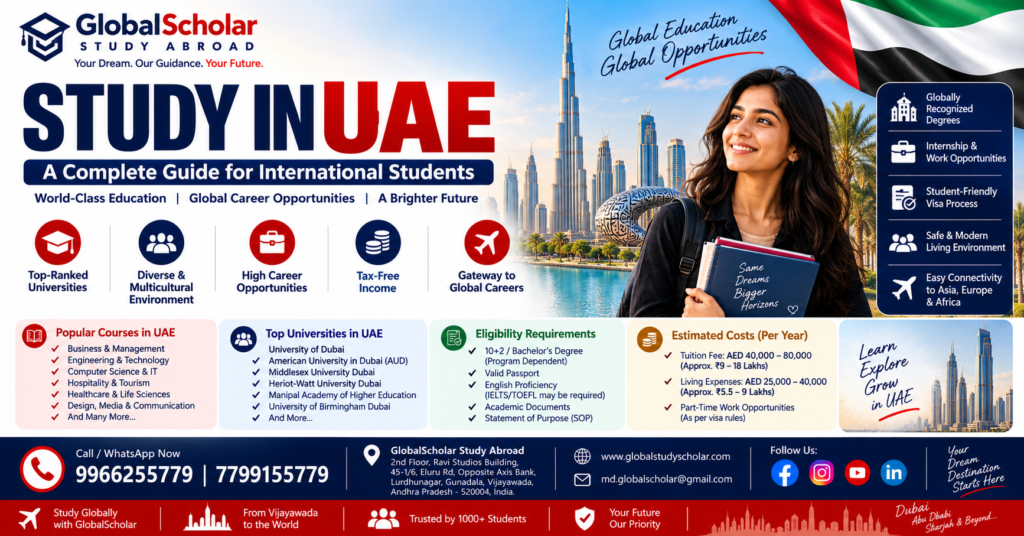
The UAE is becoming an increasingly popular study destination for international students looking for internationally oriented education, multicultural exposure and access to a fast-growing regional business hub. With universities and international branch campuses in Dubai, Abu Dhabi and other emirates, students can choose from programmes in business, engineering, technology, hospitality, healthcare, design and many other fields. If you are searching for Study in UAE, study in Dubai, UAE universities for international students, or study abroad consultants near me, this guide explains the courses, universities, eligibility, costs, visa considerations, work opportunities and career prospects. GlobalScholar Study Abroad, Vijayawada helps students from Andhra Pradesh and across India explore suitable UAE universities and admission options. Why Study in UAE? The UAE offers an international higher-education environment with universities ranging from local institutions to international branch campuses. The UAE Ministry of Education has established a national framework for classifying licensed higher education institutions, considering areas such as research and innovation, teaching quality, student life, employment and labour-market alignment, and international collaboration. Key benefits of studying in UAE include: For students interested in building an international career, studying in UAE can provide both academic and cultural exposure. Study in UAE for International Students The UAE attracts students from different countries, creating a multicultural academic environment. International students can choose programmes at different levels, including: The UAE’s higher education sector includes institutions that are subject to licensing and accreditation requirements. The UAE Ministry of Education notes that higher education institutions must meet applicable licensing and accreditation requirements, while institutions in Dubai and other emirates may also fall under relevant local authorities. Therefore, students should always verify the institution, programme accreditation and recognition before paying fees. Popular Courses to Study in UAE The GlobalScholar Study Abroad guide highlights several popular study areas. 1. Business & Management Business is one of the most popular fields for international students. Possible programmes include: The UAE’s position as a major commercial and business centre can make business education particularly attractive to students interested in international markets. 2. Engineering & Technology Students interested in technical fields can explore: Programme availability varies between universities. 3. Computer Science & IT Technology is another major area for students looking to study in UAE. Popular programmes can include: Students should compare curriculum, laboratory facilities, industry connections and accreditation when selecting a technology programme. 4. Hospitality & Tourism The UAE’s hospitality and tourism sector creates an attractive environment for students interested in: Students looking for Hotel Management in Dubai can explore diploma, undergraduate and postgraduate programmes depending on their academic qualifications. 5. Healthcare & Life Sciences Available programmes can include areas such as: Entry requirements can be more specific for regulated healthcare programmes. 6. Design, Media & Communication Students interested in creative industries can explore: The UAE’s media, advertising, events and creative sectors provide an international environment for students in these areas. Top Universities in UAE for International Students The GlobalScholar flyer highlights several universities and institutions that students can explore. Universities listed include: These institutions have different admission criteria, fees, programmes and accreditation arrangements. The UAE Ministry of Education’s classification framework provides an official mechanism for evaluating licensed higher education institutions, and the Ministry has also emphasised the importance of checking recognised institutions and programmes. Always verify the current status of the specific university and programme before applying. University of Dubai The University of Dubai offers programmes across areas such as business, computing and other disciplines. It can be considered by students looking for: Students should check current course availability, fees and entry requirements directly with the university. American University in Dubai The American University in Dubai (AUD) offers a range of undergraduate and postgraduate programmes in areas such as business, engineering, communication, architecture and arts. It may appeal to students looking for an American-style educational environment in Dubai. Middlesex University Dubai Middlesex University Dubai is an international university campus offering programmes across areas including: Students should check the specific programme’s current accreditation and entry requirements. Heriot-Watt University Dubai Heriot-Watt University Dubai offers programmes across fields including: The Dubai campus provides an international university environment within the UAE. Manipal Academy of Higher Education, Dubai Manipal Academy of Higher Education, Dubai offers programmes across areas including: Indian students may also find the institution familiar because of its wider educational presence. University of Birmingham Dubai The University of Birmingham Dubai is another option for students looking for a UK university presence in the UAE. Programme availability can include areas such as: Students should check the latest programmes and entry requirements for their intended intake. Study in UAE Eligibility Requirements Eligibility depends on the course and university. The GlobalScholar flyer highlights: 10+2 / Bachelor’s Degree – Programme Dependent This means: For Bachelor’s Programmes Students will generally need: For Master’s Programmes Students will generally need: For Diploma Programmes Entry requirements can vary significantly. Some programmes may accept students after Class 10 or Class 12, depending on the institution and qualification. There is no single UAE eligibility rule for every course. IELTS Requirement for UAE Universities English-language requirements vary between universities and programmes. Some institutions may accept: Therefore, students searching for: Study in UAE without IELTS or Study in Dubai without IELTS should not assume that IELTS is unnecessary for every programme. The correct requirement must be confirmed with the selected university. UAE Student Visa for International Students International students generally need appropriate residence permission to study in the UAE. The official UAE Government platform states that students can stay in the UAE for study under sponsorship of a parent who is a UAE resident or through sponsorship by an accredited university or college. In many cases, the university assists eligible international students with the student residence visa process. Students may need documents such as: Visa procedures can vary, so students should follow the university’s current instructions. UAE Student Visa Benefits Studying at an accredited UAE institution can provide international students with a structured legal residence route while they study. However, students should distinguish between: University admission and Immigration approval.
LLM in the UK 2026: Courses, Eligibility, Specialisations, Careers & Study Guide

An LLM in the UK is a popular postgraduate option for law graduates who want to develop specialist legal knowledge, gain international exposure and explore career opportunities in areas such as international law, corporate law, human rights, intellectual property, commercial law and data protection. The UK has a long-established legal education system and offers a wide range of LLM courses in the UK for domestic and international students. Depending on the university, students can choose general LLM programmes or specialise in a particular area of law. For students from Vijayawada, Andhra Pradesh and across India, GlobalScholar Study Abroad can assist with university selection, application preparation, admission guidance and UK study planning. What Is an LLM in the UK? LLM stands for Master of Laws. It is a postgraduate-level law qualification designed for students who want to develop advanced knowledge in a particular legal subject or broaden their understanding of law. An LLM in the UK can be useful for: The exact purpose and professional value of an LLM depends on the course and the student’s career objective. Why Study LLM in the UK? The UK is an attractive destination for postgraduate law education because students can choose from a broad range of legal specialisations and university programmes. Key advantages include: For students searching for LLM courses in the UK, the most important consideration should be whether the course matches their previous legal education and long-term career plans. Popular LLM Specialisations in the UK The GlobalScholar LLM flyer highlights several popular areas of specialisation. 1. International Law International Law focuses on legal relationships between countries, international organisations and individuals. Students may explore areas such as: This can be relevant to students interested in international organisations, policy, legal research and cross-border legal work. 2. Corporate & Commercial Law Corporate and Commercial Law focuses on legal issues involving businesses and commercial transactions. Topics may include: This specialisation can be useful for students interested in corporate legal departments, law firms and compliance-related careers. 3. Human Rights Law Human Rights Law examines legal protections and fundamental rights at national and international levels. Students can explore topics involving: 4. Criminal Justice & Criminal Law This area examines legal principles relating to criminal offences, criminal procedure and the administration of justice. Students interested in criminal justice, legal research and policy may find this specialisation relevant. 5. Intellectual Property Law Intellectual Property Law deals with the protection of creations and innovations. It can cover: The specialisation can be particularly relevant to businesses operating in technology, media, entertainment and innovation. 6. Environmental Law Environmental Law focuses on legal frameworks relating to environmental protection and sustainability. Students may study: 7. Data Protection & Privacy Law With organisations collecting and processing increasing amounts of personal information, privacy and data protection have become important legal areas. Students can explore: LLM UK Course Duration The duration of an LLM in the UK varies depending on the university and study mode. Many full-time LLM programmes are completed in one year, although some programmes may have different structures. Students should check: before applying. LLM UK Eligibility Eligibility varies between universities and individual programmes. A common route is a Bachelor’s degree in Law or a related qualification. However, some LLM programmes may consider applicants with different academic backgrounds or relevant professional qualifications. For example, the University of Portsmouth’s LLM Law entry requirements for September 2026/January 2027 include a second-class honours degree or equivalent professional experience/qualifications, with international qualifications assessed for UK equivalence. Typical application requirements may include: Important: An LLM should not be advertised as universally open to graduates from every stream. Eligibility is university-specific. Can I Study LLM in the UK Without IELTS? Some universities may accept alternative evidence of English proficiency or provide exemptions in specific circumstances. However, IELTS is not universally waived for every LLM applicant. For example, one current UK LLM programme lists IELTS 6.5 with no component below 5.5, while also specifying circumstances in which IELTS or an equivalent certificate is not required. Therefore, students searching for: LLM UK without IELTSLLM in UK without IELTSLLM courses in UK without IELTS should have their individual academic and English-language background checked against the selected university’s requirements. LLM in the UK for Indian Students An LLM in the UK for Indian students can be an option for graduates who want international legal education and exposure to different legal systems. Before choosing an LLM, Indian students should consider: An LLM can strengthen specialist knowledge, but an LLM alone does not automatically qualify an international graduate to practise as a lawyer in the UK. Career Opportunities After LLM in the UK The GlobalScholar flyer highlights several potential career areas. International Lawyer Graduates with an international law specialisation may explore roles involving cross-border legal matters, international organisations, policy and legal research. Legal Consultant Legal consultants provide specialist legal or regulatory knowledge depending on their role and qualifications. Corporate Counsel Corporate legal teams advise organisations on legal and regulatory matters. Compliance Manager Compliance professionals help organisations understand and follow relevant laws, regulations and internal policies. Policy Advisor Policy professionals research legislation, regulation and public policy and help organisations develop appropriate responses. Legal Researcher Legal researchers investigate legislation, case law, legal principles and academic materials. Academic / Lecturer Students interested in academia can pursue further research and teaching pathways, subject to the relevant academic and institutional requirements. Important: Does an LLM Make You a Solicitor in the UK? No. An LLM is a postgraduate academic qualification. It is not, by itself, a licence to practise as a solicitor or barrister. For someone seeking qualification as a solicitor of England and Wales through the SQE route, the SRA currently requires: The SRA states that QWE can include relevant legal work such as paralegal work, placements and pro bono legal work, provided the requirements are met. Therefore, students should decide whether their goal is: LLM for specialisation and academic development or professional qualification to practise law in England and Wales. These are related but different pathways. Can Indian Lawyers Work
MSc Artificial Intelligence in the UK 2026: Course, Eligibility, Careers & Study Guide
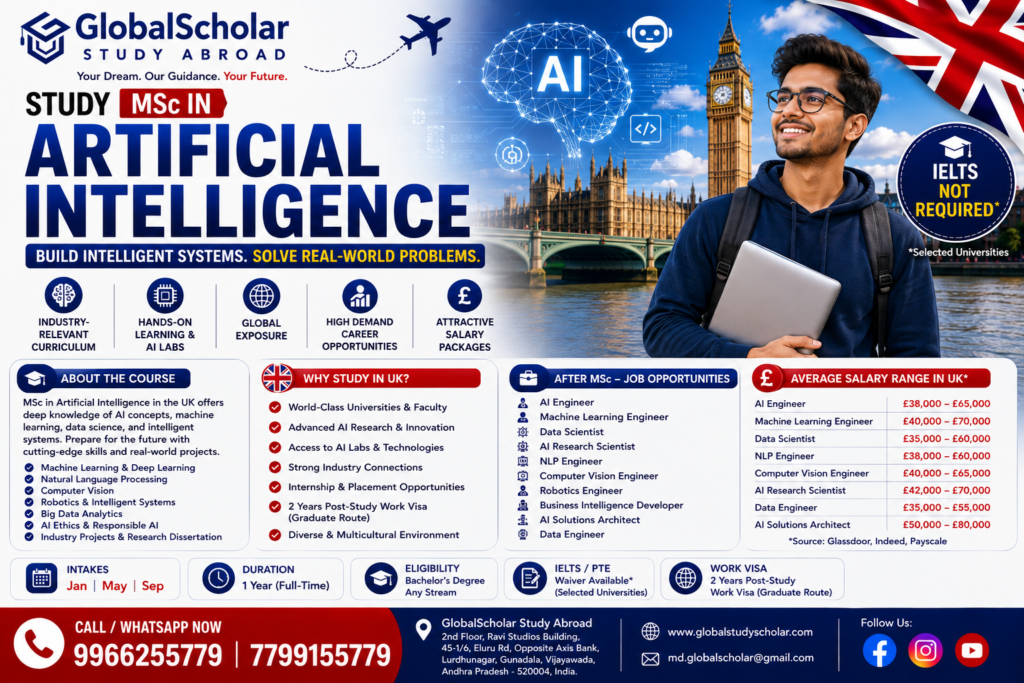
Artificial Intelligence is transforming industries ranging from technology and finance to healthcare, manufacturing, retail and professional services. For students looking to build advanced technical skills, an MSc Artificial Intelligence in the UK can provide an opportunity to study machine learning, deep learning, data science, natural language processing and intelligent systems. A Master’s in Artificial Intelligence UK can be particularly suitable for graduates who want to develop specialist knowledge and prepare for careers in AI engineering, machine learning, data science, computer vision, robotics and related fields. The UK is also actively assessing AI skills shortages and future workforce requirements. A 2026 UK government-supported AI labour-market survey reported significant skills gaps among surveyed organisations, while projections indicate substantial growth in AI-related employment through 2035. For students from Vijayawada, Andhra Pradesh and across India, GlobalScholar Study Abroad provides guidance for selecting suitable UK universities and planning the admission journey. Why Study MSc Artificial Intelligence in the UK? The UK has a strong ecosystem of universities, research institutions and technology businesses working in areas related to artificial intelligence. Key benefits of studying AI in the UK include: The UK’s current AI labour-market research also highlights shortages in AI skills. In the 2025 survey, 97% of surveyed organisations identified at least one AI skills gap, while 35% reported difficulty filling AI roles. This makes specialist education and practical skills increasingly relevant for students considering Artificial Intelligence courses in the UK. What Is an MSc Artificial Intelligence? An MSc Artificial Intelligence is a postgraduate programme that focuses on the technologies and methods used to develop intelligent computer systems. Depending on the university, students may study: The exact modules vary between universities, so students should compare individual course structures before applying. MSc Artificial Intelligence UK Course Duration Many full-time MSc AI courses in the UK can be completed in one year. The programme advertised in the GlobalScholar flyer highlights: Duration: 1 Year – Full-TimeIntakes: January | May | September However, not every UK university offers all three intakes. Course duration and available start dates depend on the university and programme. Students should confirm the latest intake availability before applying. MSc Artificial Intelligence UK Eligibility The eligibility criteria for an Artificial Intelligence Master’s in the UK vary from university to university. The GlobalScholar flyer highlights: Bachelor’s Degree – Any Stream However, students should understand that this is not a universal requirement across all UK MSc Artificial Intelligence programmes. Many technical AI programmes may expect students to have previous knowledge of areas such as: Some universities may consider applicants from broader academic backgrounds if they can demonstrate relevant quantitative, computing or professional experience. Common documents include: GlobalScholar can help students identify programmes that match their academic background. IELTS Requirement for MSc Artificial Intelligence UK The flyer states: IELTS / PTE Waiver Available – Selected Universities This should be understood as university- and applicant-specific. Some UK universities may accept alternative evidence of English proficiency, previous English-medium education or other approved routes, depending on their policies. Therefore, students searching for: MSc Artificial Intelligence UK without IELTSMSc AI in UK without IELTSArtificial Intelligence courses in UK without IELTS should check the specific university’s English-language requirements before applying. A waiver or alternative English assessment should never be assumed to apply to every UK university. MSc Artificial Intelligence UK Curriculum A typical MSc Artificial Intelligence UK programme can combine theoretical knowledge with practical application. 1. Machine Learning & Deep Learning Students learn how algorithms can identify patterns in data and make predictions or decisions. Topics may include: 2. Natural Language Processing NLP focuses on enabling computers to understand and process human language. Applications include: The UK AI labour-market survey found that the use of NLP among surveyed organisations has increased substantially in recent years, demonstrating the growing importance of language-related AI skills. 3. Computer Vision Computer vision enables machines to interpret visual information. Students may explore: 4. Robotics & Intelligent Systems This area combines AI with robotics and automation to develop systems capable of sensing, learning and making decisions. 5. Big Data & Analytics Students may learn how large datasets can be processed and analysed to support intelligent decision-making. 6. AI Ethics & Responsible AI Modern AI programmes increasingly address ethical issues such as: 7. Industry Project & Dissertation Many Master’s programmes include an independent project or dissertation where students apply their knowledge to a real research or industry-related problem. Career Opportunities After MSc Artificial Intelligence UK An MSc Artificial Intelligence in the UK can open career pathways across technology, data, research and digital industries. Potential roles include: AI Engineer AI Engineers develop and implement intelligent software systems using machine learning and other AI technologies. Machine Learning Engineer Machine Learning Engineers build, train and deploy machine-learning models. Data Scientist Data Scientists use statistical, analytical and computational methods to extract insights from data. AI Research Scientist AI Research Scientists work on developing and evaluating new AI methods and technologies. NLP Engineer NLP Engineers work with technologies that process and understand human language. Computer Vision Engineer Computer Vision Engineers develop systems capable of analysing images and video. Robotics Engineer Robotics professionals combine software, hardware and AI to develop intelligent automated systems. Data Engineer Data Engineers design and maintain systems used to collect, process and store data. AI Solutions Architect AI Solutions Architects help organisations design technology solutions that incorporate AI capabilities. Business Intelligence Developer AI and data knowledge can also support careers involving business intelligence, analytics and data-driven decision-making. AI Jobs in the UK The UK’s AI sector is experiencing significant skills development and recruitment challenges. The 2025 AI Labour Market Survey reported that 35% of surveyed organisations struggled to fill AI roles, with lack of work experience and insufficient technical skills among the major barriers. Another UK government-supported projection estimates that jobs directly involving AI activities could increase from around 158,000 in 2024 to 3.9 million by 2035, although these are projections rather than guaranteed employment outcomes. This highlights why students should focus not only on obtaining an MSc Artificial Intelligence degree, but also
MSc Psychology in the UK 2026: Course, Eligibility, Careers & Study Guide
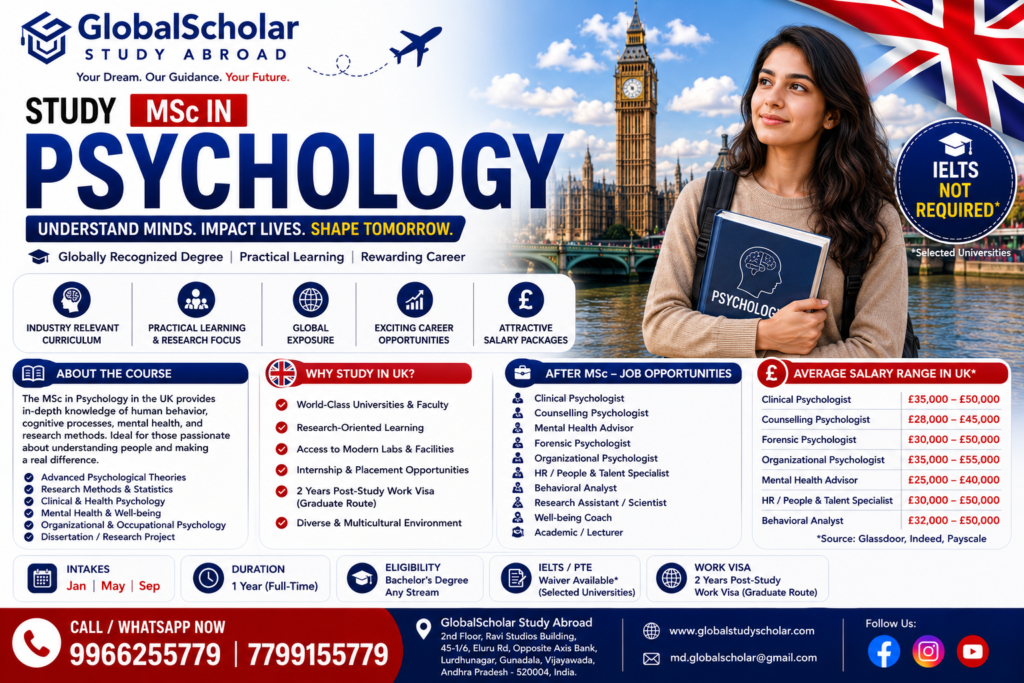
If you are interested in understanding human behaviour, mental health, cognitive processes and psychological research, studying an MSc Psychology in the UK can be a valuable postgraduate option. UK universities offer psychology programmes covering areas such as research methods, mental health, organisational psychology, health psychology and behavioural science. For international students, a Psychology Master’s in the UK can provide exposure to research-led teaching, modern academic facilities and a multicultural learning environment. GlobalScholar Study Abroad, Vijayawada helps students explore suitable UK universities, understand eligibility, prepare applications and receive guidance throughout the admission and visa process. Why Study MSc Psychology in the UK? The UK has a well-established higher education sector and offers postgraduate psychology programmes with different academic and career specialisations. Key advantages include: An MSc Psychology in the UK can be particularly useful for students who want to develop their understanding of psychological theory while gaining experience in research, statistics and evidence-based approaches. What Is an MSc Psychology? An MSc Psychology is a postgraduate degree designed to provide advanced knowledge of psychology and related areas. Depending on the university and programme, students may study topics such as: The exact modules differ between universities, so students should always check the curriculum and professional accreditation before applying. MSc Psychology UK – Course Duration Many UK universities offer psychology Master’s programmes that can be completed in one year of full-time study. The flyer for this programme highlights: Duration: 1 Year – Full-TimeIntakes: January | May | September However, available intakes and course duration vary by university. Some universities may offer only September entry, while others may have January or additional intakes. Students should check the current university intake before submitting an application. MSc Psychology UK Eligibility A common entry route is a recognised Bachelor’s degree. The exact academic requirements depend on the university and the specific psychology programme. Typical requirements may include: Some psychology Master’s programmes may accept students from related or different academic backgrounds, while others require a psychology degree or specific prerequisite subjects. Therefore, “Bachelor’s degree in any stream” should not be treated as universal eligibility. GlobalScholar can check the requirements of individual universities before application. IELTS Requirement for MSc Psychology in the UK The flyer highlights “IELTS Not Required – Selected Universities.” This should be understood as university- and applicant-specific, rather than a blanket rule. For UK Student visa purposes, degree-level students generally need to demonstrate English at CEFR B2, although a Higher Education Provider may assess English itself in qualifying circumstances. Students may also be able to prove English through an eligible degree taught in English or an approved English-language test. So, if you are searching for: MSc Psychology UK without IELTSorPsychology Master’s in UK without IELTS the correct approach is to check whether your chosen university accepts your previous English-medium education or another approved method of demonstrating English proficiency. MSc Psychology UK Curriculum The curriculum varies between universities, but students may encounter subjects such as: 1. Advanced Psychological Theories Students explore major psychological theories and contemporary developments in psychology. 2. Research Methods Research methodology is an important part of postgraduate psychology education. Students learn how to design, evaluate and interpret psychological research. 3. Statistics Psychology involves significant use of quantitative and qualitative research methods. Students may develop skills in analysing and interpreting research data. 4. Clinical & Health Psychology Some programmes introduce students to psychological factors associated with health, illness and wellbeing. 5. Mental Health & Wellbeing Students can explore psychological perspectives on mental health, wellbeing and behavioural development. 6. Organisational & Occupational Psychology This area examines behaviour in workplace environments, including employee wellbeing, motivation, leadership and organisational behaviour. 7. Dissertation / Research Project Many Master’s programmes include an independent research project where students investigate a specific psychological question using appropriate research methods. Career Opportunities After MSc Psychology in the UK An MSc Psychology can support careers across several areas depending on your previous qualification, experience, specialisation and professional accreditation. Possible career areas include: The flyer also highlights roles such as Clinical Psychologist, Counselling Psychologist and Forensic Psychologist. However, an important distinction is necessary: a general MSc Psychology does not automatically qualify a graduate to work as a UK Clinical Psychologist or Counselling Psychologist. These are regulated/protected professional titles with specific training and registration requirements. For example, the UK route to becoming a Clinical Psychologist normally involves professional doctoral-level training. Therefore, students who specifically want to become a Clinical Psychologist in the UK should choose their academic pathway carefully and check HCPC/BPS requirements before enrolling. Psychology Careers in the UK Psychology graduates can explore opportunities in several sectors. Mental Health Graduates may pursue support, research or related roles in mental health services, depending on their qualifications and experience. Human Resources Psychology provides useful knowledge of behaviour, motivation, communication and workplace relationships, making it relevant to HR and people-management careers. Organisational Psychology Students interested in workplace behaviour can explore organisational and occupational psychology pathways. Research Students with strong research and analytical skills can explore research assistant, research coordinator and related positions. Education Psychology knowledge can also be useful in educational support, student wellbeing and behavioural-development environments, subject to the role’s specific requirements. Behavioural Science Behavioural science is another area where psychology graduates can apply research, analytical and behavioural knowledge. Can I Work While Studying MSc Psychology in the UK? Eligible international students studying a full-time degree-level course at a qualifying higher education provider can generally work up to 20 hours per week during term time and full-time outside term time, subject to their Student visa conditions. Students should always check the work conditions attached to their individual visa. Working while studying can help students gain experience and manage some living expenses, but students should not rely on part-time work as their primary source of funding for tuition and living costs. UK Graduate Route After MSc Psychology The UK Graduate Route can allow eligible international students to stay in the UK after successfully completing an eligible course. However, the rules have changed. For applications made on or before 31
MSc Healthcare Management in the UK 2026: Eligibility, Fees, Universities & Career Opportunities
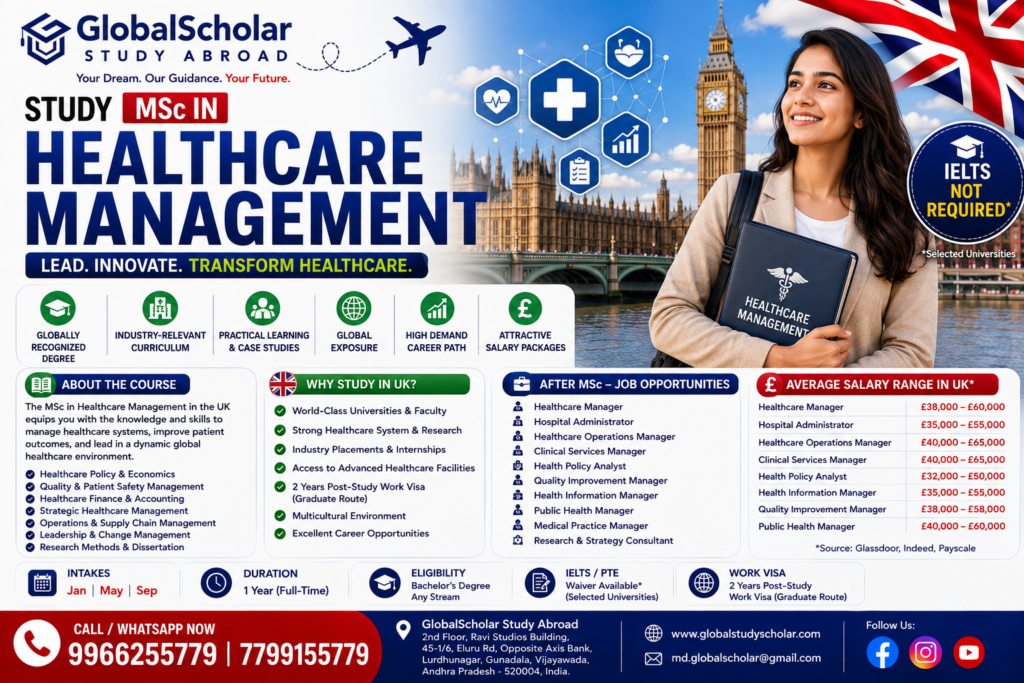
If you are planning to build a career in the healthcare sector but are interested in management, leadership, administration and business, an MSc Healthcare Management in the UK can be an excellent postgraduate study option. The UK is known for its internationally recognised universities, established healthcare sector and wide range of postgraduate programmes. Students can develop knowledge in healthcare leadership, strategic management, healthcare policy, operations, finance, quality improvement and organisational management. For Indian students, choosing the right course and university is an important decision. Academic background, tuition fees, English-language requirements, location, career plans and university entry criteria should all be considered before applying. If you are searching for UK education consultants in Vijayawada, Andhra Pradesh, or near me, GlobalScholar Study Abroad can help you explore suitable UK Master’s options and understand the admission process. Why Study MSc Healthcare Management in the UK? Healthcare is a large and complex sector that requires professionals who understand not only healthcare services but also management, leadership and organisational strategy. An MSc Healthcare Management UK programme can help students develop a combination of management and healthcare-related knowledge. 1. Globally Recognised Education UK universities attract students from around the world and offer a wide range of postgraduate programmes. Studying in the UK can provide exposure to different approaches to healthcare management, leadership and organisational development. 2. Develop Management & Leadership Skills Healthcare organisations require professionals who can manage teams, resources, operations and services effectively. A Master’s programme can help students develop skills in: 3. International Exposure Studying alongside students from different countries can provide valuable international exposure. Students can learn about different healthcare systems and develop communication, teamwork and professional networking skills. 4. Wide Range of Career Pathways Healthcare management graduates can explore roles across hospitals, healthcare organisations, pharmaceutical companies, health insurance, public-sector organisations, consulting firms and other healthcare-related businesses. Employment opportunities depend on the student’s qualifications, experience, professional skills and employer requirements. What Is MSc Healthcare Management? An MSc Healthcare Management is a postgraduate programme that combines healthcare knowledge with management and leadership principles. The exact curriculum varies between universities, but students may study areas such as: Many programmes also include a dissertation, research project, consultancy project or practical assignment. MSc Healthcare Management UK Eligibility Eligibility requirements vary between universities and individual programmes. Generally, international students may need: Some universities may accept students from a wide range of academic backgrounds, while others may prefer applicants with healthcare, nursing, medicine, pharmacy, life sciences, public health, business or management backgrounds. Therefore, students should check the specific entry requirements of each university before applying. Can Indian Students Study Healthcare Management in the UK? Yes, eligible Indian students can apply for suitable Healthcare Management Masters UK programmes. Students from backgrounds such as: may find suitable programmes, depending on the university’s entry requirements. Students should choose a course that matches their previous qualification and long-term career goals. Do You Need IELTS for MSc Healthcare Management in the UK? English-language requirements vary by university. Many UK universities require international students to demonstrate their English proficiency through an accepted test. Depending on the institution and applicant’s educational background, alternative forms of evidence may sometimes be accepted. Possible English-language requirements can include: Some universities may provide English-language waivers in specific circumstances. Important: Do not assume that IELTS is either compulsory or automatically waived. Always check the current requirements of your selected university. MSc Healthcare Management Course Duration in the UK Many full-time MSc Healthcare Management UK programmes can be completed in approximately one year. However, course duration varies depending on: Students interested in gaining practical experience can also explore programmes that offer placement or work-experience opportunities. MSc Healthcare Management Fees in the UK Tuition fees vary depending on the university, course structure and international student fee category. In addition to tuition fees, students should consider other expenses, including: The overall cost of studying in the UK depends significantly on the university’s location and the student’s lifestyle. Students should prepare a complete financial plan before starting their application. Scholarships for Healthcare Management Students Some UK universities offer scholarships or financial support to eligible international students. Scholarship availability can depend on: Students should check the individual university’s current scholarship information. At GlobalScholar Study Abroad, students can also discuss available university options and scholarship opportunities during the admission planning process. What Will You Learn in an MSc Healthcare Management? The modules vary between universities, but students may develop knowledge in several important areas. Healthcare Leadership Students learn about leadership approaches, decision-making and managing teams in healthcare environments. Strategic Healthcare Management This area focuses on strategic planning and how healthcare organisations can improve their services and achieve organisational objectives. Healthcare Operations Students can learn how healthcare services are planned, organised and delivered efficiently. Healthcare Finance Healthcare managers need to understand budgeting, resource allocation and financial decision-making. Healthcare Quality & Improvement Quality management is an important aspect of healthcare. Students may explore approaches to improving services, patient experience and organisational performance. Healthcare Policy Students may study healthcare policies, regulations and the factors influencing healthcare organisations. Human Resource Management Healthcare organisations depend on large multidisciplinary teams. Students may learn about recruitment, workforce planning, employee development and team management. Research Methods Research skills can help students analyse information, evaluate evidence and complete academic research projects. Career Opportunities After MSc Healthcare Management An MSc Healthcare Management can lead to different management and administrative career pathways. Potential roles may include: Healthcare Manager Healthcare managers support the management and coordination of healthcare services and teams. Hospital Administrator Hospital administrators may work with operational, administrative and organisational activities within healthcare facilities. Healthcare Operations Manager Operations professionals focus on improving processes, resources and service delivery. Healthcare Project Manager Project managers coordinate healthcare-related projects, timelines, teams and resources. Healthcare Consultant Healthcare consultants may work with organisations to improve processes, strategy and performance. Healthcare Quality Manager Quality professionals work on improving organisational standards, processes and service quality. Healthcare Business Analyst Business analysts may analyse organisational data and processes to support decision-making. Healthcare HR Manager Healthcare HR
MSc Project Management in the UK 2026: Eligibility, Course, Jobs, Salary & Career Opportunities
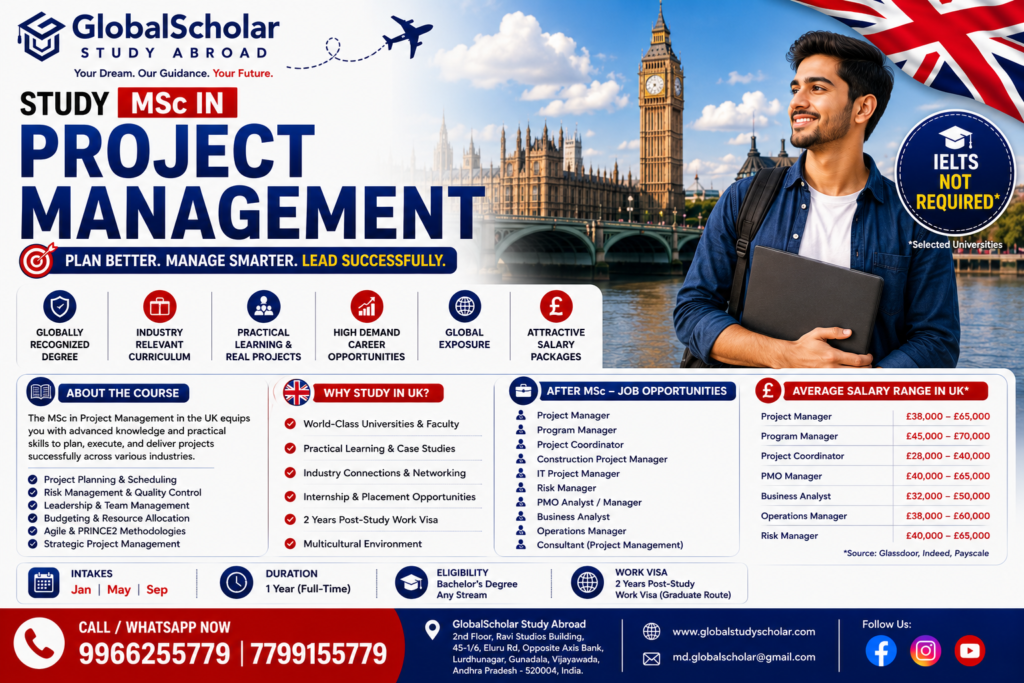
Project management is an important function across almost every industry. Businesses, technology companies, construction firms, financial organisations, healthcare providers and public-sector organisations all need professionals who can plan projects, manage resources, control risks and deliver work successfully. An MSc Project Management in the UK can be a strong postgraduate option for students who want to develop leadership, planning, communication, risk-management and project-delivery skills. For students from India, studying a Project Management Master’s in the UK can also provide international academic exposure and the opportunity to understand project management practices in a global business environment. At GlobalScholar Study Abroad, Vijayawada, we help students from Vijayawada and across Andhra Pradesh explore UK master’s programmes, understand eligibility requirements and receive guidance throughout the application process. Why Study MSc Project Management in the UK? The UK has universities offering postgraduate programmes across business, management, technology, engineering and professional disciplines. Project management skills are useful across many industries, which means graduates can potentially explore different career paths rather than being restricted to one sector. UK government careers information describes business project managers as professionals who plan tasks and organise people and resources to complete projects on time and within budget. The National Careers Service currently lists business project manager salaries from £29,000 for starters to £75,000 for experienced professionals. The UK is also continuing to invest heavily in infrastructure and digital transformation. For example, a March 2026 UK government infrastructure update identified substantial future workforce requirements across major infrastructure projects. Key benefits of studying Project Management in the UK can include: What Is an MSc Project Management? An MSc Project Management is a postgraduate qualification designed to develop advanced knowledge of planning, managing and delivering projects. The exact modules vary between universities, but students may study: The course can combine theoretical knowledge with practical case studies and project-based learning. What Will You Learn During MSc Project Management? 1. Project Planning Students learn how to define project objectives, establish timelines, allocate resources and create structured project plans. Planning is one of the most important stages of successful project delivery. 2. Project Scheduling Scheduling involves determining: Students may use project-management software and scheduling techniques as part of their studies. 3. Risk Management Every project can face risks. These may include: Students learn how to identify, assess and manage these risks. 4. Leadership & Team Management Project managers often work with people from different departments and professional backgrounds. Therefore, effective project management requires: 5. Budgeting & Resource Allocation Projects need to be delivered within available budgets and resources. Students may learn about: 6. Agile Project Management Agile methodologies are widely used in technology and other project environments. Students may explore Agile principles, Scrum and other approaches to iterative project delivery. 7. Strategic Project Management Strategic project management connects individual projects with wider organisational goals. This helps students understand how projects contribute to business growth and long-term strategy. MSc Project Management UK Eligibility Entry requirements vary from one university to another. In general, international students may need: One advantage of some Project Management master’s programmes is that applicants may come from a variety of academic backgrounds. Depending on the university, suitable backgrounds may include: However, eligibility is university-specific. Students should check the published entry requirements before applying. Can Students From Any Bachelor’s Degree Study Project Management? Potentially, yes. Project management is used across many sectors, so some universities accept applicants from a broad range of academic backgrounds. For example, a student with a bachelor’s degree in: may be able to find suitable Project Management master’s programmes. However, not every university accepts every academic background. At GlobalScholar Study Abroad, Vijayawada, we can assess your academic profile and help identify programmes where your previous qualification may meet the published entry requirements. IELTS Requirement for MSc Project Management in the UK English-language requirements vary by university and individual student profile. Some universities may require IELTS, while others may accept alternative forms of English-language evidence. For degree-level study, UK Student visa applicants generally need to meet the applicable English-language requirement, although there are circumstances where another accepted method of demonstrating English can apply. Therefore, students should not assume that: “IELTS is not required for every UK university.” Instead, the English-language requirement should be checked for the specific university and course. MSc Project Management Course Duration in the UK Many full-time MSc Project Management programmes can be completed in approximately: 1 Year A typical one-year master’s programme may include: Term/Semester 1: Core project-management modules Term/Semester 2: Advanced project-management modules Final stage: Dissertation, consultancy project or capstone project Some universities may also offer: The duration and structure depend on the university. MSc Project Management With Placement Some UK universities may offer Project Management programmes with placement or professional experience options. A placement can help students gain exposure to real workplace environments. Students may develop practical experience in areas such as: However, students should understand that a placement opportunity is not the same as a guaranteed placement. The availability of a placement may depend on: Career Opportunities After MSc Project Management An MSc Project Management can support career paths across different industries. Potential roles include: Project Manager Project managers plan and coordinate projects, manage resources and work towards delivering projects within agreed requirements. Project Coordinator Project coordinators assist project managers with documentation, scheduling, communication and administration. Programme Manager Programme managers can oversee multiple related projects and coordinate them towards broader organisational objectives. PMO Analyst / PMO Manager PMO professionals support project governance, reporting, processes and project performance. Business Analyst Business analysts examine business problems and identify opportunities for improvement. Operations Manager Operations managers focus on improving the performance and efficiency of organisational activities. Risk Manager Risk managers identify potential risks and help organisations develop strategies to manage them. IT Project Manager IT project managers coordinate technology projects such as software development, digital transformation and infrastructure projects. The UK National Careers Service currently lists IT project manager salaries at approximately £35,000 to £60,000, depending on experience. Industries Hiring Project Management Professionals One of the advantages of
MSc Data Analytics in the UK 2026: Courses, Eligibility, Skills, Jobs & Career Opportunities
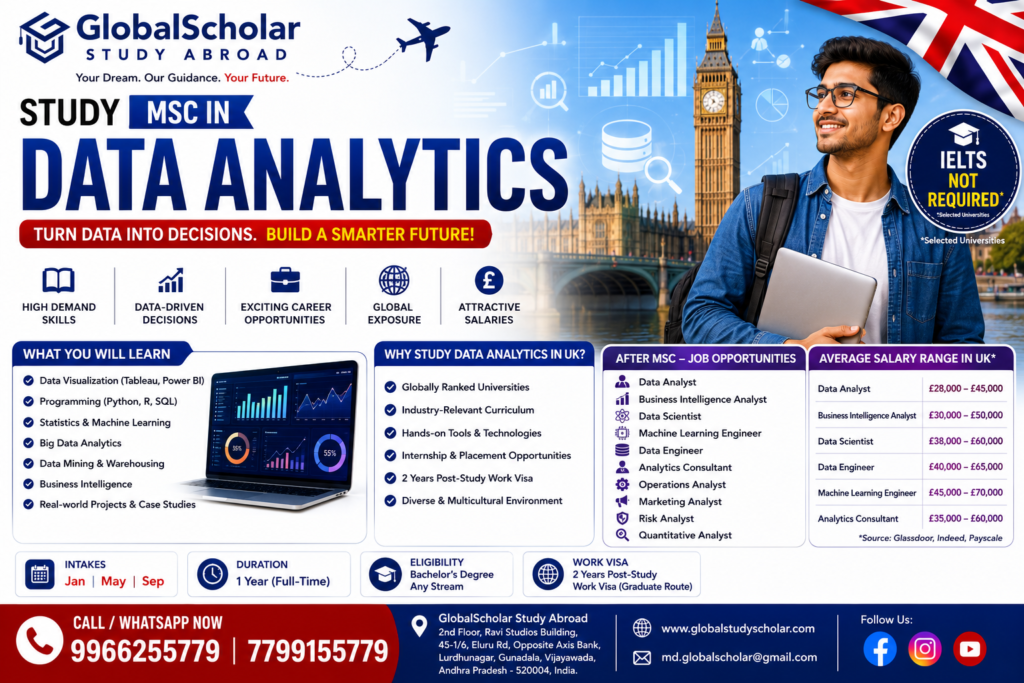
Data is now one of the most valuable resources for modern organisations. Businesses use data to understand customers, improve operations, forecast trends, manage risks and make better decisions. As a result, professionals with strong skills in data analytics, statistics, programming, business intelligence and machine learning can explore career opportunities across many industries. An MSc Data Analytics in the UK can be an attractive option for students who want to develop advanced analytical and technical skills in an international academic environment. At GlobalScholar Study Abroad, Vijayawada, we help students from Andhra Pradesh explore suitable UK universities and postgraduate programmes based on their academic background, career goals and preferred study location. Why Study MSc Data Analytics in the UK? The UK has a well-established technology and business ecosystem, with data being used across finance, healthcare, retail, consulting, technology, marketing, manufacturing and government. UK government research has highlighted significant demand for data skills. Earlier government research found that 48% of surveyed businesses were recruiting for roles requiring data skills, with Data Analyst among the most commonly recruited data-focused roles. Studying data analytics in the UK can therefore help students develop skills that can be applied across multiple industries. Key benefits include: What Is an MSc Data Analytics? An MSc Data Analytics is a postgraduate programme focused on collecting, processing, analysing and interpreting data to support business and organisational decisions. The exact modules differ between universities, but students may study areas such as: The combination of technical and analytical knowledge can help students prepare for different roles within the data and technology sector. What Will You Learn During MSc Data Analytics? 1. Data Visualisation Data visualisation teaches students how to convert complex datasets into understandable charts, dashboards and reports. Common tools can include: The goal is not simply to create attractive charts but to communicate meaningful insights clearly. 2. Python, R and SQL Programming and database skills are increasingly important for data professionals. Students may learn: These skills can be useful when working with large datasets. 3. Statistics Statistics forms an important foundation of data analytics. Students may learn: 4. Machine Learning Depending on the programme, students may be introduced to machine-learning techniques used to identify patterns and make predictions from data. 5. Big Data Analytics Large organisations generate enormous amounts of information. Big-data modules can introduce students to methods and technologies used to process and analyse large datasets. 6. Business Intelligence Business intelligence focuses on turning organisational data into useful information for decision-makers. Students may work with dashboards, KPIs, reports and analytical models. MSc Data Analytics UK Eligibility Entry requirements vary between universities. Generally, students applying for an MSc Data Analytics may need: Some universities may prefer applicants with backgrounds such as: However, eligibility can differ considerably between courses. Some universities may accept students from other academic backgrounds if they demonstrate appropriate mathematical, analytical or technical ability. Always check the specific university’s entry requirements before applying. Can Non-IT Students Study Data Analytics in the UK? Potentially, yes. This depends entirely on the university and course. Some MSc Data Analytics programmes are designed primarily for students with computing, mathematics or technical backgrounds. Others may be structured as conversion or multidisciplinary programmes. For students from: the correct course selection is particularly important. At GlobalScholar Study Abroad, we can assess your academic profile and identify programmes whose published entry requirements may match your background. IELTS Requirement for MSc Data Analytics in the UK English-language requirements vary by university. Some universities may accept IELTS, while others may accept alternative English-language evidence depending on the applicant’s previous education and circumstances. For UK Student visa purposes, students studying at degree level or above generally need to meet the relevant English-language requirement at CEFR B2, unless another permitted method of demonstrating English applies. GOV.UK also states that a degree taught in English may be used in certain circumstances to demonstrate English ability. Therefore, the statement “IELTS is not required” should never be treated as universal. It should be confirmed for the specific university, course and student profile. MSc Data Analytics UK Course Duration Many full-time MSc Data Analytics programmes can be completed in approximately: 1 Year Some universities may offer longer programmes that include: The exact duration should be checked with the university before applying. A typical one-year master’s programme may include: Semester 1 → Core modules Semester 2 → Advanced modules Final stage → Dissertation / Capstone Project Course structures vary by university. MSc Data Analytics with Placement or Internship Some UK universities offer programmes that include placement or professional experience options. A placement can help students gain exposure to a professional environment and understand how analytical skills are used in real organisations. Students may develop experience in: However, students should understand the difference between a placement opportunity and a guaranteed placement. A placement is not automatically guaranteed. Availability can depend on the university, employer requirements, student performance, competition and the student’s ability to secure the position. Career Opportunities After MSc Data Analytics An MSc Data Analytics can lead to a variety of career paths. Data Analyst Data analysts examine datasets and produce insights that help organisations make decisions. Business Intelligence Analyst Business intelligence analysts work with organisational data to develop reports, dashboards and business insights. Data Scientist Data scientists use advanced statistics, programming and machine learning to analyse data and develop predictive models. The UK’s National Careers Service currently lists data scientist salaries from approximately £32,000 for starters to £83,000 for experienced professionals, demonstrating how significantly earnings can vary with experience and career progression. Data Engineer Data engineers help build and maintain systems that collect, process and store data. Machine Learning Engineer Machine learning engineers work with algorithms and systems that allow computers to learn from data. Analytics Consultant Analytics consultants help organisations use data to solve business problems and improve decision-making. Marketing Analyst Marketing analysts use customer and campaign data to evaluate performance and identify trends. Operations Analyst Operations analysts examine business processes and data to improve efficiency. Risk Analyst Risk analysts use data to identify
MSc Cyber Security in the UK with Placement Year 2026: Eligibility, Fees, Jobs & Career Opportunities

Cyber security has become an important part of modern business, government, finance, healthcare and technology. As organisations increasingly depend on digital systems and cloud technologies, protecting data, networks and applications has become a major priority. For students interested in technology, ethical hacking, network security, cloud security and digital risk management, studying an MSc Cyber Security in the UK can be an excellent way to develop advanced technical and professional skills. A Cyber Security Master’s in the UK with a placement year can offer an additional opportunity to gain practical industry experience alongside academic study. However, placement availability and eligibility depend on the university and individual course. At GlobalScholar Study Abroad, Vijayawada, we help students explore UK cyber security courses, compare universities, understand eligibility requirements and prepare their applications. Why Study MSc Cyber Security in the UK? The UK has a well-developed technology and cyber security sector, with organisations across financial services, government, consulting, healthcare, telecommunications and technology requiring cyber security expertise. The UK government’s latest cyber security labour-market research estimates that approximately 143,000 people were working in the UK’s cyber security workforce, while the estimated annual workforce gap was around 3,800 professionals. The same research also identified continuing technical skills gaps in areas such as auditing and assurance, digital forensics and cryptography. This makes cyber security an interesting area for students who want to build careers in a technology-focused field. Key advantages can include: What Is an MSc Cyber Security? An MSc Cyber Security is a postgraduate programme designed to develop advanced knowledge of protecting computer systems, networks, applications, organisations and data from cyber threats. The exact curriculum varies between universities, but students may study subjects such as: Network Security Students learn how networks are protected from unauthorised access, attacks and other security threats. Ethical Hacking Ethical hacking involves identifying vulnerabilities in systems and applications so that organisations can improve their security. Cloud Security As organisations increasingly use cloud infrastructure, understanding cloud security has become an important technical skill. Cryptography Cryptography focuses on protecting information through encryption and other security techniques. Digital Forensics Digital forensics involves examining digital systems and evidence following security incidents. Security Operations Students can learn about monitoring systems, identifying suspicious activity and responding to cyber security incidents. Risk Management Cyber security is not only about technology. Organisations must also identify risks, assess their impact and develop appropriate security strategies. Cyber Law and Compliance Students may also learn about legal, regulatory and ethical considerations surrounding data and cyber security. MSc Cyber Security with Placement Year in the UK One of the major attractions for international students is the possibility of studying a programme that includes a placement year. A placement-year programme may typically involve: Academic Study + Industry Placement For example, a two-year programme may consist of: The exact structure depends on the university. A placement can allow students to apply classroom knowledge in a professional environment and develop practical workplace skills. However, students should understand an important distinction: A placement opportunity is not the same as a guaranteed job. Placement availability, eligibility and the ability to secure a placement can depend on academic performance, skills, interview performance, employer requirements and university policies. What Will You Learn During an MSc Cyber Security? Depending on the university, students may encounter modules covering: The UK government’s 2025 cyber security labour-market research identified cyber security, vulnerability, auditing, ISO/IEC 27001, risk management and incident response among commonly requested skills in core cyber security job postings. This highlights the importance of developing both technical and professional skills rather than relying only on a degree title. Eligibility for MSc Cyber Security in the UK Entry requirements vary between universities. In general, international students applying for an MSc Cyber Security may need: Some universities may prefer applicants with a background in: However, some programmes may accept applicants from other academic backgrounds if they meet the university’s specific requirements. Always check the individual university’s eligibility criteria before applying. Can Students from Any Bachelor’s Background Study Cyber Security? Not necessarily. This is one of the most important points students should understand. Some UK universities offer cyber security master’s programmes that accept students from a broad range of academic backgrounds, while others require a computing, IT, engineering or related degree. Therefore, if you are searching for: “MSc Cyber Security UK for non-IT students” you should check the exact entry requirements of each university. GlobalScholar Study Abroad can assess your academic background and help identify universities where your profile may be suitable. IELTS Requirement for MSc Cyber Security in the UK English-language requirements depend on the university and course. Some universities may require IELTS or another accepted English-language qualification, while others may consider alternative evidence depending on the student’s previous education and circumstances. The UK Student visa process also includes English-language requirements depending on the course and applicant circumstances. GOV.UK provides the current requirements for Student visa applicants. Therefore, students should not assume that IELTS is automatically waived for every cyber security programme. Always check the university’s latest requirements. Duration of MSc Cyber Security in the UK The duration depends on the course structure. Standard Master’s Many full-time MSc programmes can be completed in approximately: 1 Year Master’s with Placement Year A programme including a dedicated placement year may take: 2 Years A typical structure could be: Year 1: Academic studyYear 2: Industry placement The exact structure varies by university. Students should carefully check whether the placement is: Cyber Security Placement Year in the UK A placement year can help students develop professional skills such as: Students may explore placement opportunities in areas such as: A placement can strengthen a student’s CV, but employment after graduation is not guaranteed. Cyber Security Jobs After MSc in the UK An MSc Cyber Security can support applications for a range of roles depending on the graduate’s technical skills and experience. Potential career paths include: Cyber Security Analyst Cyber security analysts monitor systems, investigate suspicious activity and help organisations respond to threats. Security Engineer Security engineers help design, implement and maintain