
Study in Europe 2026: Courses, Fees, Scholarships & Admission Guide
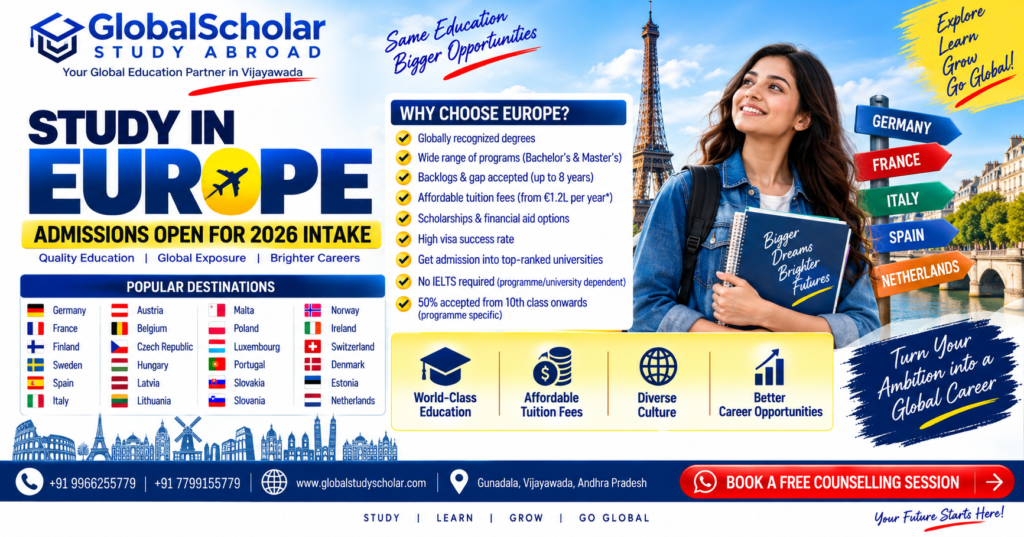
Are you planning to study in Europe in 2026? European countries offer a wide range of Bachelor’s and Master’s programmes, internationally recognised higher-education systems, scholarship opportunities and diverse student experiences. For Indian students, destinations such as Germany, France, Italy, Ireland, Malta, Spain, the Netherlands, Austria, Belgium, Finland, Sweden, Poland, Portugal, Hungary, Latvia, Lithuania, Norway, Denmark, Estonia and other European countries can provide different academic and career pathways. However, Europe is not one single education or immigration system. Tuition fees, admission requirements, English-language requirements, student work rules and visa conditions vary by country, university and programme. The European Commission’s Study in Europe resources cover higher education systems across 33 European countries. If you are looking for quality education, international exposure, scholarship opportunities and European career experience, choosing the right country and programme is an important first step. Why Study in Europe? There are several reasons international students consider Europe for higher education. 1. Globally Recognised Education European countries are part of the European Higher Education Area, which helps make higher-education systems more compatible and supports academic mobility across participating countries. Students can find universities and institutions offering programmes at: The exact qualification structure varies by country and institution. 2. Wide Range of Courses Students planning to study in Europe can choose from a wide range of academic fields, including: Course availability depends on the country and university. 3. English-Taught Programmes Many European universities offer programmes taught in English, particularly at Master’s level, while some countries also have substantial English-taught Bachelor’s options. However, English-taught does not automatically mean IELTS is waived. Each university or programme may specify its own accepted English-language evidence. Students should check whether IELTS, TOEFL, another test or alternative proof such as previous English-medium education is accepted. 4. Scholarship Opportunities Europe has a large number of scholarship and financial-support schemes for international students. The European Commission states that there are hundreds of thousands of scholarships and financial-support opportunities across Europe. Some can contribute towards tuition, while others may also support living expenses. Possible funding sources include: Eligibility varies considerably between programmes. Popular Countries to Study in Europe The GlobalScholar flyer highlights several European destinations for international students. Study in Germany Germany is a popular destination for international students, particularly in engineering, technology, business and science. Many state universities in Germany do not charge tuition fees for Bachelor’s and many Master’s programmes, although exceptions exist and some programmes or states may charge fees. The European Commission currently estimates average living costs at around €1,150 per month. For non-EU students, visa applicants must demonstrate sufficient financial resources. Germany’s official information states that the required proof of funds is at least €11,904 for 2026 through accepted means such as a blocked account or scholarship. Popular areas include: Study in France France provides international students with access to public universities, specialised institutions and English-taught programmes. For the 2026–27 academic year, Campus France lists differentiated public tuition fees for eligible first-time non-EU students of: Some students and programmes may qualify for exemptions or reduced fees, so students should check the exact university rules. Popular fields include: Study in Italy Italy is another popular European study destination, particularly for students interested in affordable public university options and scholarships. Tuition fees can vary according to the university, programme and student circumstances. Students can explore: Italy also offers regional and university scholarship opportunities for eligible international students. Study in Ireland Ireland is an English-speaking European destination with universities and institutions offering programmes in areas such as: Students should check the specific programme’s tuition, admission requirements, immigration rules and graduate opportunities before applying. Study in Malta Malta offers higher-education programmes in areas including: Many programmes are delivered in English, but admission and English-language requirements depend on the institution and course. Study in the Netherlands The Netherlands offers many English-taught programmes, particularly at Bachelor’s and Master’s level. The European Commission notes that non-EU students in the Netherlands who work while studying are generally limited to 16 hours per week during term time, with full-time work permitted in June, July and August under the applicable rules and work permit requirements. Popular fields include: Other European Study Destinations Depending on your academic profile and preferred course, you can also explore: Country Popular Study Areas Germany Engineering, IT, Business France Business, Engineering, Data Science Italy Business, Architecture, Engineering Ireland IT, Business, Healthcare Malta Business, Hospitality, Computing Netherlands Business, Engineering, Technology Austria Business, Engineering, Technology Belgium Business, Engineering, Social Sciences Finland Technology, Business, Engineering Sweden Technology, Engineering, Business Poland Business, IT, Engineering Portugal Business, Technology, Hospitality Hungary Business, Medicine, Engineering Latvia Business, IT, Engineering Lithuania Business, IT, Engineering Spain Business, Tourism, Engineering Norway Selected programmes and research Denmark Business, Engineering, Technology Estonia IT, Digital Technology, Business Slovenia Business, Technology, Engineering This is a general guide rather than a ranking. Programme availability and admission requirements differ by university. The European Commission’s country profiles can be used to compare tuition, living costs, admission and visa information across European destinations. Study in Europe: Tuition Fees One of the most important questions for Indian students is: How much does it cost to study in Europe? There is no single tuition fee for Europe. Tuition depends on: The European Commission states that tuition fees for non-EU students across Europe can range approximately from €1,000 to €20,000 per year, depending on the country and programme. Some public universities can be significantly more affordable than private institutions. For example, many state universities in Germany have no tuition fees for Bachelor’s and many Master’s programmes, subject to exceptions. France’s public higher-education tuition structure for eligible non-EU students is another example of how costs differ by country. Always check the exact tuition fee with the university before applying. Study in Europe Scholarships Scholarships can make studying abroad more affordable for eligible students. University Scholarships Many European universities offer scholarships based on: Government Scholarships Some European countries offer government-funded scholarships to international students. Regional Scholarships Certain countries have regional funding schemes that can support eligible international students. Erasmus Mundus Erasmus Mundus Joint
Study in Latvia 2026 | Courses, Fees, Eligibility & Careers
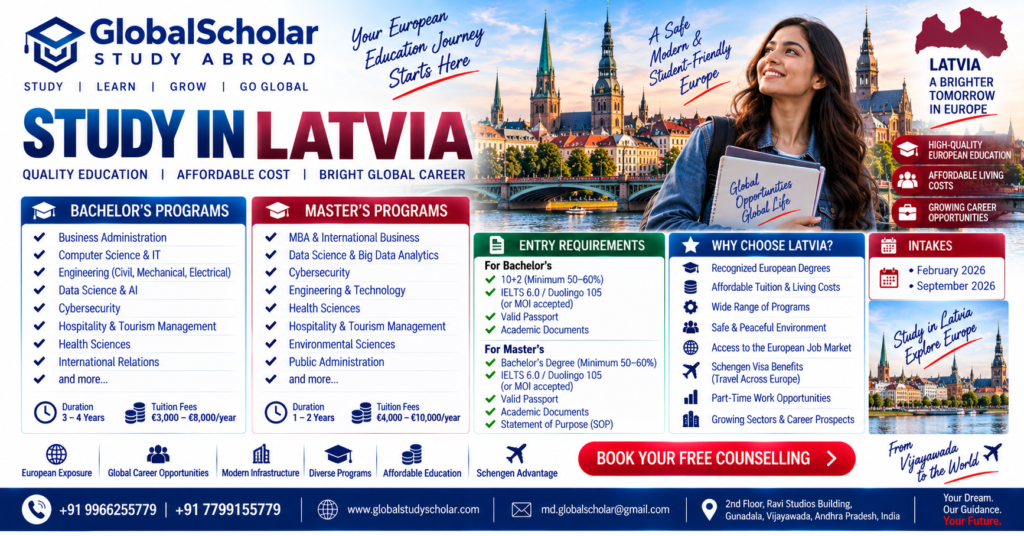
Study in Latvia 2026 | Courses, Fees, Eligibility & Careers Study in Latvia 2026 Latvia is becoming an increasingly attractive destination for international students looking for European higher education, English-taught programmes and relatively affordable study options. Students can choose from Bachelor’s and Master’s programmes in business, computer science, engineering, data science, cybersecurity, health sciences, hospitality and other fields. If you are planning to study in Latvia in 2026, it is important to compare universities, courses, tuition fees, living expenses, entry requirements, intakes and student visa procedures before making your decision. For Indian students, Latvia can provide an opportunity to experience European education while developing academic and professional skills in an international environment. GlobalScholar Study Abroad helps students from Vijayawada, Andhra Pradesh and across India explore suitable Latvia universities, courses, admissions and student visa options. Important: Admission requirements, tuition fees, English-language requirements and available programmes vary between universities. Always verify the latest requirements with the selected institution. Latvia’s official study portal confirms that universities can have their own specific admission requirements. Why Study in Latvia? There are several reasons international students consider Latvia for higher education. Key advantages include: Latvia’s official higher-education portal reports 16,000+ international students in 2024, with students from countries including India, Uzbekistan, Sweden, Ukraine and Germany. Indian students represented the largest group among the listed countries, with 3,158 students in 2024. This makes Latvia particularly relevant for Indian students researching European study destinations. Study in Latvia for Indian Students Indian students can explore Bachelor’s and Master’s programmes in a variety of academic areas. Popular study fields include: The right programme depends on your previous qualification, academic performance, career goals, budget and university-specific eligibility requirements. Popular Bachelor’s Programmes in Latvia Students who have completed their higher secondary education can explore Bachelor’s programmes in Latvia. Business Administration Business programmes can cover management, marketing, finance, entrepreneurship and international business. Computer Science and IT Computer Science and IT programmes can help students develop knowledge in programming, software, databases, networks and information technology. Data Science and Artificial Intelligence Students interested in data and technology can explore areas such as: Cybersecurity Cybersecurity programmes can cover: Engineering Engineering options can include: Hospitality and Tourism Management Students interested in international hospitality can explore hotel, tourism and hospitality management programmes. Popular Master’s Programmes in Latvia Students with a Bachelor’s degree can explore Master’s programmes in Latvia. Popular areas include: A Master’s programme can allow students to specialise in a particular academic or professional field. Latvia University Entry Requirements Entry requirements vary between universities and programmes. For Bachelor’s programmes, students generally need a recognised secondary education qualification that allows them to continue to higher education. Latvia’s official guidance states that secondary education should generally correspond to at least 12 years of secondary-level education. For Master’s programmes, applicants generally need a completed Bachelor’s-level qualification. Common documents may include: Some universities may also require entrance examinations, subject-specific tests or interviews. English Language Requirements in Latvia Students applying to Latvia need to demonstrate sufficient proficiency in the language of study. The official Study in Latvia portal states that the required level is generally B2 or higher under the Common European Framework of Reference for Languages (CEFR). However, the exact way students demonstrate their English ability can vary. Some universities may accept: Students should check the exact requirements of their chosen university. Important for Indian students If your previous education was completed in English, some Latvian universities may accept official documentation confirming the language of instruction. Latvia’s official guidance says that applicants who previously completed secondary or higher education in the study language may not need an internationally recognised language certificate, although some universities can require an additional online language examination. This is different from saying that all Latvian universities accept MOI instead of IELTS. Latvia Tuition Fees 2026 Tuition fees depend on the university, programme and study level. The GlobalScholar flyer presents indicative ranges of: Bachelor’s Programmes €3,000 – €8,000 per year Master’s Programmes €4,000 – €10,000 per year These should be treated as indicative promotional ranges, not universal Latvia tuition fees. According to the official Study in Latvia portal, tuition can vary significantly by programme. Typical annual fees listed for selected fields include approximately: Study Area Typical Annual Tuition Business Administration & Management €2,000 – €6,000 Engineering €2,700 – €3,500 Computer Science €1,800 – €3,800 Health Care & Medicine €8,000 – €15,000 The official portal also notes that some Bachelor’s programmes cost less than €1,600 per year, while specialised programmes can be considerably more expensive. Therefore, students should always confirm the exact tuition fee with the university. Cost of Living in Latvia Your cost of living depends on your city, accommodation and lifestyle. Students should budget for: Riga generally provides more accommodation and employment options because it is Latvia’s largest city and major higher-education centre. Other student cities can provide alternative living environments. Before choosing a university, compare tuition + accommodation + living expenses, rather than looking only at tuition fees. Latvia Intakes 2026 The GlobalScholar flyer highlights two main intakes: February Intake The spring intake generally begins in February. September Intake The autumn intake generally begins in September and is a major admission period for many programmes. According to the official Study in Latvia application guide, spring applications generally run around November–December for February starts, while autumn applications commonly run from March until July or August for September starts. However, deadlines can be earlier depending on the student’s citizenship and university. Important Not every course is available in every intake. Always check the exact intake and deadline for your selected programme. How to Apply to Study in Latvia The Latvia admission process can generally be divided into several stages. Step 1: Choose Your Course Select a course based on your previous education and career plans. Step 2: Choose a University Compare: Step 3: Check Eligibility Review the university’s academic and English-language requirements. Step 4: Submit Your Application Prepare and submit your academic documents, passport and other required paperwork. The official Latvia application guidance says documents may need
Explore study abroad destinations with GlobalScholar. Compare countries, universities, courses, scholarships, fees and career opportunities.
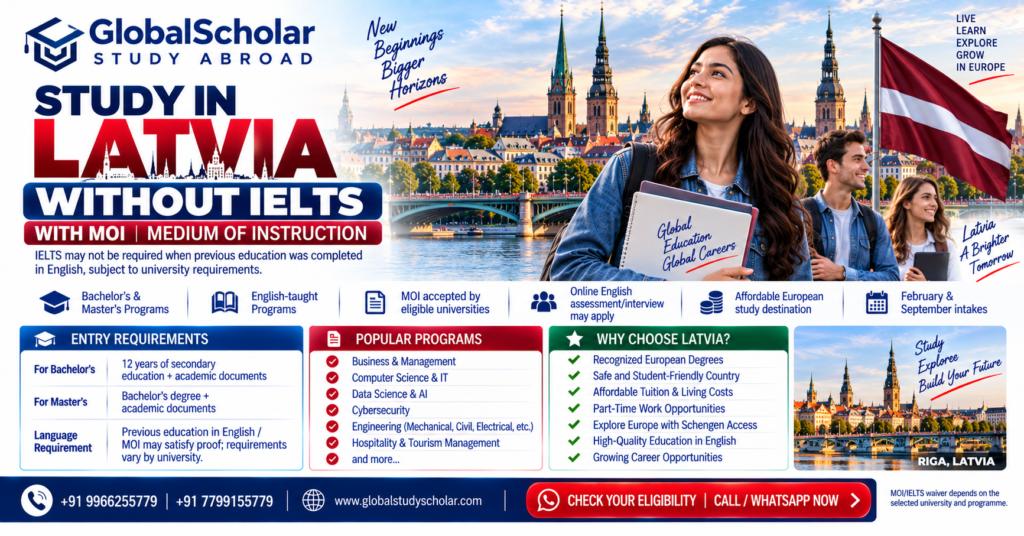
Study in Latvia Without IELTS in 2026 Are you planning to study in Latvia without IELTS? For some international students, an IELTS certificate may not be required when previous education was completed in English and the selected Latvian university accepts alternative proof of English proficiency, such as a Medium of Instruction (MOI) certificate. Latvia offers Bachelor’s and Master’s programmes in areas such as Business, Computer Science, Data Science, Artificial Intelligence, Cybersecurity, Engineering, Hospitality and Tourism Management. For Indian students, Latvia can be an attractive European study destination because of its range of English-taught programmes, relatively affordable study options and international student environment. GlobalScholar Study Abroad helps students from Vijayawada, Andhra Pradesh and across India explore Latvia universities, courses, admission requirements and student visa options. Important: “Without IELTS” does not mean “without an English-language requirement.” The exact requirement depends on the university and programme. Latvia’s official study portal states that students generally need sufficient study-language proficiency, normally at B2 level, while universities may have their own procedures for assessing it. Can You Study in Latvia Without IELTS? Yes, some students may be able to apply without submitting IELTS, depending on the university and their previous education. The official Study in Latvia guidance states that applicants who previously completed their secondary or higher education in the study language, when this is documented officially, may not need to provide an internationally recognised language certificate. However, some universities can require an additional online language assessment. This means that students should not assume that IELTS is automatically waived for every university. You may be considered for an IELTS waiver if: Therefore, the safest approach is to check the English-language requirement of your chosen university before applying. What Is MOI? MOI stands for Medium of Instruction. An MOI certificate is an official document issued by an educational institution confirming the language used to teach a student’s previous programme. For example, if you completed your Bachelor’s degree in English, your university may provide an official document stating that English was the medium of instruction. Depending on the Latvian university and programme, this document may be considered as evidence of English-language education. However, MOI acceptance is university-specific. The official Latvia admission guidance confirms that institutions can have their own requirements and language-assessment procedures. IELTS vs MOI for Latvia IELTS MOI International English-language test Proof of previous English-medium education Requires a test Usually issued by your previous institution Score requirement varies Acceptance varies by university Commonly used internationally Useful where the university accepts previous English-medium education May be required by some programmes May provide an alternative to an English test The key point is simple: MOI acceptance is not universal. Before applying, students should confirm whether their selected Latvian university accepts MOI instead of IELTS. Study in Latvia Without IELTS for Indian Students Indian students with English-medium education may explore Latvian universities that accept alternative evidence of English proficiency. The application will usually depend on: For a Bachelor’s programme, students normally need a recognised secondary education qualification. For a Master’s programme, students generally need a recognised Bachelor’s degree or equivalent qualification. The exact requirements should always be checked with the university. Popular Courses to Study in Latvia Latvia offers programmes across several academic areas. 1. Business and Management Business programmes can cover: These programmes can be suitable for students interested in corporate, management and entrepreneurial careers. 2. Computer Science and IT Computer Science and IT programmes can cover: Students interested in technology can use these programmes to build technical and analytical skills. 3. Data Science and Artificial Intelligence Data-focused programmes can include: These areas can be suitable for students interested in technology, statistics and data-driven decision-making. 4. Cybersecurity Cybersecurity is another popular technology-related field. Students may study: Cybersecurity can lead to career opportunities across technology, finance, government and other sectors. 5. Engineering Students can explore engineering programmes such as: Programme availability and entry requirements vary by university. 6. Hospitality and Tourism Management Latvia also offers opportunities in hospitality and tourism-related education. Students can explore areas such as: This can be an option for students who want an international career in hospitality and tourism. Bachelor’s Programmes in Latvia Students who have completed their higher secondary education can explore Bachelor’s programmes in Latvia. Popular areas include: General documents may include: The official Latvia admission process includes qualification recognition and language requirements, with additional programme-specific requirements determined by universities. Master’s Programmes in Latvia Students with a Bachelor’s degree can explore Master’s programmes in Latvia. Popular areas include: Typical Master’s documents Latvia Entry Requirements The exact requirements vary by university and programme. Bachelor’s Generally, applicants need: 12 years of secondary education + academic documents Some programmes may have additional subject or grade requirements. Master’s Generally, applicants need: A recognised Bachelor’s degree + academic documents Certain Master’s programmes may require a related academic background. English Language Latvia’s official study portal states that students need sufficient proficiency in the language of study, generally at B2 level. The exact method of proving proficiency can vary by institution. Latvia Without IELTS: Online English Assessment If you do not have IELTS, some Latvian universities may assess your English proficiency themselves. Depending on the institution, this could involve: The official Latvia guidance states that universities can organise their own assessment when applicants do not provide an internationally recognised language certificate. Therefore, students should ask: “Does this university accept MOI, and will I need an online English assessment?” This is much safer than assuming that IELTS is automatically waived. Latvia Tuition Fees Tuition fees depend on the university, programme and study level. The GlobalScholar promotional flyer presents indicative tuition ranges of: Bachelor’s €3,000 – €8,000 per year Master’s €4,000 – €10,000 per year These figures are indicative, not universal. The official Study in Latvia portal confirms that tuition varies by programme and institution. Students should check the exact fee for their selected course before accepting an offer. Cost of Living in Latvia Your total budget will depend on your city and lifestyle. Typical expenses include: The official Study in
Study in Malta 2026: Tuition Fees, 70% Tax Credit, Education Loans & Career Opportunities

Malta is becoming an attractive European study destination for international students looking for English-taught education, a multicultural environment, European exposure and career opportunities. Located in the Mediterranean, Malta combines a relatively compact lifestyle with access to the wider European environment. For Indian students, particularly those looking for business, IT, healthcare, hospitality, accounting and management programmes, Malta can be an option worth considering. The latest GlobalScholar Study Abroad campaign highlights Malta with the message “Small Island, Big Opportunities” and promotes benefits such as tuition-fee support, collateral-free education-loan options, English-language education, internships and career opportunities. However, one important point needs clarification: the advertised “70% tuition fee back” should not be understood as an automatic cash refund for every international student. Malta’s 2026 Get Qualified scheme provides an eligible person with a tax credit of up to 70% of eligible study costs, subject to the scheme’s conditions. Eligibility includes being liable to tax in Malta. Why Study in Malta? Malta offers an interesting combination of: Malta’s education sector is regulated by the Malta Further and Higher Education Authority (MFHEA). Institutions providing further or higher education in or from Malta generally require the appropriate MFHEA licence, while programmes can be accredited and mapped to the Malta Qualifications Framework (MQF). This makes checking the institution and programme before paying fees extremely important. Study in Malta in English One of Malta’s major advantages for international students is the availability of programmes delivered in English. This can make Malta particularly interesting for Indian students who want to study in Europe without having to learn a new European language before starting their academic programme. Depending on the institution and course, students can find programmes in areas such as: The exact language of instruction, admission requirements and English-language evidence should always be confirmed with the institution. Malta Tuition Fees Tuition fees in Malta vary significantly according to: The flyer promotes tuition fees starting from €6,000, but this should be treated as an indicative starting figure rather than a universal Malta tuition fee. For example, one Maltese higher-education institution currently lists 2026–27 full-time diploma and degree tuition at €6,696 per academic year, with a separate non-EU administration fee for students requiring a student visa. Therefore, students should always request the latest official fee structure for their selected programme. Can Students Get 70% of Their Tuition Fees Back? This is one of the most important points in the latest Malta campaign. Malta’s Get Qualified Scheme Malta’s Get Qualified 2026 scheme provides eligible applicants with a tax credit of up to 70% of eligible costs, including certain registration, tuition, educational and examination expenses. The 2026 scheme states that eligible individuals can use the tax credit over a period of up to 15 fiscal years, subject to the applicable rules. But there is an important condition The official eligibility requirement says applicants must be persons liable to tax in Malta and must have commenced a relevant course of study after the age of 16. Therefore, an Indian student arriving in Malta should not assume that 70% will automatically be refunded after paying tuition fees. A student may need to meet the applicable conditions, successfully complete the relevant programme and have the necessary Maltese tax position to benefit. Some Maltese institutions also specifically explain that the scheme can benefit international students who subsequently work and pay tax in Malta. For example, MCAST states that eligible students may apply for a 70% tuition-fee refund in the form of a tax rebate after successful course completion, with reimbursement available to students paying tax in Malta. So the correct SEO-friendly claim is: “Eligible students may benefit from up to 70% through Malta’s Get Qualified tax-credit scheme, subject to eligibility and conditions.” That is much safer and more accurate than saying “everyone gets 70% tuition fees back.” Is Malta Education Loan Available Without Collateral? Education financing can be another important part of planning your Malta studies. Depending on the student’s profile, university and lender, students may explore: However, loan approval is never automatic. The lender may evaluate: GlobalScholar Study Abroad can help students understand available financing options before proceeding with their admission. Work While Studying in Malta International students may be able to work part-time in Malta, but specific immigration and employment conditions apply. According to Malta’s Identità, third-country nationals pursuing qualifying full-time higher-education courses recognised by MQRIC may work for a maximum of 20 hours per week, subject to the relevant work-permit conditions. Identità also states that students need the appropriate employment authorisation and that conditions can change. Therefore: Study first + permitted part-time employment = possible but Student visa = unrestricted full-time employment is not correct. Students should follow their residence permit and employment-permit conditions. Internships and Career Opportunities in Malta Malta’s economy includes sectors such as: Depending on the programme, students may have opportunities for: However, internship or employment is not guaranteed by simply enrolling in a course. Students should select programmes that provide relevant industry exposure and carefully check what internship or placement support is actually included. Popular Courses to Study in Malta 1. Business & Management Business programmes can suit students interested in: These programmes can lead to careers across multiple industries. 2. Accounting & Finance Malta’s financial-services environment makes accounting and finance an interesting area for students. Possible study areas include: 3. Information Technology Technology programmes can include: Students should verify the MQF level and accreditation of the programme before enrolling. 4. Healthcare & Nursing Healthcare-related programmes are another important study area. Students can explore: Professional healthcare programmes can have additional regulatory and registration requirements, so course recognition should be checked carefully. 5. Hospitality & Tourism Malta’s tourism industry creates a natural connection with: For students interested in international hospitality careers, Malta can provide European cultural and industry exposure. Schengen Access and European Travel Malta is part of the Schengen Area. This makes Malta particularly attractive to students who want European travel opportunities. However, students should understand the distinction between: Studying and residing in Malta and having unrestricted rights to live
Study in Malta for Indian Students – November Intake, Courses, Fees, IELTS & Visa Guide
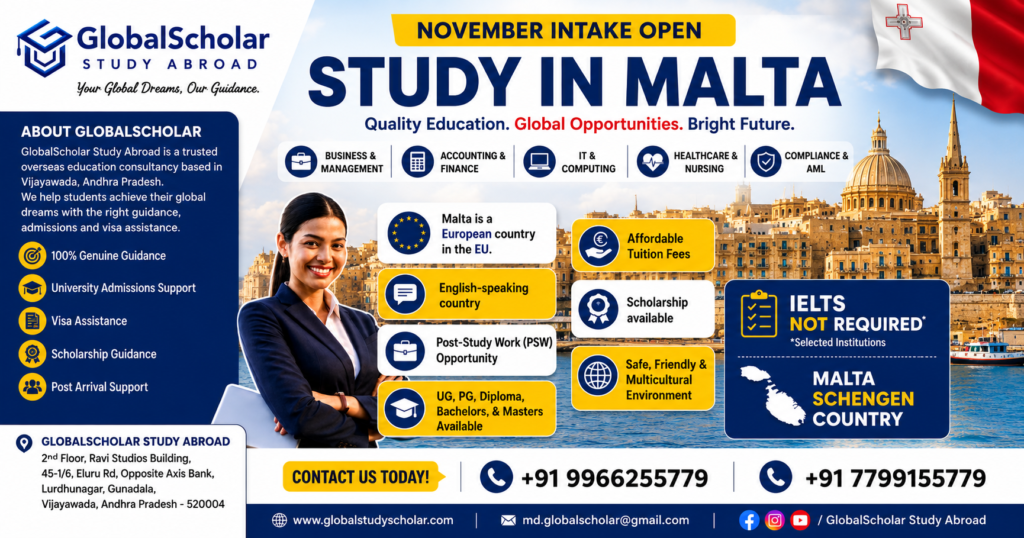
Are you planning to study abroad from Vijayawada, Andhra Pradesh? Malta is an attractive European study destination for students looking for international education, English-taught programmes and exposure to a multicultural environment. The November intake is an important opportunity for students planning their next academic step. Depending on the institution and programme, students can explore UG, PG, Diploma, Bachelor’s and Master’s programmes in areas such as Business & Management, Accounting & Finance, IT & Computing, Healthcare & Nursing, Compliance and AML, and other fields. GlobalScholar Study Abroad, Vijayawada helps students understand suitable Malta study options, admission requirements, documentation and visa procedures. 🇲🇹 Why Study in Malta? Malta is a European country and an EU member state. It is also known for its English-speaking environment and international student community. For Indian students, Malta can offer an opportunity to experience European education while studying in an English-speaking environment. Key benefits of studying in Malta include: However, students should always verify the exact programme, accreditation and institution before applying. 🎓 November Intake in Malta The promotional banner highlights: NOVEMBER INTAKE OPEN Students planning to start their international education journey can explore programmes available for the November intake. Intake availability varies by institution and programme, so students should confirm: Applying early is recommended because admission and visa procedures can take time. 📚 Courses to Study in Malta Students can explore a variety of academic and professional fields. 💼 Business & Management Business and management programmes may cover: These programmes can be suitable for students interested in corporate, management and entrepreneurial careers. 📊 Accounting & Finance Students interested in finance can explore programmes related to: The exact subjects and professional recognition depend on the selected programme. 💻 IT & Computing Malta also offers opportunities in technology-related fields. Possible areas include: Students interested in technology can select programmes according to their previous qualification and career goals. 🏥 Healthcare & Nursing Healthcare-related programmes may be available at selected institutions. Students should pay particular attention to professional recognition and licensing requirements when choosing regulated healthcare or nursing programmes. A qualification that is suitable for study does not automatically mean that it provides professional licensing in Malta or another country. ⚖️ Compliance & AML Malta has a financial-services sector, making areas such as Compliance and Anti-Money Laundering (AML) relevant fields of study. Programmes may cover areas such as: These programmes may appeal to students interested in finance, banking, compliance and corporate services. 🎓 UG, PG, Diploma, Bachelor’s & Master’s Programmes The banner highlights several programme levels, including: Diploma Programmes Suitable programmes may be available for students who meet the required academic criteria. Bachelor’s / Undergraduate Programmes Students who have completed 12th/Intermediate can explore suitable undergraduate programmes. Master’s / Postgraduate Programmes Students with a recognised Bachelor’s degree can explore postgraduate opportunities. Other Professional Programmes Students can also explore specialised programmes depending on their previous education and career objectives. The exact eligibility, duration and qualification level must be confirmed with the selected institution. 🇬🇧 Is Malta an English-Speaking Study Destination? English is one of Malta’s official languages, and many higher-education programmes are delivered in English. This makes Malta an attractive option for international students who prefer an English-speaking study environment. However, English-language requirements are programme-specific. 📝 Is IELTS Required to Study in Malta? The promotional banner states: IELTS NOT REQUIRED* with the qualification that this applies to selected institutions. Therefore, students should not assume that IELTS is unnecessary for every Malta programme. Some institutions may consider: Students should confirm the current English-language requirement with the specific institution before applying. 💰 Affordable Tuition Fee Options Malta can offer different tuition-fee options depending on the institution, course and qualification level. Students should compare: Rather than choosing a programme based only on the advertised tuition fee, students should calculate the complete study-abroad budget. 🎓 Scholarships in Malta The banner also highlights: Scholarships Available Scholarships may be offered by selected institutions and can depend on: A scholarship is not automatically available to every student, so students should ask for the specific scholarship eligibility criteria and terms before applying. 💼 Post-Study Work Opportunities The promotional material mentions a Post-Study Work (PSW) opportunity. Students should understand that post-study work options depend on: A student should never assume that completing a course automatically provides a right to remain permanently or work indefinitely in Malta. Students should check the latest official rules before making a decision based on post-study employment. 🛂 Malta Student Visa for Indian Students Indian students are non-EU nationals and need to follow Malta’s applicable student visa and residence-permit requirements. For students who require a visa, Malta’s Identità states that students taking a course of 105 days or more need to apply for a National Long-Stay D visa for study before travelling. For longer-term study, students may also need a study residence permit. Identità states that non-EU students accepted for eligible full-time higher-education courses can apply through its Expatriates Online Portal, with requirements depending on the course and qualification level. Typical documentation can include: The exact requirements can change, so students should check the current official requirements before submitting their application. 🎓 Check Malta Course Accreditation Before Applying This is one of the most important steps for international students. The Malta Qualifications Registry provides information about programmes referenced to the Malta Qualifications Framework (MQF), including accredited programmes offered by licensed providers. The Malta Further and Higher Education Authority (MFHEA) is responsible for licensing further and higher education institutions and accrediting programmes. Students should therefore check: Institution → Programme → Accreditation → MQF Level → Qualification → Progression Options before paying tuition fees. 🌍 Why Accreditation Matters Students often see advertisements describing courses as: These terms should always be verified. The official Malta Qualifications Registry provides information about accredited programmes and their MQF levels. If a student needs formal recognition of a qualification, the Malta Qualifications Recognition Information Centre (MQRIC) can provide recognition statements confirming the recognition status and relevant qualification framework information. 👨🎓 Who Can Study in Malta? Eligibility depends on the programme. After 12th /
Study in Mauritius for Indian Students – Courses, Fees, Eligibility & Visa Guidance
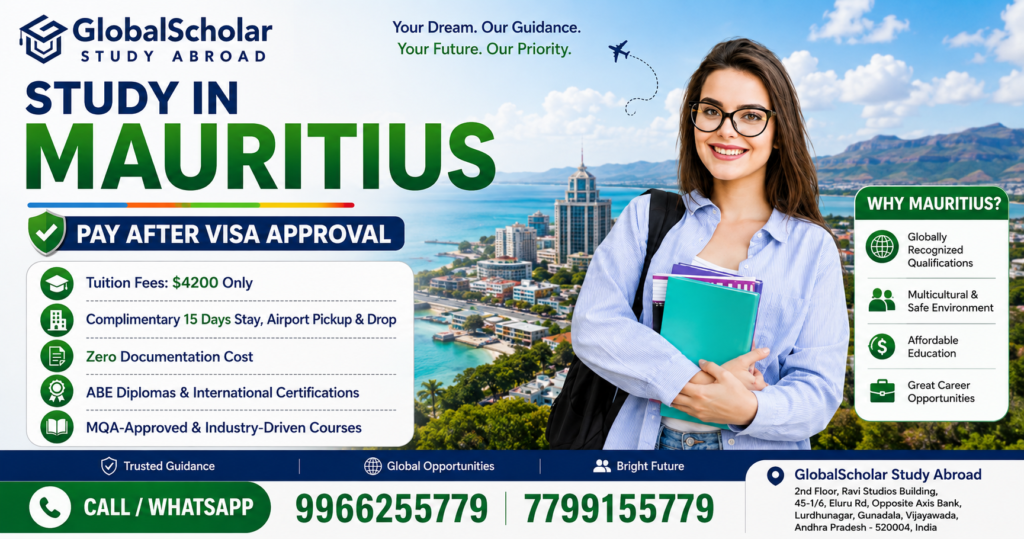
Are you planning to study abroad from Vijayawada, Andhra Pradesh? Mauritius is an emerging study-abroad destination for Indian students looking for affordable international education, globally oriented qualifications and a multicultural learning environment. Students from 10th, 12th/Intermediate and degree backgrounds can explore suitable diploma and professional education options in Mauritius, depending on the programme’s eligibility requirements. If you are searching for study abroad consultants near me in Vijayawada or Mauritius education consultants near me, GlobalScholar Study Abroad, Vijayawada can assist you with course selection, admission guidance, documentation and visa-related support. 🇲🇺 Why Study in Mauritius? Mauritius combines an international education environment with a multicultural and student-friendly atmosphere. Its location in the Indian Ocean also makes it an interesting option for Indian students looking for an overseas education destination. Key Benefits of Studying in Mauritius Students should always verify the current recognition, accreditation and progression opportunities of the specific qualification before applying. 🎓 Who Can Study in Mauritius? Eligibility depends on the institution and programme. Students with different academic backgrounds can explore suitable options. After 10th Students who have completed 10th standard may be eligible for selected diploma-level programmes, subject to the institution’s admission requirements. After 12th / Intermediate Students who have completed 12th or Intermediate can explore diploma, advanced diploma and other suitable programmes. After Degree Graduates can explore specialised or professional programmes based on their previous qualification and career goals. Important: Admission requirements vary by course. Students should confirm their eligibility before submitting an application. 📚 Courses to Study in Mauritius Mauritius offers programmes across several academic and professional areas. Depending on availability, students can explore areas such as: The right course should be selected according to your academic background and future career plans. 🏨 Hotel Management in Mauritius Students interested in hospitality can consider Hotel Management and Hospitality programmes in Mauritius. Hospitality-related studies may cover areas such as: These skills can be useful for students planning careers in hotels, resorts, restaurants, tourism companies and related service industries. 🎓 ABE Diplomas & International Certifications The promotional flyer highlights ABE Diplomas and international certifications. Students considering an ABE-related qualification should verify: Understanding the qualification before admission is important for making an informed study-abroad decision. 🏫 MQA-Approved & Industry-Driven Courses The promotional material also highlights MQA-approved and industry-driven courses. Students should verify the current approval status of their chosen programme and institution with the relevant authority before enrolling. An industry-oriented programme can help students develop practical knowledge alongside academic learning. 💰 Tuition Fees in Mauritius The promotional flyer provided for this blog displays: Tuition Fees: US$4,200 Only This is a promotional figure shown in the supplied advertisement and should be confirmed with the institution before payment, as fees can vary by course, intake and programme. Students should also consider additional expenses such as: Always request a complete fee structure before making an admission decision. 💳 Pay After Visa Approval The supplied promotional material highlights a “Pay After Visa Approval” offer. Students should confirm the exact terms and conditions of this offer directly with the institution or authorised representative before making an application. Ask for written clarification regarding: Understanding the payment terms can help students avoid unexpected costs. 🏠 Complimentary 15-Day Stay & Airport Pickup The promotional flyer also mentions a complimentary 15-day stay and airport pickup/drop. Availability and conditions may vary, so students should confirm: These details should be confirmed before booking travel. 📄 Documentation Support Preparing documents correctly is an important part of the study-abroad process. Depending on the course and institution, students may need documents such as: The exact document list varies by programme and student profile. 🇲🇺 Mauritius Student Visa Students planning to study in Mauritius need to follow the applicable immigration and student permit requirements. The visa/permit process may involve: Visa requirements can change, so students should always verify the current requirements before applying. 🌍 Career Opportunities After Studying in Mauritius The career opportunities available after graduation depend on the student’s qualification, skills, experience and employer requirements. For hospitality students, possible roles may include: For business and accounting students, possible roles may include: For IT students, career pathways may include entry-level roles in: Employment is not guaranteed and depends on individual qualifications, skills, employer requirements and applicable employment regulations. 🌟 Why Choose GlobalScholar Study Abroad – Vijayawada? Choosing the right college and programme is one of the most important parts of studying abroad. GlobalScholar Study Abroad, Vijayawada helps students explore international education options based on their academic profile and career goals. Our Guidance Includes: ✅ Profile Assessment✅ Course Selection Guidance✅ Institution Selection✅ Eligibility Checking✅ Application Assistance✅ Documentation Guidance✅ Admission Process Support✅ Visa Documentation Guidance✅ Pre-Departure Guidance Our objective is to help students understand their options before making an international education decision. 📍 Study in Mauritius from Vijayawada, Andhra Pradesh Students from Vijayawada, Andhra Pradesh can explore Mauritius study opportunities with guidance from GlobalScholar Study Abroad. If you are searching for: you can contact GlobalScholar Study Abroad in Vijayawada for course and admission guidance. Students from nearby cities and districts across Andhra Pradesh can also explore suitable programmes. 🔎 What Should Students Check Before Applying? Before choosing a Mauritius programme, students should carefully compare: 1. Course Eligibility Make sure your academic qualification meets the programme requirements. 2. Institution Recognition Check the institution’s current registration and recognition status. 3. Qualification Understand exactly what qualification you will receive. 4. Tuition Fees Request the complete and current fee structure. 5. Accommodation Understand accommodation availability and costs. 6. Visa Requirements Check the latest student visa/permit requirements. 7. Career Progression Understand possible further-study and career pathways. 8. Payment & Refund Policy Read all payment, cancellation and refund terms before making payment. 🚀 Start Your Mauritius Study Journey If you are a student from Vijayawada or Andhra Pradesh planning to study abroad, Mauritius can be an option worth exploring. Whether you have completed 10th, Intermediate/12th or a Degree, GlobalScholar Study Abroad can help you understand suitable programme options according to your academic background. 🇲🇺 Study in Mauritius with GlobalScholar Study Abroad GlobalScholar Study Abroad