
Study Abroad with PR Pathways 2026 | Countries, Courses & Career Options
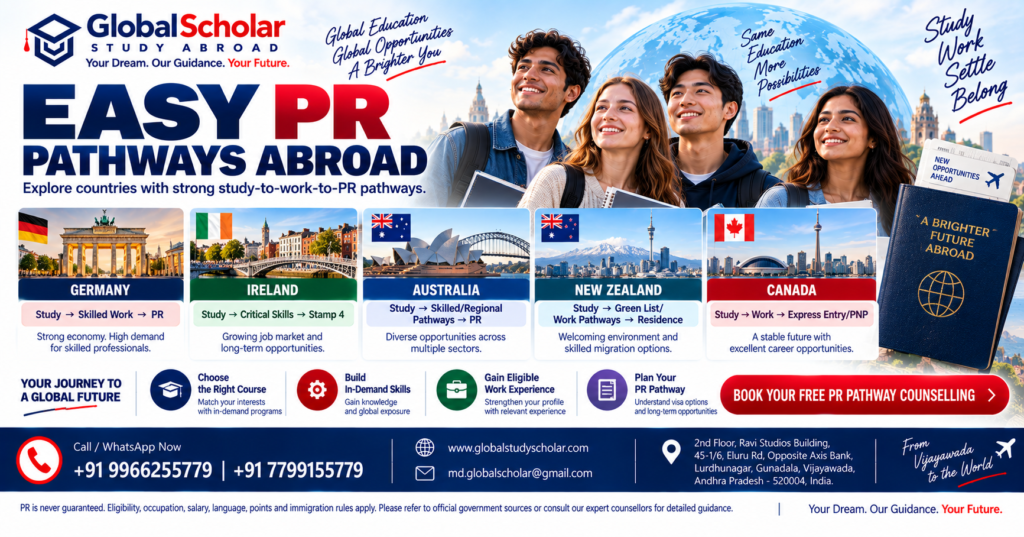
For many Indian students, studying abroad is not only about earning an international degree. Students increasingly look for countries where they can study, gain eligible work experience and potentially progress toward long-term residence. Germany, Ireland, Australia, New Zealand and Canada are among the destinations that offer immigration or residence pathways for eligible skilled graduates and workers. However, studying in a country does not automatically lead to permanent residence. Each country has its own requirements, occupation rules, points systems, work experience conditions and immigration policies. GlobalScholar Study Abroad, Vijayawada helps students compare study destinations, courses and potential post-study pathways before making an international education decision. What Does a PR Pathway Mean? A PR pathway refers to a possible route through which an international student can move from temporary status—such as a student visa—to an eligible work/residence status and eventually apply for permanent residence. A typical journey may look like: Study → Graduate → Eligible Work → Skilled Employment → Residence/PR Eligibility The exact process varies considerably between countries. For example, Canada has several permanent-residence categories including Express Entry and Provincial Nominee Programs, while Australia and New Zealand have their own skilled and residence visa systems. Best Countries to Explore for Study-to-PR Pathways 🇩🇪 Germany Germany is an attractive destination for students looking for a combination of education, employment and long-term residence opportunities. The official Make it in Germany portal states that international graduates can generally obtain a residence permit for up to 18 months to look for qualified employment after completing their studies. Once they obtain suitable skilled employment, they can transition to an appropriate work residence permit or EU Blue Card. Germany pathway Study in Germany → Graduate → Job Search → Skilled Employment → Settlement Permit Germany provides a particularly interesting pathway for graduates who successfully enter qualified employment. According to the current official guidance, graduates of German higher-education institutions can apply for a settlement permit after more than two years of skilled employment, subject to the applicable requirements. Why consider Germany? Important German language skills can be extremely valuable for employment and long-term integration. Settlement permits can also require language and other conditions. So “Study in Germany = automatic PR” is incorrect. 🇮🇪 Ireland Ireland is another popular destination for international students interested in education and post-study employment opportunities. Ireland offers a graduate permission system that can allow eligible graduates to remain in the country after completing qualifying programmes. Under current Irish immigration rules: Eligible graduates can use this period to seek suitable employment and potentially progress to an employment permit and longer-term residence routes. Ireland pathway Study → Graduate Permission → Employment → Employment Permit → Long-Term Residence/PR Route Popular fields Why Ireland? Students should always check the latest Irish immigration requirements before choosing a course because eligibility depends on the programme and current immigration rules. 🇦🇺 Australia Australia is one of the most recognised destinations for students interested in skilled migration opportunities. However, the Australian system is based on specific visa categories and eligibility requirements rather than an automatic student-to-PR route. Australia’s Department of Home Affairs explains that permanent residence is granted through eligible permanent visa pathways, including certain skilled and family visas. Australia pathway Study → Graduate Work Rights/Eligible Visa → Skilled Employment → Skilled Migration Pathway → PR Depending on the student’s profile and occupation, pathways can involve: Popular areas to consider Why Australia? Important Occupation lists, state nomination criteria, points requirements and visa conditions can change. Therefore, students should select their course based on both career suitability and current migration rules, rather than choosing a course solely because someone advertises it as an “easy PR course.” 🇳🇿 New Zealand New Zealand provides residence pathways for eligible skilled workers. The immigration system includes skilled residence options, and the requirements depend on the applicant’s occupation, qualification, employment, employer and other factors. New Zealand’s official immigration website explains that permanent residence generally comes after obtaining an eligible resident visa and meeting the requirements for permanent residence. New Zealand pathway Study → Graduate → Skilled Employment → Eligible Resident Visa → Permanent Residence Popular fields Why New Zealand? Again, eligibility is not automatic and depends on the immigration category available when you apply. 🇨🇦 Canada Canada remains an important destination for students considering long-term immigration options. Canada has several economic immigration programmes, including: Canada’s current immigration system uses Express Entry to manage applications for several skilled-worker programmes. Canada pathway Study → Eligible Work Permit → Skilled Canadian Work Experience → Express Entry/PNP or Other Eligible Programme → PR Canada’s official guidance specifically notes that international students may potentially qualify for permanent-residence categories after graduation, but eligibility depends on the relevant programme. Express Entry Express Entry currently manages three federal programmes: Candidates create a profile and enter a pool. Invitations are issued based on the applicable selection criteria and ranking. Provincial Nominee Programs Canadian provinces and territories can nominate eligible candidates under their own immigration streams. This can be particularly important for students and graduates whose skills match regional labour-market needs. Which Country Has the Easiest PR? There is no universally easiest PR country. The best destination depends on your individual profile. Factors can include: A country that may be suitable for one student may not be suitable for another. Instead of asking: “Which country gives easy PR?” A better question is: “Which study destination offers a realistic career and residence pathway for my profile?” Best Courses for Long-Term Career Opportunities Students interested in long-term residence should not select a course simply because it appears on an immigration-related list. Choose a course that provides genuine career opportunities. 1. Information Technology Possible areas: 2. Engineering Possible areas: 3. Healthcare Possible areas: Professional licensing may be required for regulated healthcare occupations. 4. Construction & Infrastructure Demand can exist for qualified professionals in areas such as: 5. Education Education-related occupations can offer opportunities in certain countries, but professional registration and local requirements may apply. 6. Skilled Trades Depending on the country, opportunities may exist in: How to Choose the Right
🇮🇹 Study in Italy 2026 with Scholarships | Fees, Courses & Financial Support
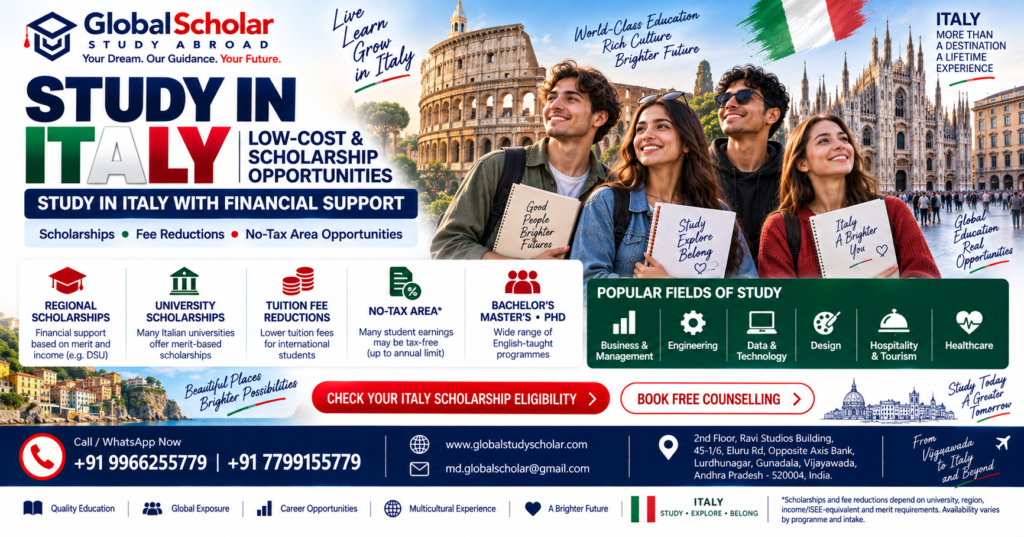
Studying in Italy can be an attractive option for international students looking for quality European education, scholarship opportunities and relatively affordable tuition. Italian universities offer Bachelor’s, Master’s and PhD programmes across areas such as Business, Engineering, Data & Technology, Design, Hospitality, Tourism and Healthcare. For students from Vijayawada, Andhra Pradesh and across India, GlobalScholar Study Abroad provides guidance on university selection, scholarship opportunities, applications, education loans and visa documentation. Italy’s official Universitaly portal provides information on university programmes, tuition fees, scholarships and accommodation options. Why Study in Italy in 2026? Italy combines internationally recognised higher education with a wide range of academic and financial-support opportunities. Key advantages include: The Italian higher-education system provides scholarships and concessions through both regional bodies and individual universities. Study in Italy with Financial Support One of the biggest reasons international students consider Italy is the range of financial-support opportunities. However, it is important to understand that scholarships and tuition reductions are not automatically available to every student. Eligibility can depend on: Universitaly states that scholarships and concessions may be offered by regional authorities and higher-education institutions, with students required to meet the conditions in the relevant annual calls. Italy Regional Scholarships Regional student-support systems are an important part of Italy’s higher-education funding structure. Regional bodies can provide financial assistance to eligible students who meet the applicable requirements. Depending on the region and specific scholarship, support may include combinations of: Universitaly provides information on regional right-to-study organisations across Italy. Important for Indian Students International students may need financial and family-income documentation in the required format. Universitaly specifically notes that international students may need an ISEE Parificato for certain benefits. Therefore, scholarship planning should begin early. University Scholarships in Italy Italian universities may also offer their own scholarships and financial concessions. These can be based on: The official Universitaly scholarship portal allows students to explore scholarships and concessions offered by institutions and regions. No-Tax Area and Tuition Fee Reductions The flyer highlights No-Tax Area opportunities. This is an important area for students to understand. Italy has mechanisms through which eligible students from lower-income households can receive reductions or, in some circumstances, significant relief from university fees. Universitaly explains that the No Tax Area / Bonus Università can provide a reduction or elimination of university tuition fees for eligible students from households with low ISEE values. For international students, the documentation and eligibility process can differ, so students should check the specific university and regional requirements. Is Education Free in Italy? This is one of the most common questions from Indian students. The accurate answer is: Italy does not have universally free university education for every international student. Public universities can have relatively lower tuition costs compared with many Western countries, while tuition may depend on factors including family income, programme and university. Some students may qualify for: The Italian government’s Study in Italy information explains that tuition varies according to the institution, degree course and other factors, and some universities offer exemptions based on applicable rules. So instead of advertising “100% free education for everyone,” students should evaluate their individual scholarship and tuition-fee eligibility. Popular Courses to Study in Italy Italy offers programmes across a wide range of disciplines. 1. Business & Management Popular areas include: These programmes can be suitable for students interested in international business and management careers. 2. Engineering Italy has a strong academic reputation in engineering and technology. Popular areas include: 3. Data & Technology Technology-focused programmes are increasingly popular among international students. Possible areas include: 4. Design Italy is globally associated with design, fashion and creative industries. Students can explore programmes related to: 5. Hospitality & Tourism Italy’s tourism industry makes it an interesting destination for students interested in: Students interested in international hospitality careers can explore both academic and professionally oriented programmes. 6. Healthcare Healthcare-related programmes are also available across Italian higher-education institutions, although admission requirements can be highly programme-specific. Students should carefully check: Bachelor’s, Master’s & PhD in Italy Italy offers higher-education programmes at different levels. Bachelor’s Degree Bachelor’s programmes generally provide undergraduate-level education and may be offered in Italian, English or a combination depending on the programme. Master’s Degree Master’s programmes are popular among international students, particularly in areas such as: PhD Italy also offers doctoral research programmes for students interested in advanced academic and research careers. English-Taught Courses in Italy Students who do not speak Italian can find English-taught programmes, particularly at the Master’s level. However, English-language availability varies by university and course. Before applying, check: The official Universitaly portal allows students to search programmes and obtain course-specific information. Italy University Application Process The typical process can involve several stages. Step 1: Choose Your Course Select a programme based on: Step 2: Select Universities Compare: Step 3: Prepare Documents Common documents may include: Exact requirements vary by university. Step 4: Apply to the University Submit your application according to the university’s process and deadline. Step 5: Scholarship Application Apply separately where required. Do not assume that submitting a university application automatically means you have applied for every scholarship. Step 6: Pre-Enrolment International students requiring a study visa generally use the official Universitaly pre-enrolment system where applicable. Universitaly states that it is the official free portal for pre-enrolment for international students. Step 7: Apply for the Student Visa After completing the required university/pre-enrolment process, students can proceed with the applicable visa process. Italy Student Visa for Indian Students Students from India who require a visa must satisfy the applicable Italian immigration and study requirements. Importantly, university admission does not guarantee visa approval. The Italian authorities state that the final decision on a study visa is made by the relevant diplomatic or consular representation. Students should therefore prepare their: carefully. Government of Italy Scholarships The Italian Ministry of Foreign Affairs and International Cooperation also offers scholarships for eligible foreign students under specific annual calls. For the 2026–27 academic year, the official MAECI scholarship call had a deadline of 26 March 2026, so students should check the latest annual call
TOEFL iBT Discount Voucher 2026: Fees, Acceptance, Test Format & Study Abroad Guide
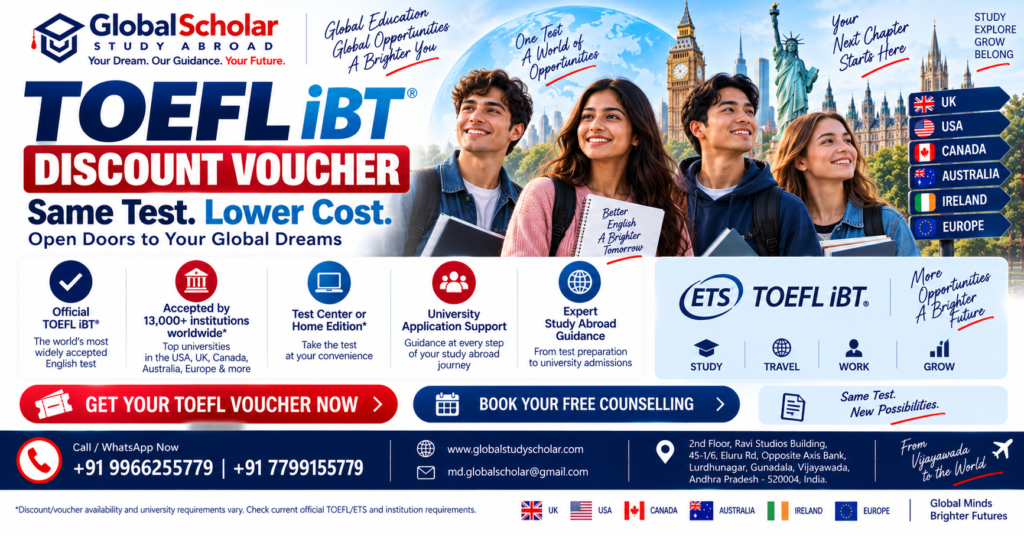
TOEFL iBT is one of the most widely recognized English-language proficiency tests for students planning to study abroad. It is accepted by 13,000+ institutions across 160+ countries, including universities in the USA, UK, Canada, Australia, Ireland and Europe. For students from Vijayawada, Andhra Pradesh and across India, GlobalScholar Study Abroad provides guidance on TOEFL preparation, voucher availability, university requirements, admission planning and the overall study-abroad process. What Is the TOEFL iBT? The TOEFL iBT (Test of English as a Foreign Language) is an English proficiency examination designed to assess the academic English skills required for university study. The test evaluates four major skills: TOEFL iBT is widely used by universities and institutions to assess whether international applicants have the English-language skills needed to participate successfully in academic environments. TOEFL iBT Discount Voucher 2026 If you are planning to take TOEFL for your overseas education application, a TOEFL discount voucher can help reduce your testing cost when a valid promotional offer is available. GlobalScholar Study Abroad provides students with guidance regarding TOEFL voucher availability, registration and study-abroad applications. Important: Voucher availability, discount value, validity and applicable terms can change. Students should confirm the current offer and official TOEFL/ETS requirements before making a payment. Why Consider a TOEFL Voucher? A valid voucher may help students: Get your TOEFL voucher information from GlobalScholar Study Abroad, Vijayawada. Where Is TOEFL iBT Accepted? TOEFL iBT has broad international acceptance. ETS currently states that TOEFL scores are accepted by more than 13,000 institutions in over 160 countries. Popular destinations include: 🇬🇧 UK TOEFL scores are accepted by universities across the UK. However, individual universities and programmes can have different score requirements. 🇺🇸 USA TOEFL is extensively used for admission to universities and colleges throughout the United States. 🇨🇦 Canada TOEFL is widely accepted by Canadian institutions for international admissions. 🇦🇺 Australia Many Australian universities and institutions accept TOEFL, subject to their individual admission and visa requirements. 🇮🇪 Ireland TOEFL can be used for English-language requirements at many Irish institutions. 🇪🇺 Europe Many European universities accept TOEFL for English-taught programmes. Students should always check the specific university and programme requirements before booking the test because required scores vary by institution, course and degree level. TOEFL iBT Test Options TOEFL iBT is available through different testing arrangements depending on location and eligibility. Students can generally choose between: The Home Edition is taken on a computer at home and is monitored by a live human proctor. This gives students flexibility when planning their English proficiency test. New TOEFL iBT Format in 2026 One important change for students taking TOEFL in 2026 is the updated test format and scoring system. From January 21, 2026, TOEFL iBT introduced an updated experience, including adaptive elements in Reading and Listening and a new 1–6 scoring scale in half-point increments. The four sections continue to assess: The overall score is calculated from the four section scores and reported on the new 1–6 scale. During the transition period, TOEFL score reports also provide a comparable 0–120 overall score estimate. Why Is This Important? Students may still see universities mentioning traditional TOEFL scores such as: At the same time, newer university pages may refer to the 1–6 scale. ETS recommends checking the institution’s current requirement rather than trying to make your own conversion. Official score reports provide the comparable information during the transition. TOEFL Score Requirements There is no single TOEFL score that applies to every university. Requirements can depend on: For example, a university may have different English requirements for an undergraduate programme and a postgraduate programme. Therefore, before booking your TOEFL test, it is better to identify your target universities and check their latest English-language requirements. How Long Are TOEFL Scores Valid? TOEFL scores are generally valid for two years from the test date. This means students should plan their test date according to their intended university intake. For example, if you are planning: you should consider application deadlines, conditional offers, visa timelines and the validity of your TOEFL score. How Quickly Do TOEFL Results Arrive? ETS currently states that official TOEFL scores can be available as soon as 4 days after the test, depending on the current score-release process. Students should still allow additional time for: So it is better not to wait until the final university deadline to take the test. Sending TOEFL Scores to Universities Students can select up to four institutions to receive official TOEFL score reports at no additional charge when selecting recipients before the test, subject to ETS rules. Additional score reports can be ordered for a fee. This can be useful if you are applying to several universities. Why Choose TOEFL for Study Abroad? 1. Global Acceptance TOEFL is accepted by more than 13,000 institutions in 160+ countries. 2. Multiple Study Destinations A single English proficiency test can potentially support applications across destinations such as the: However, acceptance must always be checked for your specific programme. 3. Test Centre or Home Edition Depending on availability and eligibility, students can take TOEFL at a test centre or use the Home Edition. 4. Academic English Focus TOEFL is designed around English skills used in academic environments, including reading, listening, speaking and writing. 5. Useful for Multiple Applications Students considering multiple countries can potentially use TOEFL scores for applications to different institutions that accept the test. TOEFL vs IELTS Students often ask whether they should choose TOEFL or IELTS. The better choice depends on: Neither test should be selected simply because it is advertised as “easier.” Before choosing your test: TOEFL Eligibility TOEFL does not have a traditional academic eligibility requirement like a university course. Students planning undergraduate or postgraduate study can generally take the test, subject to the applicable test registration rules. The test is designed around university-level academic English, so students should prepare properly before attempting it. ETS states that there is no general age restriction for TOEFL iBT, although specific test-centre arrangements may apply for younger test takers. Documents and Information Required for TOEFL Registration Students
Study in Ireland 2026: Courses, Work Opportunities, Graduate Permission & Career Guide
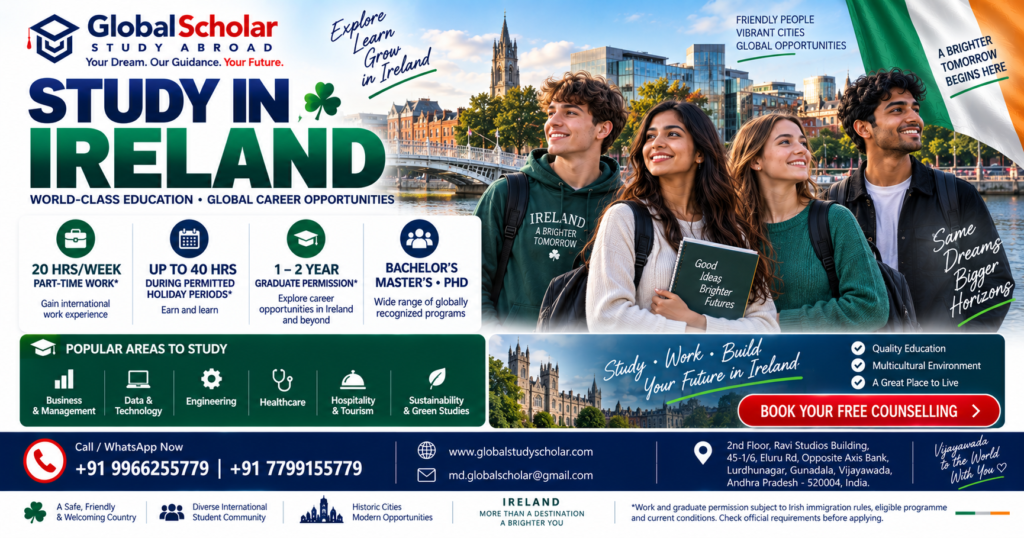
Ireland has become an increasingly attractive destination for international students looking for high-quality education, English-taught programmes, international exposure and career opportunities. For Indian students, Ireland offers programmes ranging from Bachelor’s and Master’s degrees to PhD programmes across areas such as Business, Data & Technology, Engineering, Healthcare, Hospitality & Tourism, Sustainability and Green Studies. The latest GlobalScholar Study Abroad campaign highlights Ireland as a destination where students can study, gain international work experience and build their careers. One important advantage is that eligible non-EEA students on Stamp 2 can generally work up to 20 hours per week during term time and 40 hours per week during specified vacation periods, subject to the applicable immigration conditions. Why Study in Ireland? Ireland combines internationally oriented education with a strong English-speaking environment and access to European opportunities. Some of the key reasons students consider Ireland include: For students from India, Ireland can be particularly attractive because students can study in an English-speaking European country while gaining international academic and professional exposure. Popular Areas to Study in Ireland The GlobalScholar Ireland campaign highlights several popular fields. 1. Business & Management Business remains one of the most popular areas for international students. Students can explore programmes in: A business qualification can provide career opportunities across multiple industries. 2. Data & Technology Ireland has a strong technology ecosystem, making technology-related programmes attractive to international students. Popular areas include: Students should select programmes according to their previous academic background and career objectives. 3. Engineering Ireland offers programmes across several engineering disciplines, including: Engineering students should carefully check professional recognition requirements if they intend to work in regulated engineering roles. 4. Healthcare Healthcare is another important study area. Students may explore: Professional healthcare programmes can involve additional registration requirements, so students should check the relevant Irish professional body before choosing a programme. 5. Hospitality & Tourism Ireland’s tourism sector also makes hospitality an interesting option for international students. Possible programmes include: These programmes can combine academic learning with practical industry exposure depending on the institution. 6. Sustainability & Green Studies Sustainability is another growing academic area. Students can explore: These courses can be relevant for students interested in environmental and sustainability-focused careers. Study Levels Available in Ireland International students can find programmes at different qualification levels. Bachelor’s Degrees Bachelor’s programmes commonly take several years depending on the course and institution. Master’s Degrees Ireland offers a wide range of postgraduate programmes, including many one-year Master’s options. Popular choices include: PhD Ireland also offers research-based doctoral programmes for students interested in advanced academic and research careers. Can International Students Work While Studying in Ireland? Yes, eligible non-EEA students holding Stamp 2 permission can work within specified limits. The current Irish immigration guidance states that eligible students can work: 20 hours per week during term time and 40 hours per week during specified vacation periods, currently including June, July, August and September, and from 15 December to 15 January. This can provide students with an opportunity to gain work experience while studying. However, students should not plan their entire education budget on the assumption that part-time employment will cover all tuition and living costs. Irish immigration guidance specifically requires students to demonstrate sufficient financial resources without relying on casual employment. Ireland Graduate Permission After Study One of the major attractions for international students is the Third Level Graduate Programme. Eligible graduates can receive permission to remain in Ireland after completing an eligible qualification to seek graduate-level employment and pursue an employment permit. According to current Irish immigration guidance: NFQ Level 8 Graduates with a Level 8 qualification can receive 12 months of graduate permission under the programme, subject to the applicable conditions. NFQ Level 9 or Above Graduates with a Level 9 or higher qualification may receive up to 24 months, generally in two 12-month periods, subject to the applicable conditions. During Stamp 1G graduate permission, eligible graduates can work full-time while seeking suitable employment and an employment permit. Important Graduate permission is not a permanent residence guarantee. Students who want to remain in Ireland longer generally need to qualify for another immigration permission, such as an appropriate employment permit. Ireland Student Visa Indian students generally require the appropriate Irish immigration permission to study in Ireland. The long-stay study visa process can require evidence of: Irish Immigration Service states that visa officers assess applications on their individual merits and may request additional information. Ireland Student Visa Financial Requirement Financial planning is an important part of an Irish student visa application. For academic courses beginning after 1 July 2023, Irish immigration guidance requires visa-required students to demonstrate access to at least €10,000 for a one-year course, representing the estimated cost of living for one academic year. Students must also demonstrate access to the same level of funds for each subsequent year, in addition to course fees. For courses resulting in a stay of 6–8 months, the current requirement is €833 per month, or €6,665 in total, whichever is lower. This means students should prepare their finances well before submitting their visa application. How Much Tuition Fee Must Be Paid Before an Ireland Student Visa? Irish immigration guidance states that where course fees are less than €6,000, the fees must be paid in full before applying for the visa. Where course fees are more than €6,000, at least €6,000 must generally be paid before the visa application, although the college may require full payment according to its own policy. Students should therefore obtain an official fee schedule and payment instructions from their institution. English Language Requirements for Ireland International students must demonstrate that they have sufficient English-language ability to study their chosen programme. The exact requirement depends on: Possible English tests may include: Students should not assume that one English test is accepted by every Irish university. Can I Study in Ireland Without IELTS? Some institutions may accept alternatives to IELTS, including other recognised English tests or specific forms of English-language evidence. However, “Ireland without IELTS” is not a universal rule. The university
Study in Malta 2026: Tuition Fees, 70% Tax Credit, Education Loans & Career Opportunities

Malta is becoming an attractive European study destination for international students looking for English-taught education, a multicultural environment, European exposure and career opportunities. Located in the Mediterranean, Malta combines a relatively compact lifestyle with access to the wider European environment. For Indian students, particularly those looking for business, IT, healthcare, hospitality, accounting and management programmes, Malta can be an option worth considering. The latest GlobalScholar Study Abroad campaign highlights Malta with the message “Small Island, Big Opportunities” and promotes benefits such as tuition-fee support, collateral-free education-loan options, English-language education, internships and career opportunities. However, one important point needs clarification: the advertised “70% tuition fee back” should not be understood as an automatic cash refund for every international student. Malta’s 2026 Get Qualified scheme provides an eligible person with a tax credit of up to 70% of eligible study costs, subject to the scheme’s conditions. Eligibility includes being liable to tax in Malta. Why Study in Malta? Malta offers an interesting combination of: Malta’s education sector is regulated by the Malta Further and Higher Education Authority (MFHEA). Institutions providing further or higher education in or from Malta generally require the appropriate MFHEA licence, while programmes can be accredited and mapped to the Malta Qualifications Framework (MQF). This makes checking the institution and programme before paying fees extremely important. Study in Malta in English One of Malta’s major advantages for international students is the availability of programmes delivered in English. This can make Malta particularly interesting for Indian students who want to study in Europe without having to learn a new European language before starting their academic programme. Depending on the institution and course, students can find programmes in areas such as: The exact language of instruction, admission requirements and English-language evidence should always be confirmed with the institution. Malta Tuition Fees Tuition fees in Malta vary significantly according to: The flyer promotes tuition fees starting from €6,000, but this should be treated as an indicative starting figure rather than a universal Malta tuition fee. For example, one Maltese higher-education institution currently lists 2026–27 full-time diploma and degree tuition at €6,696 per academic year, with a separate non-EU administration fee for students requiring a student visa. Therefore, students should always request the latest official fee structure for their selected programme. Can Students Get 70% of Their Tuition Fees Back? This is one of the most important points in the latest Malta campaign. Malta’s Get Qualified Scheme Malta’s Get Qualified 2026 scheme provides eligible applicants with a tax credit of up to 70% of eligible costs, including certain registration, tuition, educational and examination expenses. The 2026 scheme states that eligible individuals can use the tax credit over a period of up to 15 fiscal years, subject to the applicable rules. But there is an important condition The official eligibility requirement says applicants must be persons liable to tax in Malta and must have commenced a relevant course of study after the age of 16. Therefore, an Indian student arriving in Malta should not assume that 70% will automatically be refunded after paying tuition fees. A student may need to meet the applicable conditions, successfully complete the relevant programme and have the necessary Maltese tax position to benefit. Some Maltese institutions also specifically explain that the scheme can benefit international students who subsequently work and pay tax in Malta. For example, MCAST states that eligible students may apply for a 70% tuition-fee refund in the form of a tax rebate after successful course completion, with reimbursement available to students paying tax in Malta. So the correct SEO-friendly claim is: “Eligible students may benefit from up to 70% through Malta’s Get Qualified tax-credit scheme, subject to eligibility and conditions.” That is much safer and more accurate than saying “everyone gets 70% tuition fees back.” Is Malta Education Loan Available Without Collateral? Education financing can be another important part of planning your Malta studies. Depending on the student’s profile, university and lender, students may explore: However, loan approval is never automatic. The lender may evaluate: GlobalScholar Study Abroad can help students understand available financing options before proceeding with their admission. Work While Studying in Malta International students may be able to work part-time in Malta, but specific immigration and employment conditions apply. According to Malta’s Identità, third-country nationals pursuing qualifying full-time higher-education courses recognised by MQRIC may work for a maximum of 20 hours per week, subject to the relevant work-permit conditions. Identità also states that students need the appropriate employment authorisation and that conditions can change. Therefore: Study first + permitted part-time employment = possible but Student visa = unrestricted full-time employment is not correct. Students should follow their residence permit and employment-permit conditions. Internships and Career Opportunities in Malta Malta’s economy includes sectors such as: Depending on the programme, students may have opportunities for: However, internship or employment is not guaranteed by simply enrolling in a course. Students should select programmes that provide relevant industry exposure and carefully check what internship or placement support is actually included. Popular Courses to Study in Malta 1. Business & Management Business programmes can suit students interested in: These programmes can lead to careers across multiple industries. 2. Accounting & Finance Malta’s financial-services environment makes accounting and finance an interesting area for students. Possible study areas include: 3. Information Technology Technology programmes can include: Students should verify the MQF level and accreditation of the programme before enrolling. 4. Healthcare & Nursing Healthcare-related programmes are another important study area. Students can explore: Professional healthcare programmes can have additional regulatory and registration requirements, so course recognition should be checked carefully. 5. Hospitality & Tourism Malta’s tourism industry creates a natural connection with: For students interested in international hospitality careers, Malta can provide European cultural and industry exposure. Schengen Access and European Travel Malta is part of the Schengen Area. This makes Malta particularly attractive to students who want European travel opportunities. However, students should understand the distinction between: Studying and residing in Malta and having unrestricted rights to live
Education Loan Without Collateral and Co-Signer for Study Abroad in 2026

Studying abroad is a major goal for many Indian students, but arranging the required funds can sometimes be the biggest challenge. Traditional education loans may require property collateral, a family co-signer or co-applicant, income documentation and other financial security. However, selected international education-loan providers now offer financing options where eligible students may be able to study abroad without collateral and without a co-signer. These options are generally based on factors such as the student’s university, programme, academic profile and future earning potential. For students from Vijayawada, Andhra Pradesh and across India, GlobalScholar Study Abroad provides guidance on university selection, admission, education-loan options and the overall study-abroad process. Important: “No collateral” and “no co-signer” are not available for every student, university, country or course. Loan approval depends on the lender’s eligibility criteria, underwriting and available funding. What Is an Education Loan Without Collateral? A collateral-free education loan is a student loan that does not require the borrower or family to pledge property, land, fixed deposits or other assets as security. Traditional secured education loans may require property or another acceptable security, particularly when the loan amount is higher. Some international lenders instead evaluate the student’s: For example, Prodigy Finance currently advertises loans for eligible international students at supported universities without collateral or a co-signer. Its current 2026 information says Indian students can apply for supported postgraduate programmes, subject to eligibility and funding criteria. What Is an Education Loan Without a Co-Signer? A co-signer or co-applicant is another person who may share responsibility for the loan or guarantee repayment. In many traditional education-loan structures, parents or guardians are involved as co-obligors. For example, SBI’s standard student-loan documentation specifies parent/guardian co-obligation and different security requirements depending on the loan amount. Some international lenders have a different model. For eligible students, lenders such as MPOWER Financing and Prodigy Finance offer no-cosigner financing for certain international programmes and universities. MPOWER currently states that Indian students can apply for eligible international student loans without a co-signer or collateral, with eligibility based on factors such as academic programme and future earning potential. Can Indian Students Get an Education Loan Without Collateral and Co-Signer? Yes, some Indian students can, but it depends heavily on the lender, university and programme. There is an important difference between: “Education loan available without collateral/co-signer” and “Every student can get a loan without collateral/co-signer.” The second statement is not accurate. International lenders may restrict loans to specific: For example, Prodigy Finance’s current 2026 information lists supported postgraduate programmes and countries including the UK, USA, Germany, France, Canada and Australia, while availability varies by institution and programme. How No-Collateral Education Loans Work The process can be different from a conventional bank education loan. Step 1: Choose Your University First, identify the university and programme you want to study. The university is particularly important because international lenders may only finance students admitted to their supported institutions. Step 2: Check Loan Eligibility The lender reviews factors such as: Step 3: Receive a Loan Offer If eligible, the lender may provide a loan offer explaining: Step 4: Arrange University Payment Depending on the lender, tuition may be paid directly to the university, while eligible living expenses may be handled according to the lender’s disbursement process. Step 5: Use the Loan for Your Study-Abroad Expenses Depending on the loan product, funding may help cover eligible: The exact coverage varies between lenders. Which Countries Can Students Consider? Depending on the lender and university, international education financing may be available for destinations such as: 🇬🇧 UK Popular for Master’s programmes in: 🇺🇸 USA Students may explore financing for eligible Master’s and other postgraduate programmes at supported universities. 🇨🇦 Canada Selected institutions and programmes may qualify for international student financing. 🇩🇪 Germany Selected postgraduate programmes may qualify depending on the lender and institution. 🇫🇷 France Certain eligible postgraduate programmes can also be considered through international education-loan providers. 🇦🇺 Australia Some international lenders support eligible Australian institutions and programmes. Always check the lender’s current supported-university list before relying on a particular loan option. Prodigy Finance for Indian Students Prodigy Finance is one example of an international lender offering education financing to eligible international students. Its current information for Indian students indicates that eligible Master’s students may apply without a co-signer or collateral, subject to the supported university/programme and its lending criteria. For Fall 2026, Prodigy Finance states that applications are open for eligible Indian students and that loans can be used for supported Master’s programmes. The lender’s current Spring 2027 information also advertises no-collateral, no-co-signer loans for eligible Indian Master’s students, with loan offers subject to eligibility and credit/funding criteria. MPOWER Financing for Indian Students MPOWER Financing is another international student-loan provider. Its current information for Indian students states that eligible students can apply for certain international student loans without a co-signer or collateral. It evaluates factors including the student’s programme and future earning potential. MPOWER currently lists financing for eligible students at supported schools, particularly for programmes in the United States and Canada, with specific eligibility requirements. Therefore, students should check the exact university and course eligibility before including MPOWER financing in their financial plan. What About Indian Banks? Indian banks continue to offer education loans for students going abroad, but their requirements can be different from international lenders. For example, SBI’s current Student Loan Scheme states that education loans for studies abroad can have different security requirements depending on the loan amount. Loans up to ₹7.50 lakh may be available without security but with parent/guardian co-obligation, while higher amounts can involve collateral requirements. SBI also has specialised overseas education-loan products such as Global Ed-Vantage, with eligibility and security conditions that differ from the standard student-loan scheme. Therefore, students should compare: Loan Type Collateral Co-signer/Co-applicant Typical Evaluation Traditional secured education loan Often required for higher amounts Often required Family + student profile Collateral-free bank loan May not be required in selected cases May be required Student + co-applicant International no-cosigner loan Not required for eligible products Not required University +
Study in UK Without IELTS with MOI 2026: Complete Guide for International Students

Study in the UK without IELTS using a Medium of Instruction (MOI) certificate — understand eligibility, admission, visa requirements, courses, intakes, work opportunities and the Graduate visa. Study in UK Without IELTS with MOI 2026 Are you planning to study in the UK without IELTS? For many international students, English-language testing is one of the biggest concerns when applying to UK universities. However, depending on the university, course and student’s academic background, there can be alternative ways to demonstrate English-language ability. One option is a Medium of Instruction (MOI) certificate, which confirms that a student’s previous qualification was taught in English. However, an important distinction must be made: Having an MOI does not automatically mean that every UK university or the UK Student visa will waive an English-language requirement. UK immigration rules allow certain ways of demonstrating English proficiency, including a degree-level qualification taught in English. For an overseas degree, an Ecctis assessment may be required in circumstances where the qualification is being used to prove English ability. A UK higher education provider can also assess English for certain degree-level courses and state its assessment method on the CAS. Therefore, students interested in studying in the UK without IELTS with MOI should check both the university’s admission requirements and the applicable UK Student visa requirements. GlobalScholar Study Abroad, Vijayawada helps students explore suitable UK universities and understand their admission and visa requirements. What Is MOI? MOI stands for Medium of Instruction. An MOI certificate is a document issued by a student’s previous educational institution confirming the language in which the programme was taught. For example, if a student completed a Bachelor’s degree in India where the programme was taught in English, the university or college may issue an official letter confirming this. An MOI certificate may contain information such as: The exact format depends on the institution. Can You Study in the UK Without IELTS with MOI? Yes, in some cases — but it depends on the university and visa requirements. Some UK universities may accept alternative evidence of English proficiency, including previous education taught in English, subject to their own admission policies. For UK immigration purposes, the current rules also provide routes for demonstrating English through certain academic qualifications taught in English. For an overseas degree, the relevant qualification may need an Ecctis assessment confirming the required UK-equivalent qualification and English-language status. For degree-level study, the normal English requirement under the Student route is CEFR B2, unless the applicable rules provide another way of meeting the requirement. So the phrase “UK without IELTS” should be understood as: IELTS may not be required in certain cases if an accepted alternative method of demonstrating English is available. It does not mean that IELTS is universally waived for every student. How Does MOI Help with UK Admission? Universities need evidence that applicants have sufficient English-language ability to successfully complete their programme. If a university accepts previous English-medium education, an MOI certificate may be used as part of the university’s assessment. Depending on the institution, the university may: Therefore, students should confirm the requirement before applying. MOI and UK Student Visa: What You Need to Know This is one of the most important sections for students. University admission and UK visa requirements are not always the same thing. A university may accept your MOI for admission, but students still need to satisfy the UK Student visa English-language requirements where applicable. Current GOV.UK guidance says that English can be demonstrated in several ways. For an overseas degree taught in English, an Ecctis assessment can be required to confirm that the qualification is equivalent to a UK Bachelor’s degree or higher and was taught in English. For degree-level courses, a higher education provider may also assess the student’s English and record how it assessed the student on the Confirmation of Acceptance for Studies (CAS), where the rules permit this route. Therefore: MOI acceptance = university-specific Student visa English requirement = immigration-rule specific Students should verify both. Who Can Consider Studying in the UK with MOI? Students may explore this option if they have previously completed education through English-medium instruction. Potential applicants can include: Eligibility varies according to the university and programme. Study in UK Without IELTS After Bachelor’s Degree Students who have completed a Bachelor’s degree in India may explore UK Master’s programmes where the university accepts previous English-medium education as evidence of English proficiency. Popular Master’s areas include: The actual English requirement should be confirmed for each university and course. Study in UK Without IELTS After 12th Students who have completed 12th standard can also explore UK undergraduate programmes. Popular areas include: However, undergraduate applicants should pay particular attention to the university’s English-language requirements. An MOI from school may not automatically be treated in the same way as a degree-level qualification taught in English. Popular Courses to Study in the UK The UK offers a wide range of undergraduate and postgraduate programmes. Business & Management Business and management programmes are popular among international students. Potential areas include: Computer Science & IT Students interested in technology can explore: Data Analytics & Artificial Intelligence AI and analytics programmes can cover areas such as: Engineering UK universities offer engineering programmes across areas including: Healthcare Management Students interested in the management side of healthcare can explore programmes covering: MBA & Master’s Programmes UK Master’s degrees are available in many specialisations. Popular options include: UK Intakes for International Students Many UK universities offer multiple intakes. Common intakes include: January Intake The January intake can be useful for students who miss the September intake or want an alternative start date. May Intake Some universities offer May or spring/summer intakes for selected programmes. September Intake September is generally the major intake and usually has the widest range of course options. Important: Not every university or course offers all three intakes. Always check the current intake availability before applying. Eligibility to Study in UK Without IELTS Requirements depend on the university and course. Typical academic requirements may include: Undergraduate Postgraduate MOI
Education Loan for Study Abroad 2026: Complete Guide for Indian Students

Studying abroad can be a life-changing investment, but tuition fees, accommodation, living expenses, travel, insurance and other costs can make international education expensive. For many Indian students and families, an education loan for study abroad can make overseas education more financially manageable. An education loan can potentially help cover eligible expenses such as tuition fees, accommodation, examination fees, books, travel and other education-related costs, depending on the lender and loan product. For example, SBI’s Global Ed-Vantage scheme lists tuition, hostel fees, examination and library fees, travel expenses and certain other education-related costs among expenses that may be considered. At GlobalScholar Study Abroad, Vijayawada, we help students understand their study-abroad options and prepare for the financial planning involved in pursuing education in countries such as the UK, USA, Canada, Germany, Australia, France, Singapore, UAE, Malta and other destinations. What Is an Education Loan for Study Abroad? An education loan for study abroad is a loan designed to help eligible students finance higher education at recognised institutions outside India. Depending on the lender and applicant profile, the loan may help fund expenses such as: The exact expenses covered depend on the lender’s policy and the specific loan product. Why Do Students Need an Overseas Education Loan? International education involves several expenses beyond tuition fees. A student planning to study abroad may need to budget for: 1. Tuition Fees Tuition is usually one of the largest expenses. The amount varies significantly depending on: 2. Living Expenses Students may need funds for: 3. Visa & Travel Expenses Students may also need to plan for: 4. Academic Expenses Additional education expenses may include: An appropriate study abroad education loan can help eligible students finance some of these costs instead of paying the entire amount from family savings. How Much Education Loan Can You Get for Study Abroad? There is no single loan amount available to every student. The maximum amount depends on: For example, SBI currently states that its Global Ed-Vantage scheme can provide loans of up to ₹3 crore for eligible overseas education, while collateral-free loans of up to ₹50 lakh are available for students admitted to selected premier institutions under that scheme. Therefore, the ₹1.5 crore figure shown in the GlobalScholar promotional flyer should be understood as an indicative financing figure, not a universal limit applicable to every bank or student. Education Loan Without Collateral One of the most common questions from students is: Can I get an education loan without collateral for study abroad? Yes, in some cases. However, collateral-free education loans are generally subject to specific lender, institution, course and applicant criteria. For example, SBI currently states that under its Global Ed-Vantage scheme, collateral-free loans up to ₹50 lakh may be available for students admitted to selected premier institutions. This does not mean that every student can receive ₹50 lakh without collateral. The availability of an unsecured education loan depends on the lender’s eligibility criteria. Factors that can influence collateral-free eligibility include: Education Loan with Collateral For larger overseas education loans, lenders may require security. Collateral can potentially include eligible assets such as: The type and value of acceptable collateral depend on the lender. For example, SBI’s Global Ed-Vantage documentation states that secured loans may require the co-obligation of parents/guardians together with tangible collateral security of suitable value. Popular Education Loan Providers for Study Abroad The GlobalScholar flyer highlights several banking and financial institutions, including: Students should understand that loan availability, interest rates, collateral requirements, processing fees and eligibility vary between lenders. The best lender is not necessarily the one offering the highest loan amount. Students should compare the total cost of borrowing and repayment terms before accepting an education loan. SBI Education Loan for Abroad Studies SBI offers different education loan products for students pursuing higher education abroad. Its Global Ed-Vantage scheme is specifically designed for full-time regular courses at eligible foreign universities and colleges. According to SBI’s current product information, the scheme includes: SBI’s published information also lists eligible destinations including the USA, UK, Canada, Australia, Singapore, Japan, Hong Kong, New Zealand and various European countries. Education Loan for UK Studies The UK is one of the most popular destinations for Indian students. Students may require funding for: Depending on the lender and institution, students may be able to apply for an education loan for UK studies with or without collateral. The actual loan structure depends on the selected lender and university. Education Loan for USA Studies The USA has a large number of universities and postgraduate programmes. Students applying for: may explore education loans for USA studies. The lender will assess the university, course, applicant and co-borrower profile before determining loan eligibility. Education Loan for Canada Studies Students planning to study in Canada can explore education financing for: Loan approval depends on the lender’s current policies and the student’s financial and academic profile. Education Loan for Germany Germany is popular among international students because of its strong higher-education system and wide range of programmes. However, students should remember that even when tuition is comparatively low or absent at certain public institutions, they still need to plan for: An education loan may help with eligible expenses depending on the lender and course. Education Loan for France Students planning to study in France can explore financing for eligible programmes. Loan requirements may depend on: Students should prepare their admission documents and financial plan before applying. Education Loan for Australia Australia offers a wide range of undergraduate and postgraduate programmes. Students may require financing for: The loan amount and collateral requirement depend on the selected lender and applicant profile. Education Loan for Singapore Singapore is popular for programmes including: Students can explore education loan options depending on the institution, programme and lender. Education Loan for UAE Students planning to study in the UAE may need financing for: Loan eligibility depends on the selected university, programme and lender. Education Loan for Malta Students considering Malta can also explore education financing. The total financial requirement may include: Students should check the lender’s
Study Hotel Management in France 2026: Courses, Internships, Careers & Opportunities for Indian Students

Are you planning to build an international career in hotel management, hospitality, tourism or luxury services? France can be an attractive study destination for students who want to combine hospitality education with international exposure, practical learning and European experience. With its globally recognised hospitality and tourism ecosystem, France offers a wide range of programmes in hospitality management, hotel management, tourism, gastronomy and business management. Campus France notes that French institutions offer hospitality and tourism programmes at both undergraduate and master’s levels, in French as well as English. For students from India, particularly those searching for Hotel Management in France, the country can provide an opportunity to study in an internationally oriented environment while developing practical skills relevant to hotels, resorts, restaurants, tourism companies and luxury brands. GlobalScholar Study Abroad, Vijayawada helps students explore suitable France hospitality programmes, understand admission requirements and prepare their study-abroad applications. Why Study Hotel Management in France? France is particularly interesting for hospitality students because tourism, hotels, gastronomy and luxury services are deeply connected with the country’s economy and international identity. Studying Hospitality Management in France can give students exposure to: Campus France highlights tourism, hospitality, catering and gastronomy as established areas of French educational excellence and lists specialised institutions offering programmes ranging from Bachelor’s degrees to MBA and MSc-level programmes. France also has institutions offering practical hospitality education. For example, Campus France has highlighted Institut Lyfe’s international hospitality and restaurant management programmes, including practical learning and internships in France or abroad. Hotel Management Courses in France Depending on your academic background and career goals, you may find different types of hospitality programmes in France. 1. BBA in International Hospitality Management A BBA in International Hospitality Management can be suitable for students looking to build their foundation in hotel and hospitality management. Typical areas of study may include: A hospitality BBA can help students develop both business and operational knowledge for careers in hotels, resorts, restaurants, tourism companies and related businesses. 2. MBA in International Hospitality An MBA in International Hospitality is generally designed for students who already have a bachelor’s degree and want to develop advanced management and leadership skills. Possible areas include: This type of programme can be particularly relevant for graduates who want to move towards management and leadership positions in the hospitality industry. 3. MBA in Business & Hospitality Management Another option shown in the GlobalScholar programme promotion is an MBA in Business & Hospitality Management. This type of programme can combine general business management with hospitality specialisation. Students may develop knowledge in: The exact curriculum, qualification level and recognition should always be checked with the specific institution before applying. 6 Months Study + 6 Months Paid Internship in France One of the major features promoted in this GlobalScholar campaign is the opportunity for 6 months of study followed by 6 months of paid internship. This structure can be attractive because students get the opportunity to combine academic learning with professional exposure. However, the exact study duration, internship duration, remuneration, visa requirements and work authorisation depend on the university, programme and internship arrangement. Students should not assume that every Hotel Management programme in France automatically includes a six-month paid internship. For internships exceeding four months, France has a specific long-stay internship visa framework in certain circumstances, and the internship must form part of professional training and meet the applicable requirements. Therefore, GlobalScholar Study Abroad recommends verifying the internship structure and immigration requirements for the exact programme before making financial or travel decisions. Can Students Earn During a Hospitality Internship in France? The promotional flyer for this campaign mentions potential internship earnings of approximately €1,000–€2,000 per month. However, this should be treated as an indicative promotional figure and not a guaranteed salary. Actual internship compensation can depend on: Students should obtain the actual internship terms and compensation details in writing before accepting an offer. Popular Hospitality Specialisations in France Students interested in Hotel Management in France can explore different specialisations depending on their career plans. Hotel & Resort Management Learn about hotel operations, guest services, rooms division, food and beverage and management. International Hospitality Management Focus on international hotel businesses, multicultural management and global hospitality operations. Tourism Management Suitable for students interested in tourism companies, destination management and travel businesses. Luxury Hospitality France’s strong luxury ecosystem makes luxury hotels, resorts and guest experience an interesting area of study. Food & Beverage Management Suitable for students interested in restaurants, hotels, food service and hospitality operations. Hospitality Marketing Focuses on branding, digital marketing, customer acquisition and communication. Revenue Management Students can develop knowledge of pricing, demand forecasting, hotel revenue and commercial strategy. Career Opportunities After Hotel Management in France A hospitality qualification can lead to a variety of career paths. Potential roles include: Career opportunities and salaries depend on qualifications, experience, language ability, employer, location and immigration/work authorisation. For international students, learning French can also be an important advantage when seeking professional opportunities in France. Why France Is a Strong Choice for Hospitality Students 1. International Hospitality Environment France provides students with exposure to a diverse international hospitality environment. 2. Strong Tourism Industry France has a major tourism ecosystem and established educational pathways in tourism, hospitality and gastronomy. 3. Practical Learning Several hospitality institutions incorporate practical projects, industry exposure and internships into their programmes. Campus France, for example, describes Institut Lyfe’s experiential approach and regular internships. 4. European Exposure Studying in France can provide students with the opportunity to experience European culture and travel within the Schengen Area, subject to the conditions of their visa and residence status. 5. International Career Perspective Hospitality is an international industry. Experience with multicultural guests, international hotel brands and European hospitality standards can contribute to a student’s professional profile. Eligibility for Hotel Management in France Eligibility depends on the university and programme. For Bachelor’s/BBA Programmes Students may generally need: For MBA Programmes Students may generally need: Important: There is no single eligibility rule for every hospitality institution in France. Always check the requirements of the exact university or
Study in UAE 2026: Complete Guide for International Students
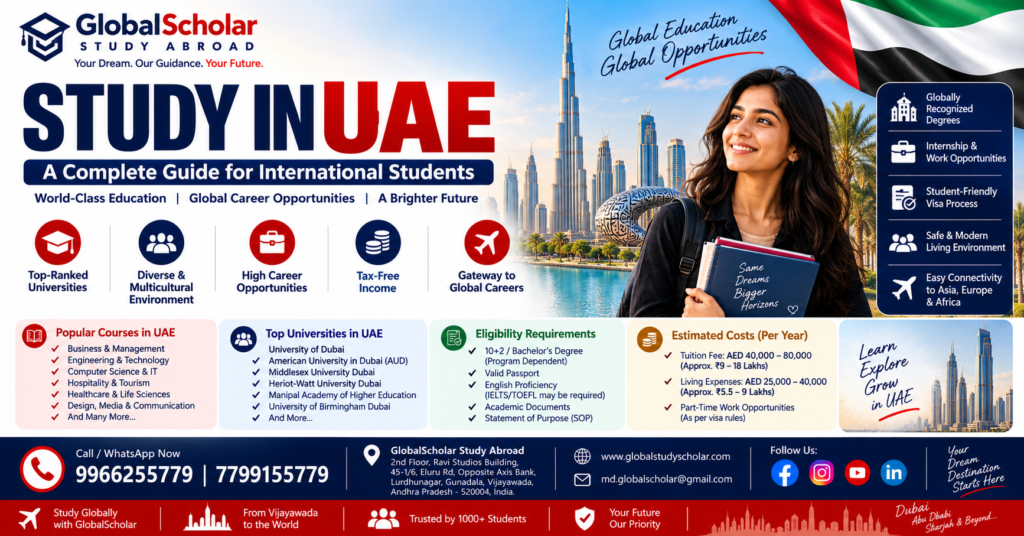
The UAE is becoming an increasingly popular study destination for international students looking for internationally oriented education, multicultural exposure and access to a fast-growing regional business hub. With universities and international branch campuses in Dubai, Abu Dhabi and other emirates, students can choose from programmes in business, engineering, technology, hospitality, healthcare, design and many other fields. If you are searching for Study in UAE, study in Dubai, UAE universities for international students, or study abroad consultants near me, this guide explains the courses, universities, eligibility, costs, visa considerations, work opportunities and career prospects. GlobalScholar Study Abroad, Vijayawada helps students from Andhra Pradesh and across India explore suitable UAE universities and admission options. Why Study in UAE? The UAE offers an international higher-education environment with universities ranging from local institutions to international branch campuses. The UAE Ministry of Education has established a national framework for classifying licensed higher education institutions, considering areas such as research and innovation, teaching quality, student life, employment and labour-market alignment, and international collaboration. Key benefits of studying in UAE include: For students interested in building an international career, studying in UAE can provide both academic and cultural exposure. Study in UAE for International Students The UAE attracts students from different countries, creating a multicultural academic environment. International students can choose programmes at different levels, including: The UAE’s higher education sector includes institutions that are subject to licensing and accreditation requirements. The UAE Ministry of Education notes that higher education institutions must meet applicable licensing and accreditation requirements, while institutions in Dubai and other emirates may also fall under relevant local authorities. Therefore, students should always verify the institution, programme accreditation and recognition before paying fees. Popular Courses to Study in UAE The GlobalScholar Study Abroad guide highlights several popular study areas. 1. Business & Management Business is one of the most popular fields for international students. Possible programmes include: The UAE’s position as a major commercial and business centre can make business education particularly attractive to students interested in international markets. 2. Engineering & Technology Students interested in technical fields can explore: Programme availability varies between universities. 3. Computer Science & IT Technology is another major area for students looking to study in UAE. Popular programmes can include: Students should compare curriculum, laboratory facilities, industry connections and accreditation when selecting a technology programme. 4. Hospitality & Tourism The UAE’s hospitality and tourism sector creates an attractive environment for students interested in: Students looking for Hotel Management in Dubai can explore diploma, undergraduate and postgraduate programmes depending on their academic qualifications. 5. Healthcare & Life Sciences Available programmes can include areas such as: Entry requirements can be more specific for regulated healthcare programmes. 6. Design, Media & Communication Students interested in creative industries can explore: The UAE’s media, advertising, events and creative sectors provide an international environment for students in these areas. Top Universities in UAE for International Students The GlobalScholar flyer highlights several universities and institutions that students can explore. Universities listed include: These institutions have different admission criteria, fees, programmes and accreditation arrangements. The UAE Ministry of Education’s classification framework provides an official mechanism for evaluating licensed higher education institutions, and the Ministry has also emphasised the importance of checking recognised institutions and programmes. Always verify the current status of the specific university and programme before applying. University of Dubai The University of Dubai offers programmes across areas such as business, computing and other disciplines. It can be considered by students looking for: Students should check current course availability, fees and entry requirements directly with the university. American University in Dubai The American University in Dubai (AUD) offers a range of undergraduate and postgraduate programmes in areas such as business, engineering, communication, architecture and arts. It may appeal to students looking for an American-style educational environment in Dubai. Middlesex University Dubai Middlesex University Dubai is an international university campus offering programmes across areas including: Students should check the specific programme’s current accreditation and entry requirements. Heriot-Watt University Dubai Heriot-Watt University Dubai offers programmes across fields including: The Dubai campus provides an international university environment within the UAE. Manipal Academy of Higher Education, Dubai Manipal Academy of Higher Education, Dubai offers programmes across areas including: Indian students may also find the institution familiar because of its wider educational presence. University of Birmingham Dubai The University of Birmingham Dubai is another option for students looking for a UK university presence in the UAE. Programme availability can include areas such as: Students should check the latest programmes and entry requirements for their intended intake. Study in UAE Eligibility Requirements Eligibility depends on the course and university. The GlobalScholar flyer highlights: 10+2 / Bachelor’s Degree – Programme Dependent This means: For Bachelor’s Programmes Students will generally need: For Master’s Programmes Students will generally need: For Diploma Programmes Entry requirements can vary significantly. Some programmes may accept students after Class 10 or Class 12, depending on the institution and qualification. There is no single UAE eligibility rule for every course. IELTS Requirement for UAE Universities English-language requirements vary between universities and programmes. Some institutions may accept: Therefore, students searching for: Study in UAE without IELTS or Study in Dubai without IELTS should not assume that IELTS is unnecessary for every programme. The correct requirement must be confirmed with the selected university. UAE Student Visa for International Students International students generally need appropriate residence permission to study in the UAE. The official UAE Government platform states that students can stay in the UAE for study under sponsorship of a parent who is a UAE resident or through sponsorship by an accredited university or college. In many cases, the university assists eligible international students with the student residence visa process. Students may need documents such as: Visa procedures can vary, so students should follow the university’s current instructions. UAE Student Visa Benefits Studying at an accredited UAE institution can provide international students with a structured legal residence route while they study. However, students should distinguish between: University admission and Immigration approval.