
How to Choose the Best Study Abroad Consultants in Vijayawada: A Complete Guide for Students and Parents
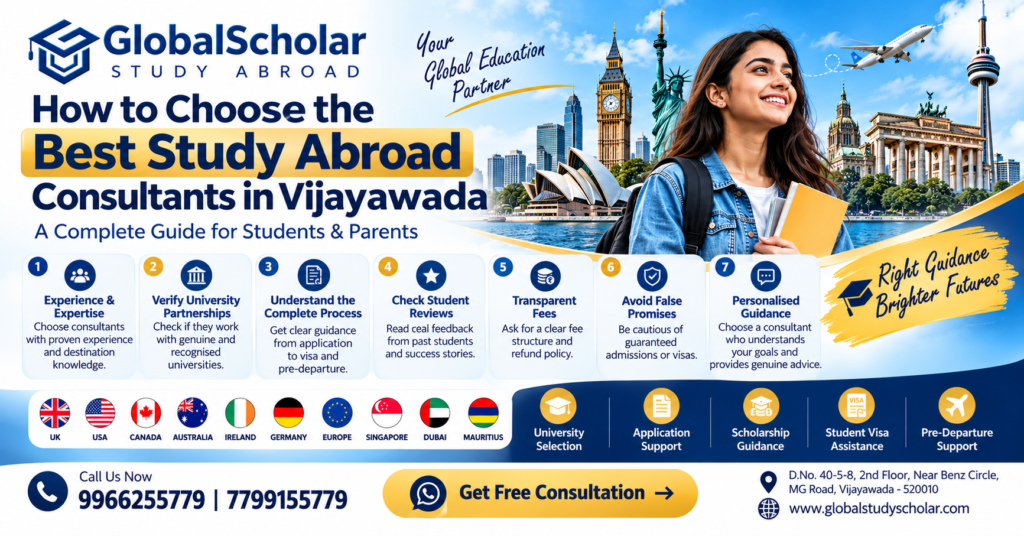
Planning to study abroad is an important decision that can shape your academic journey and future career. From selecting the right university to preparing application documents and understanding student visa requirements, the process involves several steps. Choosing the best study abroad consultants in Vijayawada can help students and parents understand these steps and make informed decisions. With many international education options available, it is important to evaluate a consultancy carefully before starting your application. Students should look for transparent information, appropriate guidance, clear fee structures and realistic advice about admissions and visas. GLOBALSCHOLAR Study Abroad supports students exploring international education opportunities by providing guidance on course selection, university applications, student visa documentation and pre-departure preparation. Why Do Students Need Study Abroad Consultants? Applying to international universities can involve different academic requirements, application deadlines, language tests, financial documents and immigration procedures. These requirements vary by destination and institution. A study abroad consultant can help students understand the process, organise documents and explore suitable education options. Professional guidance may help students with: However, students should remain actively involved in their applications and independently verify important information before making decisions or payments. 7 Things to Check Before Choosing Study Abroad Consultants in Vijayawada 1. Check Experience and Destination Knowledge Look for a consultancy that understands the admission processes and requirements of your preferred destination. Different countries have different education systems, qualification requirements, application procedures and visa rules. Ask whether the consultant can explain these differences clearly. Before choosing a consultancy, consider: Choose a consultant who provides practical, accurate information rather than making unrealistic promises. 2. Verify University Options and Partnerships A good study abroad consultation should focus on finding a suitable programme for your qualifications and career goals. Ask which institutions offer your preferred course and how you can verify their recognition and admission requirements. Before applying, check: Do not select a university solely because it is recommended by a consultant. Compare your options and confirm the information directly with the institution. 3. Understand the Complete Application Process International admission involves more than submitting an online application. Depending on the programme, students may need academic transcripts, certificates, English-language test results, a statement of purpose, references or other documents. Ask your consultant to explain the process from application preparation to receiving an admission decision. A clear process should help you understand: Keep copies of your documents, submitted applications, receipts and official correspondence. 4. Check Student Reviews and Reputation Reviews can help students understand other people’s experiences with a consultancy. However, online reviews should be considered alongside other evidence. When evaluating reviews, look for specific details about communication, documentation support, transparency and the overall service experience. You can also ask the consultancy about its services, process and how it handles application-related questions. Be cautious about relying only on promotional testimonials or claims of guaranteed admissions and visas. Admission decisions and visa approvals depend on the relevant institutions and authorities. 5. Ask for a Clear Fee Structure Before signing up for a service, understand exactly what you are paying for. Ask for written details covering: Also distinguish between consultancy service charges and payments made directly to universities, examination providers, accommodation providers or government authorities. Request receipts for payments and read the applicable terms before committing financially. 6. Avoid Guaranteed Admission or Visa Promises Be cautious if a consultant promises a guaranteed university admission, scholarship, job or student visa. Universities assess applications according to their admission criteria, while visa decisions are made by the relevant immigration authorities. A responsible consultant should explain the requirements, help you prepare accurate documents and communicate possible limitations. No consultancy can legitimately guarantee the outcome of every application. Always provide truthful information and ensure that documents submitted on your behalf are accurate. 7. Look for Personalised Guidance Every student’s situation is different. Your academic results, preferred subject, financial circumstances, language skills and future plans can influence which options are suitable. A useful consultation should consider your individual profile rather than recommending the same course or country to every student. Ask whether the consultant can help you compare: Personalised guidance helps you evaluate your options and make decisions that suit your goals. Popular Study Abroad Destinations for Indian Students Indian students can explore international education opportunities in several countries. The right destination depends on the course, institution, budget, eligibility and long-term plans. Study in the United Kingdom The UK offers undergraduate and postgraduate programmes across business, management, healthcare, engineering, technology, hospitality and other fields. Before applying, review course entry requirements, tuition fees, living expenses and the current student visa process. Study in the United States The USA offers a wide range of academic programmes at universities and colleges. Students should compare course structures, admission requirements, total education costs and applicable student visa rules. Study in Germany Germany may be an option for students interested in engineering, technology, business and other academic fields. Programme language, qualification recognition and admission requirements vary by institution. Study in Canada Students considering Canada should review available programmes, institutional eligibility, tuition fees and current study permit requirements before making a decision. Study in Australia Australia offers education opportunities across multiple disciplines. Students should check course availability, academic eligibility, total costs and the latest student visa requirements. Study in France and Italy France and Italy offer programmes in areas such as business, hospitality, fashion, design, tourism and other fields. Teaching language and entry criteria depend on the selected programme. Study in Singapore and Dubai Singapore and Dubai offer international education options in fields such as business, management, hospitality and technology. Students should confirm the institution’s recognition, course details and current visa requirements. Other destinations may also be suitable depending on your chosen programme and personal circumstances. Documents Commonly Required to Study Abroad The exact document checklist depends on the university, programme and destination. Students may commonly need: Prepare documents carefully and ensure that all information is accurate and consistent. Never submit forged or misleading documents. How Much Does It Cost to Study Abroad? The total cost depends on the
Study Abroad Consultants in Vijayawada | GLOBALSCHOLAR Study Abroad
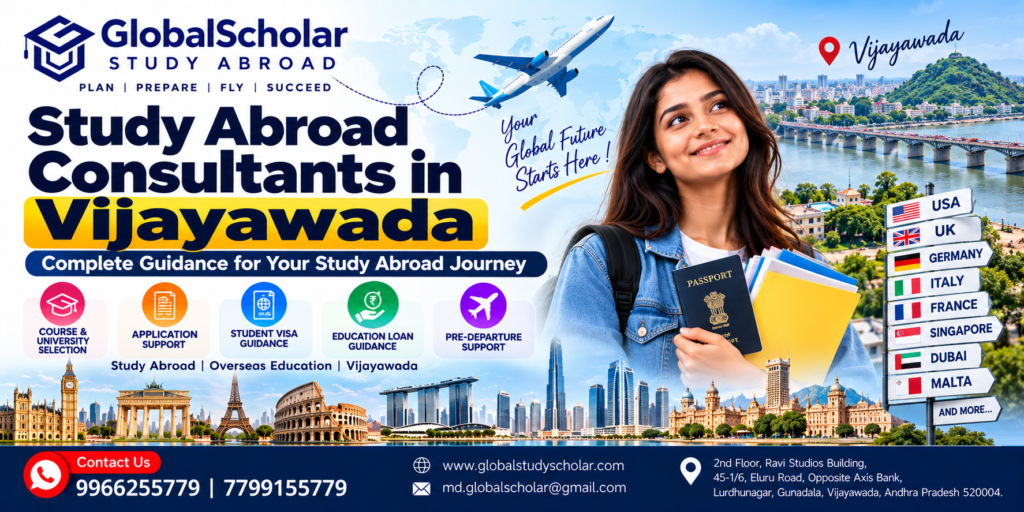
Are you planning to study abroad and looking for reliable study abroad consultants in Vijayawada? GLOBALSCHOLAR Study Abroad helps students explore international education opportunities and understand the admission process for universities and colleges in different countries. From selecting the right course and university to preparing application documents and understanding student visa requirements, our team provides guidance throughout your study abroad journey. Whether you plan to study in the USA, UK, Germany, Italy, France, Singapore, Dubai, Malta or another destination, GLOBALSCHOLAR can help you understand your options and prepare for the next steps. GLOBALSCHOLAR supports students with guidance on: Our goal is to help students make informed decisions based on their academic background, budget and career aspirations. Study Abroad Destinations Study in the USA Explore undergraduate and postgraduate education opportunities in the United States. Compare programmes, admission requirements, tuition fees and applicable student visa procedures before applying. Study in the UK Discover university and college options in the United Kingdom across business, management, healthcare, technology and other academic fields. Study in Germany Explore higher education opportunities in Germany. Check programme availability, language requirements, tuition costs and eligibility criteria for your selected institution. Study in Italy Consider Italian universities and institutions offering programmes in business, design, hospitality, engineering and other disciplines. Study in France Explore education opportunities in France, including programmes related to business, hospitality, fashion, management and other fields, depending on the institution. Study in Singapore Learn about programmes offered by eligible institutions in Singapore and compare course options, admission requirements and overall study costs. Study in Dubai, UAE Explore educational opportunities in Dubai across business, management, hospitality, technology and other fields. Confirm the institution’s recognition and current student visa requirements before applying. Study in Malta Discover suitable study options in Malta and review course availability, entry requirements, tuition fees and visa procedures. The availability of courses, admission criteria and visa requirements varies by country and institution. Always verify current information before making payments or submitting an application. Our Study Abroad Services 1. Course and University Selection Selecting a suitable course is an important part of your study abroad plan. We help you understand available options based on your qualifications, interests, budget and future goals. 2. Application Support Preparing a complete application requires attention to academic records, personal information, supporting documents and institution-specific requirements. GLOBALSCHOLAR provides guidance to help students understand the application process and prepare the necessary documents. 3. Student Visa Guidance Student visa applications require careful preparation and accurate documentation. We help students understand the relevant documentation process and the importance of meeting official requirements. Visa decisions are made by the appropriate immigration authorities. Approval is not guaranteed. 4. Education Loan Guidance Students may need financial planning to cover tuition fees, accommodation, living expenses and travel costs. We provide guidance on understanding education loan options and the documents that may be requested by financial institutions. Loan approval and terms are determined by the relevant lender. 5. Pre-Departure Support Preparing to study in another country involves more than securing admission. Students should plan accommodation, travel, budgeting, insurance and other arrangements according to their destination and institution. Pre-departure guidance can help students prepare for the transition to international education. Documents Commonly Required for Study Abroad The required documents depend on the country, institution and course. Students may need: Prepare your documents according to the official checklist provided by the institution and relevant authorities. How to Start Your Study Abroad Journey Follow these steps to begin planning your international education: Planning early gives you more time to compare options and prepare accurate documentation. Who Can Apply to Study Abroad? Students with different academic backgrounds may be eligible for international education programmes, depending on the entry requirements. Opportunities may include: Eligibility is determined by the institution and programme. A consultation can help you understand which options may suit your qualifications and plans. Frequently Asked Questions 1. Which are the best study abroad consultants in Vijayawada? When choosing a consultant, review the services offered, transparency of fees, communication, documentation support and the accuracy of the information provided. Ask questions and verify admission and visa details independently. 2. Can GLOBALSCHOLAR help me choose a university abroad? GLOBALSCHOLAR can guide you in exploring course and institution options based on your academic qualifications, budget and preferred destination. 3. Which countries can I consider for overseas education? Depending on your course and eligibility, you may explore the USA, UK, Germany, Italy, France, Singapore, Dubai, Malta and other destinations. 4. What documents are required to study abroad? Common documents include a passport, academic certificates, transcripts and institution-specific application documents. Student visa applications may require additional financial and supporting documents. 5. Does GLOBALSCHOLAR guarantee a student visa? No consultant can guarantee a visa decision. Visa approvals are made by the relevant authorities based on the application and applicable requirements. 6. When should I start my study abroad application? It is advisable to begin researching well before your intended intake so you have time to compare institutions, prepare documents and meet application and visa deadlines. Ready to explore international education opportunities? Contact GLOBALSCHOLAR Study Abroad to discuss your preferred destination, course options, academic background and application requirements. GLOBALSCHOLAR Study Abroad Address:2nd Floor, Ravi Studios Building, 45-1/6, Eluru Road, Opposite Axis Bank, Lurdhunagar, Gunadala, Vijayawada, Andhra Pradesh – 520004, India. Phone / WhatsApp: 9966255779 | 7799155779 Email: md.globalscholar@gmail.com Website: https://globalstudyscholar.com/ Plan | Prepare | Fly | Succeed Disclaimer: Course availability, tuition fees, admission criteria and visa requirements can change. Confirm all details with the relevant institution and official authorities before making payments or travel arrangements.
Study Abroad Admission Process: Step-by-Step Guide for Students
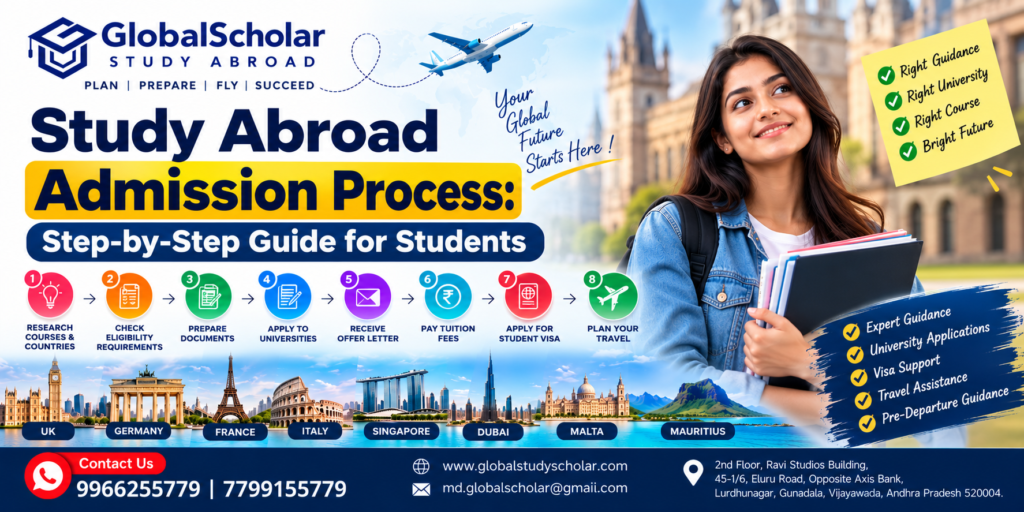
A complete guide to the study abroad admission process, covering course selection, eligibility, documents, university applications, offer letters, fees, student visas and travel.
How to Choose the Right Course to Study Abroad

Choosing the right course to study abroad is an important decision for students planning an international education. The course you select can influence your university options, study destination, budget, internship opportunities and future career path. Many students start by choosing a country or university. However, it is also important to first understand your interests, academic background and career goals. In this guide, we explain how to choose a course to study abroad by considering your interests, career opportunities, eligibility, tuition fees, return on investment, country and university. 1. Understand Your Interests The first step when choosing the right course to study abroad is understanding your interests. Think about the subjects you enjoy studying and the type of work you would like to do in the future. For example, students interested in hotels, tourism and customer service may explore hospitality and hotel management courses. Students interested in technology may consider IT and computer science programs. Your interests should be one of the factors you consider before selecting a course. 2. Explore Your Career Options Before selecting a course, research the career opportunities associated with it. Ask yourself: Understanding possible career paths can help you make a more informed decision. 3. Check Your Eligibility Every course and university can have different admission requirements. Before applying, check: Your academic background should match the requirements of the course you are considering. If you are unsure about eligibility, you can discuss your academic profile with a study abroad consultant before applying. 4. Compare Study Abroad Courses There are many types of study abroad courses available for international students. Depending on your academic background and career interests, you may explore areas such as: Hotel Management & Hospitality Students interested in hospitality, hotels, tourism, restaurants and related industries can explore international hotel management and hospitality programs. Business & Management Business-related programs can include areas such as business management, international business, marketing, finance and entrepreneurship. IT & Computer Science Students interested in technology can explore programs related to computer science, information technology, software and digital technologies. Engineering Engineering offers different specializations depending on the university and country. Healthcare & Life Sciences Students interested in healthcare and life sciences can explore relevant undergraduate and postgraduate programs based on their academic background and eligibility. Design & Creative Arts Design, media, communication and creative programs may be suitable for students interested in creative careers. The availability of specific programs, entry requirements and career opportunities varies by university and destination. 5. Compare Tuition Fees and Living Costs Your budget is another important factor when selecting a course abroad. Don’t consider tuition fees alone. Your overall study budget can include: Compare the total estimated cost before selecting a course and destination. You should also check whether scholarships or other financial support options are available for the specific university or program. 6. Consider the Return on Your Investment When comparing courses, look beyond the initial tuition fee. Consider the value of the education in relation to: A lower tuition fee does not automatically mean that a course is the right choice. Similarly, a higher tuition fee does not automatically mean better career outcomes. Compare the course structure, learning opportunities and your own career objectives before making a decision. 7. Choose the Right Country Your choice of country can affect your overall international education experience. Consider factors such as: Countries such as the UK, France, Germany, Italy, Malta, Singapore, Dubai and Mauritius offer different types of international education opportunities. However, the suitability of a destination depends on the student’s course, academic profile, budget and individual goals. 8. Select the Right University After identifying a suitable course and destination, compare universities. Check: Do not select a university based only on its name. Read the actual course information and compare the program details. 9. Check Course Duration Course duration can vary depending on the country, university and qualification. For example, you may find: Compare the duration of the course with your academic and career plans. A course with a suitable duration may help you plan your overall education budget and timeline more effectively. 10. Look at Practical Learning and Internships For some courses, practical experience can be an important part of the learning process. Before applying, check whether the program includes: The availability and conditions of internships or work opportunities depend on the specific institution, program and applicable regulations. Therefore, always verify the current details before making an application. 11. Match the Course With Your Academic Background Your previous education is an important part of course selection. For example, a student applying for a postgraduate program may need a relevant bachelor’s degree or other specific qualification. Before applying, prepare: The exact document requirements vary by institution and course. 12. Consider Your Long-Term Goals Don’t choose a course only because it is popular. Ask yourself: Where do I want this course to take me? Your answer can help you compare different programs. For example, if your goal is to build a career in hospitality, you may want to compare hotel management and hospitality programs. If you are interested in technology, you may explore IT or computer science programs. The right course should connect your education with your broader career objectives. Popular Course Areas for Study Abroad Students can explore many different academic fields depending on their qualifications and interests. Some common areas include: Always check the exact course availability and entry requirements with the institution before applying. How GlobalScholar Study Abroad Can Help Choosing the right course to study abroad can involve comparing multiple factors. GlobalScholar Study Abroad in Vijayawada provides guidance for students exploring international education opportunities. Our guidance can include: Students can discuss their academic background, preferred course, budget and destination preferences before deciding where and what to study. GlobalScholar Study Abroad Study Abroad Application Process A typical study abroad journey can include the following steps: Step 1: Understand Your Goals Identify your interests, academic background and career objectives. Step 2: Choose a Course Compare relevant courses based on curriculum, eligibility, duration and career objectives.
How to Choose the Right Study Abroad Country for Indian Students
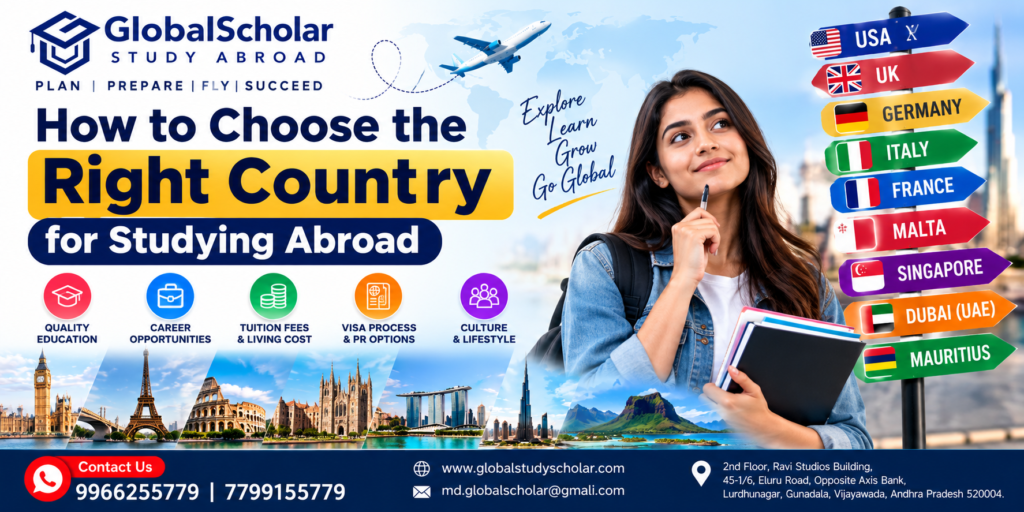
Choosing the right Study Abroad Country is one of the most important decisions for an international student. The right destination depends on your course, budget, career plans, visa requirements, lifestyle and long-term goals. Students from Vijayawada and Andhra Pradesh can explore several international destinations, including the UK, USA, Germany, France, Italy, Malta, Singapore, Dubai, Mauritius and other countries. However, there is no single country that is suitable for every student. Instead, you should compare your options carefully and choose a Study Abroad Country that matches your academic background, financial plan and career goals. This guide explains the major factors you should consider before selecting a country for your international education journey. What Is a Study Abroad Country? A Study Abroad Country is a foreign country where an international student chooses to pursue education. Students may travel abroad for: The best destination depends on the student’s individual requirements. Why Is Choosing the Right Country Important? Your destination can affect many parts of your international education experience. For example, the country you select can influence: Therefore, choosing a country should not be based only on popularity. A better approach is to compare several destinations and identify the option that fits your personal situation. 10 Important Factors to Choose a Study Abroad Country Before selecting your destination, compare these important factors. 1. Choose a Study Abroad Country Based on Your Course Your first step should be identifying the course you want to study. Different countries have different strengths and course options. For example, students may explore: Start by identifying your preferred course. Then compare which countries offer suitable programmes. 2. Compare Tuition Fees Tuition fees are an important part of your study abroad budget. Before choosing a Study Abroad Country, compare: Don’t compare only the first-year tuition fee. Instead, calculate the estimated total cost of your programme. This can help you create a more realistic financial plan. 3. Compare Living Costs Tuition fees are only one part of your expenses. You may also need to budget for: Living costs can also vary between cities within the same country. For example, studying in a major city may have different accommodation and transportation costs compared with a smaller city. Therefore, compare the total cost of studying abroad, not just tuition fees. 4. Check Admission Requirements Every university or institution has its own admission requirements. Before choosing a country, check: Some courses may also have additional requirements. Always check the current requirements of the institution before submitting an application. 5. Check English-Language Requirements English-language requirements can differ by university, programme and destination. Depending on the institution, students may be asked to provide an accepted English-language qualification such as: Some institutions may accept alternative evidence of English proficiency. Therefore, don’t assume that the same English requirement applies to every university. Check the official course requirements before applying. 6. Understand Student Visa Requirements Visa requirements are another important factor when selecting a Study Abroad Country. Before applying, understand: Visa rules can change. Therefore, students should always verify the latest requirements through the relevant official government or immigration website before submitting a visa application. 7. Consider Career Opportunities Your study abroad decision should also consider your career plans. Ask yourself: What do I want to do after graduation? For example: Your answers can help you compare countries and courses more effectively. 8. Look at Internship and Practical Training Options Practical experience can be valuable for students. Depending on the course and institution, students may find: However, internship availability is course- and institution-specific. Some programmes may include an internship as part of the curriculum, while others may not. Therefore, check the actual course structure before making a decision. 9. Consider Lifestyle and Culture Studying abroad is not only about academics. You will also live in the destination for an extended period. Consider: Think about the environment in which you will feel comfortable studying and living. 10. Consider Your Long-Term Goals Your long-term plan should also influence your choice. Students may have different goals. For example: Goal 1: Complete a degree and return to India. Goal 2: Gain international work experience. Goal 3: Build an international professional network. Goal 4: Continue with higher education. Goal 5: Explore career opportunities after graduation, subject to the country’s immigration rules. Your destination should match your actual goals. Popular Study Abroad Countries for Indian Students Indian students can explore many destinations depending on their course, budget and eligibility. UK The UK is a popular destination for international students and offers a wide range of undergraduate and postgraduate programmes. Students can explore fields such as: The UK may be considered by students looking for a wide range of academic programmes. USA The USA offers a large selection of universities and academic programmes. Students can explore areas such as: Admission requirements, tuition costs and visa requirements vary between institutions. Germany Germany is another destination students may consider for international education. Students can explore: Students should carefully check the language, academic and financial requirements of their selected programme. France France can be considered by students interested in areas such as: Some programmes may be available in English, while others may require French proficiency. Italy Italy offers programmes across several academic areas. Students can explore: Course availability and admission requirements vary by institution. Malta Malta is another European destination that students may consider for selected programmes. Popular areas can include: Students should check institution-specific admission and visa requirements. Singapore Singapore is known for its education and international business environment. Students can explore programmes related to: Course availability depends on the institution and qualification. Dubai and UAE Dubai and the wider UAE offer a range of international education options. Students can explore: Students should compare institution accreditation, tuition fees, course structure and visa requirements before applying. Mauritius Mauritius can be considered by students looking for programmes in areas such as: Students should compare the institution and course carefully before making a decision. Study Abroad Country Comparison Checklist Before selecting a destination, create a simple comparison. Factor Country A Country
STUDY ABROAD APPLICATION PROCESS 2026: STEP-BY-STEP GUIDE FROM ADMISSION TO VISA
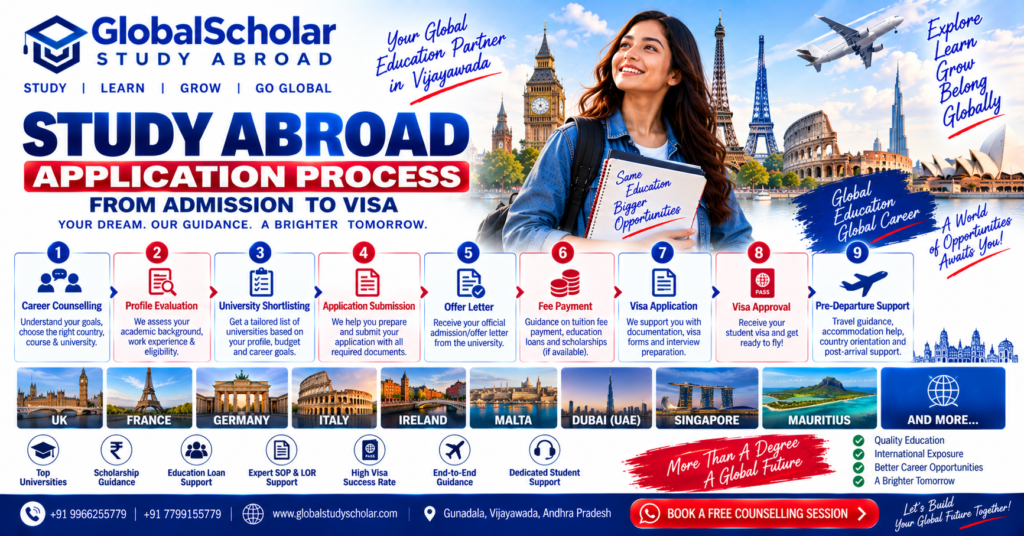
Planning to study abroad is an exciting step toward international education, global exposure and new career opportunities. However, the Study Abroad Application Process involves several important stages, from choosing the right course and university to submitting documents, receiving an offer letter, completing fee requirements and applying for a student visa. For Indian students, understanding each stage before starting the application can make the journey more organised and easier to manage. The exact requirements vary by country, university, course, qualification and student profile, so students should always check the latest requirements of their chosen institution and destination. At GlobalScholar Study Abroad, Vijayawada, students can receive guidance through the different stages of their international education journey, from initial counselling and profile evaluation to university applications, visa documentation and pre-departure support. What Is the Study Abroad Application Process? The Study Abroad Application Process is the series of steps a student normally follows to apply for an international course and prepare for studying overseas. While the process can vary between destinations, it commonly includes: Some destinations may have additional requirements such as interviews, entrance tests, language tests, financial evidence, medical checks or country-specific application procedures. Step 1: Career Counselling and Course Selection The first step is understanding your academic background, career interests and long-term goals. Before selecting a country, students should consider: Choosing a course simply because it is popular may not always be appropriate. The course should match the student’s academic background and future objectives. At GlobalScholar, the initial counselling stage can help students understand available study options and identify suitable courses and destinations. Step 2: Profile Evaluation After counselling, the next stage is profile evaluation. A student’s profile may be assessed based on: Different universities have different admission criteria. A programme that accepts one academic profile may not necessarily accept another. Therefore, students should evaluate their profile before applying to universities. Step 3: University and Course Shortlisting Once the profile is evaluated, suitable universities and courses can be shortlisted. Students should compare: Course curriculum Check the modules, subjects, practical components and learning outcomes. University requirements Review academic, language and document requirements. Tuition fees Compare the total tuition cost and understand payment schedules. Location Consider the city, transportation, accommodation and living expenses. Career opportunities Research the career relevance of the course and the opportunities available after graduation. Scholarships Check whether the university, government or regional authorities offer scholarships or fee reductions. Intake Confirm whether the selected course is available for the preferred intake. The goal is not simply to select the most famous university. The goal is to identify programmes that fit the student’s profile, budget and academic objectives. Step 4: Prepare Your Documents Document preparation is one of the most important stages of the Study Abroad Application Process. Depending on the destination and programme, students may need documents such as: Documents should be clear, accurate and consistent. If documents are not in the required language, certified translations may be required depending on the destination and application authority. For example, UK visa guidance states that supporting evidence may need certified translations when documents are not in English or Welsh. Step 5: University Application Submission After preparing the documents, the application can be submitted to the selected university or through the relevant official application platform. The application may include: Students should carefully check every field before submitting the application. A spelling mistake in a name, incorrect academic information or inconsistent dates can create unnecessary problems during the admission process. Step 6: Wait for the University Decision After submission, the university reviews the application. Possible outcomes may include: A conditional offer may require the student to satisfy specific conditions before final admission. For example, the university may request: Students should carefully read the conditions mentioned in the offer letter. Step 7: Offer Letter and Admission Confirmation Once an offer is received, students should review all details carefully. Check: Students should understand the university’s terms before making a payment. An admission offer does not automatically mean that a visa will be granted. Visa decisions are made by the relevant immigration authority or consular authority according to its own rules. Step 8: Fee Payment and Financial Planning After accepting an offer, the student may need to pay a tuition deposit or other required fee. Before making a payment, students should understand: Students who require an education loan should start the process early because loan approval and disbursement can take additional time. Proper financial planning can help students prepare for tuition and living expenses before travelling. Step 9: Student Visa Application The Study Abroad Visa Process is a separate stage from university admission. The visa requirements depend on the destination country. Students may need documents such as: For the UK, students apply online for a Student visa and may need to prove their identity through the UK Immigration: ID Check app or provide fingerprints and a photograph at a visa application centre. For France, international students from countries covered by the Études en France procedure, including India, follow the relevant Campus France process before the visa stage. France-Visas is the official visa application system. Therefore, students should never assume that the visa process is identical for every country. Step 10: Visa Documentation and Interview Preparation Some student visa applications may involve an interview or additional verification. Students should be prepared to clearly explain: Students should provide truthful and consistent information throughout the application. The information in the university application, visa application and supporting documents should be accurate and consistent. Step 11: Visa Decision After submitting the visa application and completing the required procedures, students wait for the immigration authority’s decision. The outcome can depend on: A visa should never be described as guaranteed. For the UK, GOV.UK advises applicants to allow sufficient time for a decision and states that travel should not be booked before the visa decision is received. Step 12: Pre-Departure Preparation Once the visa is approved, students can begin preparing for their journey. Important pre-departure tasks may include: Accommodation Arrange university accommodation or suitable
Hotel Management in the UK for Indian Students – Study in the UK with GlobalScholar Vijayawada
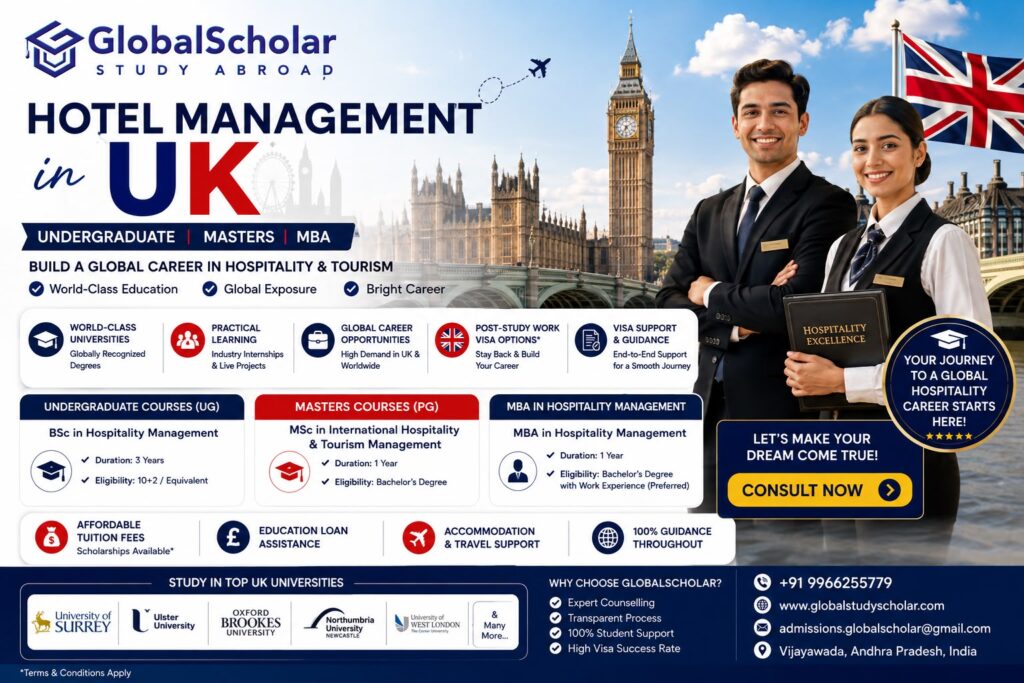
Are you planning to build an international career in Hotel Management, Hospitality and Tourism? Studying Hotel Management in the United Kingdom can provide students with academic knowledge, practical exposure and the opportunity to experience the UK’s internationally connected hospitality and tourism industry. For students from Vijayawada and Andhra Pradesh, choosing the right university, course and visa pathway is an important part of planning to study in the UK. GlobalScholar Study Abroad, Vijayawada helps students explore suitable UK hospitality programs and provides guidance with course selection, university applications, documentation and visa procedures. 7 Why Study Hotel Management in the UK? The UK is a popular destination for international students interested in hospitality, tourism and business-related education. A UK hospitality qualification can provide exposure to: Students can also benefit from studying in a country with a large tourism, accommodation, restaurant and events sector. Hotel Management Courses in the UK The right course depends on your academic qualification and career goals. Undergraduate Hotel Management Students who have completed 12th / Intermediate or an equivalent qualification may be eligible for suitable undergraduate hospitality programs, subject to the university’s admission requirements. A typical undergraduate pathway may cover areas such as: Typical duration: Around 3 years for many bachelor’s programs, although the duration can vary by university and course structure. Master’s in Hospitality Management Students who already hold a bachelor’s degree can explore postgraduate programs such as: MSc International Hospitality & Tourism Management Depending on the university, master’s programs may cover: Typical duration: Many UK master’s programs are 1 year full-time, but students should check the specific university and course. MBA in Hospitality Management Graduates interested in combining hospitality with broader business management may consider an MBA or hospitality-focused MBA where available. Admission requirements vary. Some institutions may prefer or require relevant professional work experience. Who Can Apply for Hotel Management in the UK? Eligibility depends on the university and course. For Undergraduate Programs Generally, students may need: For Master’s Programs Students generally need: For MBA Programs Applicants generally need: Always check the specific university’s current eligibility criteria before applying. Career Opportunities After Hotel Management A hospitality qualification can lead to different career pathways in the hotel, tourism and service industries. Depending on your qualification and experience, potential roles include: Career opportunities depend on the student’s qualification, skills, experience, employer requirements and applicable immigration and employment rules. Practical Learning and Industry Exposure Hospitality education is not only about classroom learning. Depending on the university and course, students may have opportunities to develop practical skills through: The availability of internships or placements depends on the individual institution and course. Students should verify the exact placement structure before accepting an offer. UK Student Visa for Hotel Management International students who want to study an eligible course in the UK generally require a UK Student visa. According to current UK government guidance, students applying for a Student visa need an offer from a licensed student sponsor, must meet the relevant financial requirements and must demonstrate English-language ability where required. The application process includes obtaining a Confirmation of Acceptance for Studies (CAS) from the education provider and completing the visa application with the required supporting documents. Important Student Visa Requirements Depending on your circumstances, you may need: Requirements can change, so students should check the latest UK government guidance before applying. Post-Study Opportunities in the UK One of the areas students often ask about is the UK’s Graduate visa. Under current UK government rules, eligible international graduates can apply for a Graduate visa after successfully completing an eligible UK course. The Graduate visa currently lasts 2 years for applications made on or before 31 December 2026 and 18 months for applications made on or after 1 January 2027. PhD and other doctoral graduates can receive 3 years. The Graduate route is not automatic. Students must meet the eligibility requirements, including completing an eligible course with the appropriate education provider. The Graduate visa can allow eligible graduates to work, look for work or be self-employed, subject to its conditions. Important: Post-study work options are subject to UK immigration rules in force at the time you apply. Students should not make an education decision based solely on post-study work opportunities. Why Choose GlobalScholar Study Abroad in Vijayawada? Choosing a UK university and hospitality course can be confusing because every institution can have different: GlobalScholar Study Abroad, Vijayawada helps students understand these options and select programs based on their academic background and career goals. GlobalScholar Guidance Includes: ✅ Student profile assessment✅ Course selection guidance✅ University selection assistance✅ Admission application support✅ Document guidance✅ English-language test guidance✅ Student visa documentation guidance✅ Pre-departure guidance✅ Accommodation and travel guidance Study Hotel Management in the UK from Vijayawada Students from Vijayawada and across Andhra Pradesh can explore UK hospitality education options with GlobalScholar. We assist students from locations including: and other parts of Andhra Pradesh. What Should Students Compare Before Choosing a UK University? Don’t choose a university only because of tuition fees or advertisements. Before applying, compare: 1. University and Course Check whether the institution and course match your academic and career goals. 2. Eligibility Make sure your academic qualification meets the university’s entry requirements. 3. Tuition Fees Compare the total tuition fee and payment schedule. 4. Living Expenses Consider accommodation, food, transportation, insurance and other living costs. 5. Course Structure Check modules, duration, assessment methods and practical opportunities. 6. Internship or Placement If practical experience is important to you, verify whether the course actually includes a placement or internship. 7. English Requirements Check which English-language tests are accepted and the minimum score required. 8. Visa Requirements Make sure you understand the current UK Student visa requirements before applying. Popular Hospitality Career Areas in the UK A hospitality graduate can explore careers across several sectors: Hotels & Resorts Work in front office, guest relations, food and beverage, housekeeping, operations and management. Restaurants Explore restaurant operations, service management and food and beverage roles. Tourism Tourism companies provide opportunities related to travel, visitor services and destination management. Events