
Study in Italy 2026: Courses, Fees, Scholarships & Admission Guide
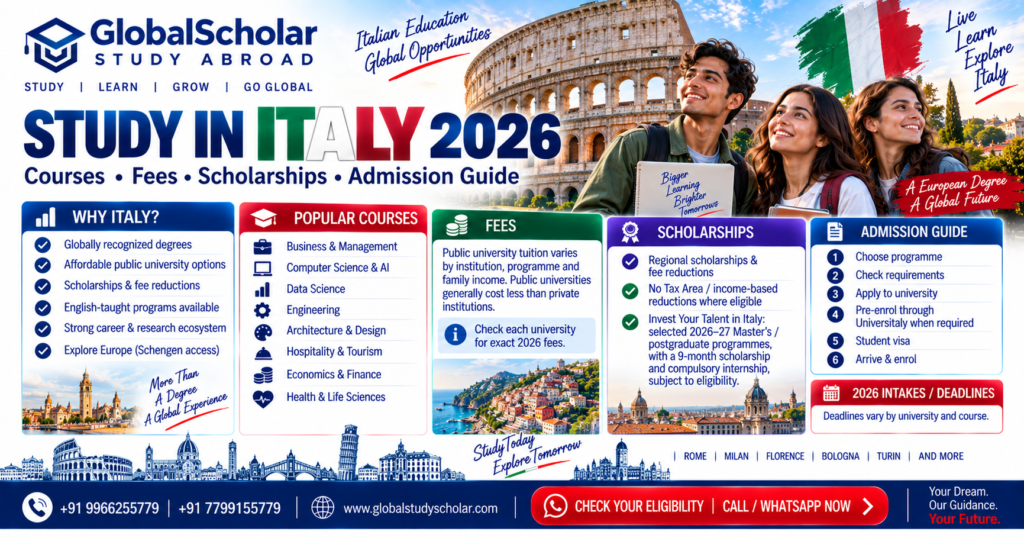
Study in Italy 2026 is an attractive option for international students looking for European higher education, internationally oriented programs and scholarship or tuition-reduction opportunities. Italy offers public and private universities across fields such as business, computer science, artificial intelligence, data science, engineering, architecture, hospitality, finance and health sciences. For students from India, the application process requires careful planning because admission requirements, tuition fees, scholarship eligibility and visa procedures can vary by university and course. This guide explains the major points students should know before planning to study in Italy in 2026. Why Study in Italy? Italy combines a long-established higher education system with universities and institutions across many academic disciplines. The official Universitaly portal allows students to search courses, compare institutions and access information about admission, tuition fees, scholarships and entry procedures. 1. Recognized European Education Italian universities offer Bachelor’s, Master’s, single-cycle and doctoral programs across a wide range of subjects. A standard first-cycle Bachelor’s degree generally lasts three years, while a second-cycle Master’s degree generally lasts two years. Some single-cycle programs have longer durations, such as five or six years. 2. Public University Options Italy has a large public university sector. Public universities generally have different fee structures from private institutions, and tuition can depend on factors such as the institution, degree program and family-income information. This makes it important to evaluate the actual fee structure of each university rather than assuming one fixed tuition amount for all students. 3. Scholarships and Fee Reductions International students may find several forms of financial support, including: Universitaly notes that regional bodies and higher-education institutions offer scholarships and benefits subject to their respective eligibility requirements. International students may need an ISEE-equivalent assessment (ISEE Parificato) for certain income-based benefits. 4. English-Taught Programs Students can find English-taught programs in areas such as: However, the language of instruction and required English or Italian proficiency must be checked for each individual course. 5. European Student Experience Studying in Italy gives students an opportunity to experience Italian culture, cities, history and a wider European environment while completing their higher education. Popular Courses to Study in Italy The GlobalScholar flyer highlights several popular academic areas. Business & Management Business-related programs can include: These courses can prepare students for careers in management, consulting, business development, marketing and related fields. Computer Science & Artificial Intelligence Technology-focused programs can include: Students interested in technology should compare the curriculum, programming requirements, specialization and practical components of each course. Data Science Data-focused programs may cover: These programs can be relevant for students planning careers in technology, analytics and data-driven business roles. Engineering Italy offers engineering programs across multiple disciplines, including: Admission requirements vary according to the university and program. Architecture & Design Students interested in creative and technical disciplines can explore: Some programs may have portfolios, entrance tests or other specific admission requirements. Hospitality & Tourism Italy is also an important destination to consider for students interested in: The exact programs and entry requirements differ by institution. Economics & Finance Students can explore programs in: Health & Life Sciences Depending on academic background and admission requirements, students can explore areas such as: Some health programs, particularly regulated or limited-enrolment courses, have additional admission procedures. Italy Tuition Fees 2026 One of the most important points when planning to study in Italy is that there is no single nationwide tuition fee for all international students. According to the official Study in Italy information, tuition at Italian universities depends on several factors, including whether the institution is public or private, the degree course and declared family income. Some universities also provide exemptions or reductions under their own rules. Public Universities Public university fees can be influenced by: Private Universities Private institutions generally have their own fee structures, which can differ considerably from public universities. Therefore, students should obtain the exact 2026/27 fee information from their selected university and program before making financial decisions. Scholarships to Study in Italy Scholarships are an important part of the Italy study-abroad process. Students may find funding through regional authorities, universities and the Italian government. Regional Scholarships Italian regions have organizations responsible for student welfare and financial support. Depending on the region and scholarship scheme, support can involve financial assistance and other student benefits. Eligibility conditions vary. University Scholarships Individual universities may offer: The conditions and application deadlines are university-specific. MAECI Scholarships The Italian Ministry of Foreign Affairs and International Cooperation (MAECI) also offers scholarships for eligible foreign students and Italian citizens residing abroad under its annual calls. For the 2026/27 call, the official Study in Italy information specifies eligible study categories and scholarship conditions. Applying for a MAECI scholarship is separate from applying for university admission. Students should always check the current official call for: No Tax Area and Tuition Reductions Some Italian universities and regional systems provide tuition reductions or exemptions based on family economic circumstances. Universitaly describes the No Tax Area as a mechanism through which eligible students from lower-income households can receive reductions or, depending on the applicable rules, potentially have university fees reduced to zero. International students may need an ISEE Parificato or other documentation to establish their economic circumstances. This means students should not assume that every international student automatically receives free tuition. Eligibility and documentation requirements apply. Eligibility to Study in Italy Admission requirements depend on the university, course and level of study. Bachelor’s Degree Students applying for a first-cycle program generally need a secondary-school qualification that is comparable to the qualification required for entry into higher education in Italy. Universitaly states that higher education institutions establish specific requirements, which can include previous qualifications, subjects and grades, admission tests, interviews and language skills. Typical Documents Students may be asked for: Master’s Degree Students normally need a relevant Bachelor’s degree or comparable qualification. Depending on the course, universities may assess: Some programs may require an interview or entrance assessment. English Language Requirements The language requirement depends on the language of instruction. For an English-taught program, the university may require evidence of English proficiency. For
Study in France 2026: Courses, Fees, Scholarships & Career Opportunities
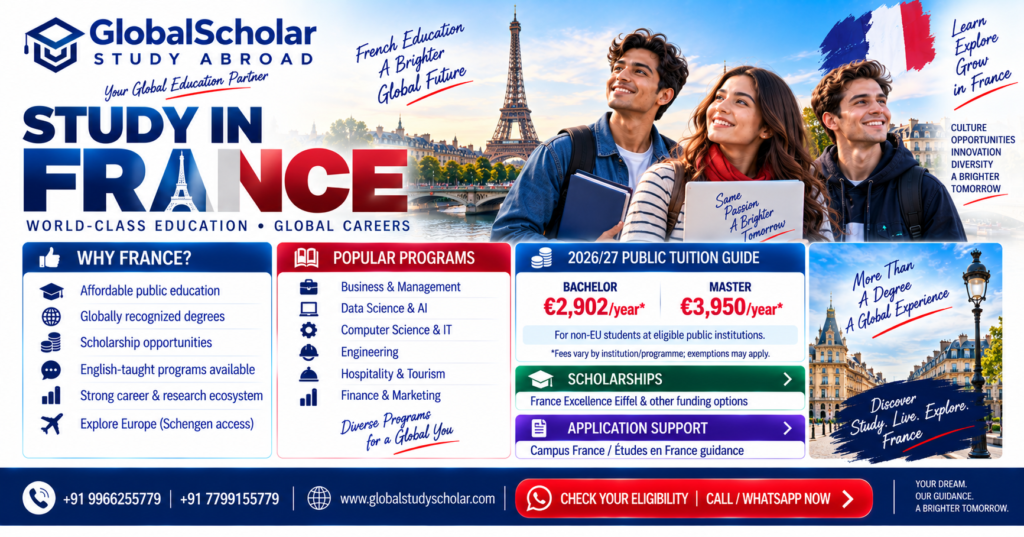
France is one of Europe’s well-known destinations for international education, offering a wide range of programs across business, technology, engineering, data science, hospitality, tourism, finance and other disciplines. For Indian students planning to study abroad in 2026, France can provide access to internationally oriented education, public higher education institutions, scholarship opportunities and exposure to a multicultural European environment. At GlobalScholar Study Abroad, students can receive guidance on choosing suitable programs, understanding eligibility requirements, preparing applications and navigating the France study process. Why Study in France? There are several reasons international students consider France for higher education. 1. Affordable Public Higher Education French public higher education receives substantial government funding. For the 2026/27 academic year, Campus France lists differentiated registration fees for eligible non-EU students at public institutions of: These amounts apply to the relevant public institutions and programs covered by the differentiated-fee system. Some students and programs can qualify for exemptions. Therefore, students should always check the exact tuition fee and exemption policy of their chosen institution before applying. 2. Globally Recognized Education France has universities, grandes écoles and specialized institutions offering programs in numerous academic fields. Students can choose from undergraduate, postgraduate and research-oriented programs depending on their academic background and career objectives. 3. English-Taught Programs International students can find programs taught in English, particularly at the Master’s level and in internationally oriented institutions. However, the language requirement depends on the specific university and program. Students should check the institution’s current admission requirements rather than assuming that every program is available in English. 4. Scholarship Opportunities France offers different scholarship and funding opportunities for international students. Depending on the scholarship, eligibility can be based on academic performance, nationality, level of study, institution, field of study or other criteria. Students should apply according to the specific scholarship conditions and deadlines. 5. European Exposure Studying in France provides students with an opportunity to experience French culture and a broader European environment. France’s location also makes it convenient for students to explore other European destinations during permitted travel periods. Popular Courses to Study in France The flyer highlights several popular academic areas for international students. Business & Management Business programs can cover areas such as: These programs can be suitable for students interested in corporate, consulting, management and entrepreneurial careers. Data Science & Artificial Intelligence Data-driven industries continue to create demand for skills in areas such as: Students interested in technology and analytical careers can explore relevant programs at French institutions. Computer Science & IT Computer Science programs may include: The exact modules and admission requirements vary by university. Engineering France has a strong engineering education ecosystem. Students can explore fields including: Engineering admission requirements can vary significantly between universities and specialized institutions. Hospitality & Tourism France is also relevant for students interested in: This can be particularly relevant for students planning international careers in hospitality and tourism. Finance & Marketing Students can also explore programs related to: France Tuition Fees 2026/27 One of the major attractions of French public higher education is the government subsidy supporting higher education. For the 2026/27 academic year, Campus France currently lists the following differentiated registration fees for eligible non-EU students at relevant public institutions: Study Level Annual Registration Fee Bachelor’s €2,902 Master’s €3,950 Doctorate €398 These figures should not be treated as the total cost of studying in France. Students also need to budget for accommodation, food, transportation, insurance, living expenses and other university-related costs. Private institutions can have substantially higher tuition fees. Campus France notes that private higher education institutions, particularly business schools, can commonly charge around €6,000–€18,000 or more per year, depending on the institution and program. Scholarships to Study in France Scholarships can help eligible international students manage the cost of education. The France Excellence Eiffel Scholarship is one of the major French government scholarship programs for international students. Other possibilities may include: Scholarship availability depends on the student’s nationality, academic profile, study level, institution and program. Some tuition exemptions are also available under specific conditions. Campus France states that certain French government scholarship recipients and students covered by eligible agreements can receive full tuition exemptions. Eligibility to Study in France Eligibility depends on the course and university. For Bachelor’s Programs Students generally need: For Master’s Programs Students generally need: Some programs may require relevant academic backgrounds or professional experience. Therefore, eligibility should be checked individually before submitting an application. English Language Requirements English-taught programs may require evidence of English proficiency. Depending on the university and program, accepted tests can include internationally recognized English-language examinations. Some institutions may consider previous education in English or other evidence, but this is not universal. Students should verify the exact language requirement directly with the university before relying on an IELTS or English-test exemption. How to Apply to Study in France The application process depends on the student’s nationality, academic level and selected institution. A typical process includes: Step 1: Choose Your Course Select a program based on: Step 2: Select the University Compare institutions based on program structure, tuition, location and admission requirements. Step 3: Check Eligibility Review academic, language and document requirements. Step 4: Prepare Documents Common documents may include: Step 5: Submit the Application Depending on the student’s situation and program, the application may involve the relevant French application process and/or the institution’s own application system. Step 6: Receive the Admission Decision If accepted, the student receives the relevant admission documentation. Step 7: Visa Process Students then complete the applicable student visa process and prepare the required supporting documents. Career Opportunities After Studying in France Depending on their qualification, specialization and experience, graduates can explore careers in areas such as: Career outcomes depend on the student’s qualification, skills, French-language ability, work experience, employer requirements and applicable immigration/work regulations. Why Indian Students Consider France France can be particularly interesting for Indian students looking for European higher education. Students may consider France because of: However, students should compare France with other destinations based on their course, budget, academic profile and career plans rather than
Study in Latvia 2026 | Courses, Fees, Eligibility & Careers
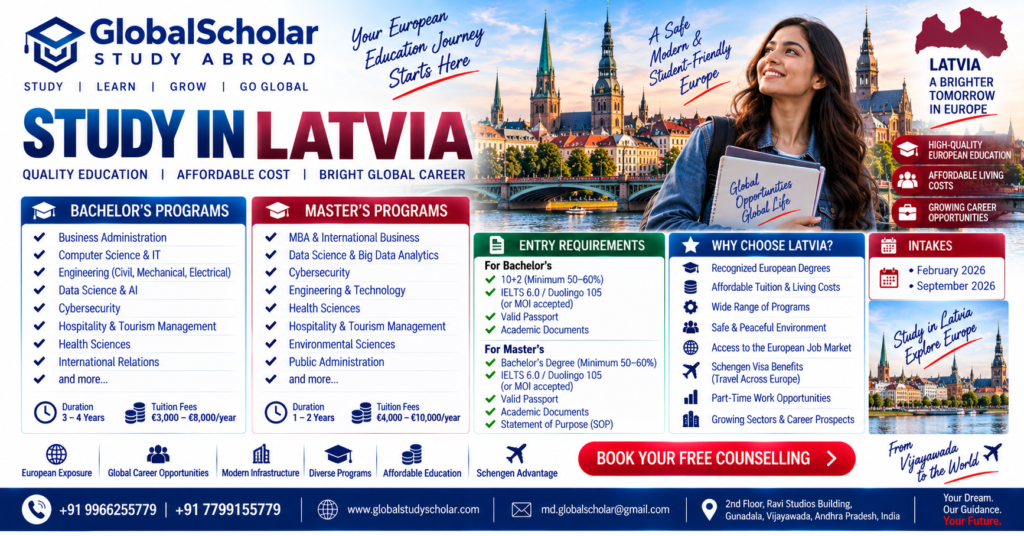
Study in Latvia 2026 | Courses, Fees, Eligibility & Careers Study in Latvia 2026 Latvia is becoming an increasingly attractive destination for international students looking for European higher education, English-taught programmes and relatively affordable study options. Students can choose from Bachelor’s and Master’s programmes in business, computer science, engineering, data science, cybersecurity, health sciences, hospitality and other fields. If you are planning to study in Latvia in 2026, it is important to compare universities, courses, tuition fees, living expenses, entry requirements, intakes and student visa procedures before making your decision. For Indian students, Latvia can provide an opportunity to experience European education while developing academic and professional skills in an international environment. GlobalScholar Study Abroad helps students from Vijayawada, Andhra Pradesh and across India explore suitable Latvia universities, courses, admissions and student visa options. Important: Admission requirements, tuition fees, English-language requirements and available programmes vary between universities. Always verify the latest requirements with the selected institution. Latvia’s official study portal confirms that universities can have their own specific admission requirements. Why Study in Latvia? There are several reasons international students consider Latvia for higher education. Key advantages include: Latvia’s official higher-education portal reports 16,000+ international students in 2024, with students from countries including India, Uzbekistan, Sweden, Ukraine and Germany. Indian students represented the largest group among the listed countries, with 3,158 students in 2024. This makes Latvia particularly relevant for Indian students researching European study destinations. Study in Latvia for Indian Students Indian students can explore Bachelor’s and Master’s programmes in a variety of academic areas. Popular study fields include: The right programme depends on your previous qualification, academic performance, career goals, budget and university-specific eligibility requirements. Popular Bachelor’s Programmes in Latvia Students who have completed their higher secondary education can explore Bachelor’s programmes in Latvia. Business Administration Business programmes can cover management, marketing, finance, entrepreneurship and international business. Computer Science and IT Computer Science and IT programmes can help students develop knowledge in programming, software, databases, networks and information technology. Data Science and Artificial Intelligence Students interested in data and technology can explore areas such as: Cybersecurity Cybersecurity programmes can cover: Engineering Engineering options can include: Hospitality and Tourism Management Students interested in international hospitality can explore hotel, tourism and hospitality management programmes. Popular Master’s Programmes in Latvia Students with a Bachelor’s degree can explore Master’s programmes in Latvia. Popular areas include: A Master’s programme can allow students to specialise in a particular academic or professional field. Latvia University Entry Requirements Entry requirements vary between universities and programmes. For Bachelor’s programmes, students generally need a recognised secondary education qualification that allows them to continue to higher education. Latvia’s official guidance states that secondary education should generally correspond to at least 12 years of secondary-level education. For Master’s programmes, applicants generally need a completed Bachelor’s-level qualification. Common documents may include: Some universities may also require entrance examinations, subject-specific tests or interviews. English Language Requirements in Latvia Students applying to Latvia need to demonstrate sufficient proficiency in the language of study. The official Study in Latvia portal states that the required level is generally B2 or higher under the Common European Framework of Reference for Languages (CEFR). However, the exact way students demonstrate their English ability can vary. Some universities may accept: Students should check the exact requirements of their chosen university. Important for Indian students If your previous education was completed in English, some Latvian universities may accept official documentation confirming the language of instruction. Latvia’s official guidance says that applicants who previously completed secondary or higher education in the study language may not need an internationally recognised language certificate, although some universities can require an additional online language examination. This is different from saying that all Latvian universities accept MOI instead of IELTS. Latvia Tuition Fees 2026 Tuition fees depend on the university, programme and study level. The GlobalScholar flyer presents indicative ranges of: Bachelor’s Programmes €3,000 – €8,000 per year Master’s Programmes €4,000 – €10,000 per year These should be treated as indicative promotional ranges, not universal Latvia tuition fees. According to the official Study in Latvia portal, tuition can vary significantly by programme. Typical annual fees listed for selected fields include approximately: Study Area Typical Annual Tuition Business Administration & Management €2,000 – €6,000 Engineering €2,700 – €3,500 Computer Science €1,800 – €3,800 Health Care & Medicine €8,000 – €15,000 The official portal also notes that some Bachelor’s programmes cost less than €1,600 per year, while specialised programmes can be considerably more expensive. Therefore, students should always confirm the exact tuition fee with the university. Cost of Living in Latvia Your cost of living depends on your city, accommodation and lifestyle. Students should budget for: Riga generally provides more accommodation and employment options because it is Latvia’s largest city and major higher-education centre. Other student cities can provide alternative living environments. Before choosing a university, compare tuition + accommodation + living expenses, rather than looking only at tuition fees. Latvia Intakes 2026 The GlobalScholar flyer highlights two main intakes: February Intake The spring intake generally begins in February. September Intake The autumn intake generally begins in September and is a major admission period for many programmes. According to the official Study in Latvia application guide, spring applications generally run around November–December for February starts, while autumn applications commonly run from March until July or August for September starts. However, deadlines can be earlier depending on the student’s citizenship and university. Important Not every course is available in every intake. Always check the exact intake and deadline for your selected programme. How to Apply to Study in Latvia The Latvia admission process can generally be divided into several stages. Step 1: Choose Your Course Select a course based on your previous education and career plans. Step 2: Choose a University Compare: Step 3: Check Eligibility Review the university’s academic and English-language requirements. Step 4: Submit Your Application Prepare and submit your academic documents, passport and other required paperwork. The official Latvia application guidance says documents may need
Explore study abroad destinations with GlobalScholar. Compare countries, universities, courses, scholarships, fees and career opportunities.
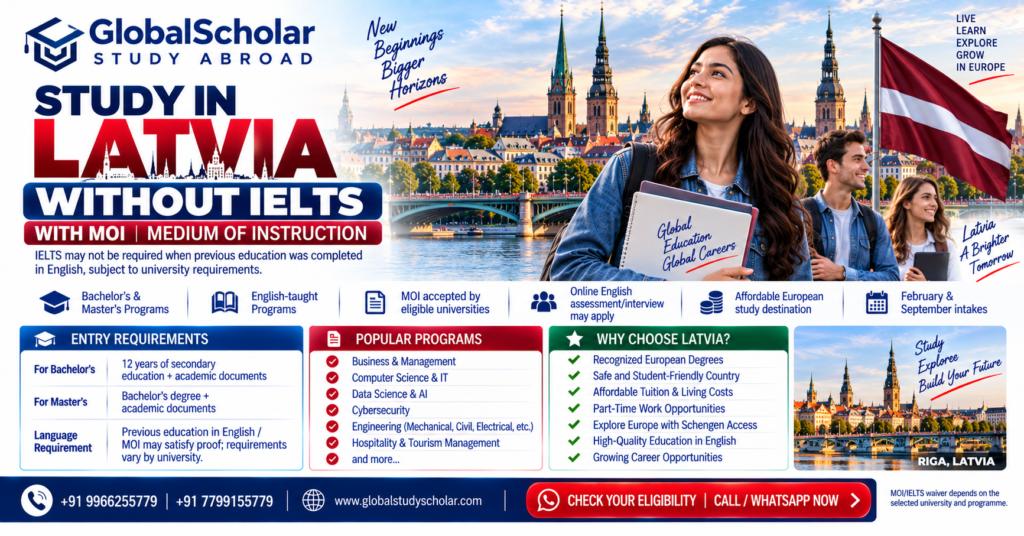
Study in Latvia Without IELTS in 2026 Are you planning to study in Latvia without IELTS? For some international students, an IELTS certificate may not be required when previous education was completed in English and the selected Latvian university accepts alternative proof of English proficiency, such as a Medium of Instruction (MOI) certificate. Latvia offers Bachelor’s and Master’s programmes in areas such as Business, Computer Science, Data Science, Artificial Intelligence, Cybersecurity, Engineering, Hospitality and Tourism Management. For Indian students, Latvia can be an attractive European study destination because of its range of English-taught programmes, relatively affordable study options and international student environment. GlobalScholar Study Abroad helps students from Vijayawada, Andhra Pradesh and across India explore Latvia universities, courses, admission requirements and student visa options. Important: “Without IELTS” does not mean “without an English-language requirement.” The exact requirement depends on the university and programme. Latvia’s official study portal states that students generally need sufficient study-language proficiency, normally at B2 level, while universities may have their own procedures for assessing it. Can You Study in Latvia Without IELTS? Yes, some students may be able to apply without submitting IELTS, depending on the university and their previous education. The official Study in Latvia guidance states that applicants who previously completed their secondary or higher education in the study language, when this is documented officially, may not need to provide an internationally recognised language certificate. However, some universities can require an additional online language assessment. This means that students should not assume that IELTS is automatically waived for every university. You may be considered for an IELTS waiver if: Therefore, the safest approach is to check the English-language requirement of your chosen university before applying. What Is MOI? MOI stands for Medium of Instruction. An MOI certificate is an official document issued by an educational institution confirming the language used to teach a student’s previous programme. For example, if you completed your Bachelor’s degree in English, your university may provide an official document stating that English was the medium of instruction. Depending on the Latvian university and programme, this document may be considered as evidence of English-language education. However, MOI acceptance is university-specific. The official Latvia admission guidance confirms that institutions can have their own requirements and language-assessment procedures. IELTS vs MOI for Latvia IELTS MOI International English-language test Proof of previous English-medium education Requires a test Usually issued by your previous institution Score requirement varies Acceptance varies by university Commonly used internationally Useful where the university accepts previous English-medium education May be required by some programmes May provide an alternative to an English test The key point is simple: MOI acceptance is not universal. Before applying, students should confirm whether their selected Latvian university accepts MOI instead of IELTS. Study in Latvia Without IELTS for Indian Students Indian students with English-medium education may explore Latvian universities that accept alternative evidence of English proficiency. The application will usually depend on: For a Bachelor’s programme, students normally need a recognised secondary education qualification. For a Master’s programme, students generally need a recognised Bachelor’s degree or equivalent qualification. The exact requirements should always be checked with the university. Popular Courses to Study in Latvia Latvia offers programmes across several academic areas. 1. Business and Management Business programmes can cover: These programmes can be suitable for students interested in corporate, management and entrepreneurial careers. 2. Computer Science and IT Computer Science and IT programmes can cover: Students interested in technology can use these programmes to build technical and analytical skills. 3. Data Science and Artificial Intelligence Data-focused programmes can include: These areas can be suitable for students interested in technology, statistics and data-driven decision-making. 4. Cybersecurity Cybersecurity is another popular technology-related field. Students may study: Cybersecurity can lead to career opportunities across technology, finance, government and other sectors. 5. Engineering Students can explore engineering programmes such as: Programme availability and entry requirements vary by university. 6. Hospitality and Tourism Management Latvia also offers opportunities in hospitality and tourism-related education. Students can explore areas such as: This can be an option for students who want an international career in hospitality and tourism. Bachelor’s Programmes in Latvia Students who have completed their higher secondary education can explore Bachelor’s programmes in Latvia. Popular areas include: General documents may include: The official Latvia admission process includes qualification recognition and language requirements, with additional programme-specific requirements determined by universities. Master’s Programmes in Latvia Students with a Bachelor’s degree can explore Master’s programmes in Latvia. Popular areas include: Typical Master’s documents Latvia Entry Requirements The exact requirements vary by university and programme. Bachelor’s Generally, applicants need: 12 years of secondary education + academic documents Some programmes may have additional subject or grade requirements. Master’s Generally, applicants need: A recognised Bachelor’s degree + academic documents Certain Master’s programmes may require a related academic background. English Language Latvia’s official study portal states that students need sufficient proficiency in the language of study, generally at B2 level. The exact method of proving proficiency can vary by institution. Latvia Without IELTS: Online English Assessment If you do not have IELTS, some Latvian universities may assess your English proficiency themselves. Depending on the institution, this could involve: The official Latvia guidance states that universities can organise their own assessment when applicants do not provide an internationally recognised language certificate. Therefore, students should ask: “Does this university accept MOI, and will I need an online English assessment?” This is much safer than assuming that IELTS is automatically waived. Latvia Tuition Fees Tuition fees depend on the university, programme and study level. The GlobalScholar promotional flyer presents indicative tuition ranges of: Bachelor’s €3,000 – €8,000 per year Master’s €4,000 – €10,000 per year These figures are indicative, not universal. The official Study in Latvia portal confirms that tuition varies by programme and institution. Students should check the exact fee for their selected course before accepting an offer. Cost of Living in Latvia Your total budget will depend on your city and lifestyle. Typical expenses include: The official Study in
Study Cybersecurity Abroad 2026 | Courses, Jobs & Careers
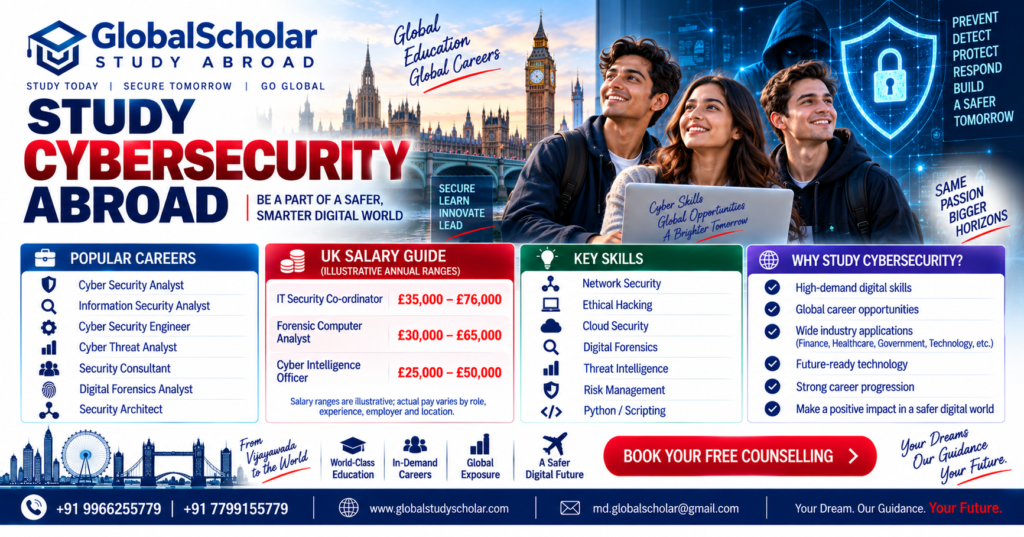
Study Cybersecurity Abroad 2026 Cybersecurity has become an important part of the modern digital economy. Businesses, banks, hospitals, governments and technology companies all need professionals who can protect systems, networks and data. If you want to study cybersecurity abroad, countries such as the UK, Ireland, Australia, New Zealand, Canada and other European destinations offer a wide range of cybersecurity and information-security programmes. For Indian students, studying cybersecurity abroad can provide international academic exposure, practical technical skills and access to a global technology industry. At the same time, students should compare university quality, tuition fees, living costs, course content, visa rules and career opportunities before making a decision. GlobalScholar Study Abroad helps students from Vijayawada, Andhra Pradesh and across India explore suitable cybersecurity courses, universities, admission requirements and study-abroad options. Why Study Cybersecurity Abroad? The demand for digital security skills continues to make cybersecurity an important career area. The UK government reported that around 143,000 people were employed in cybersecurity roles across the UK economy, based on 2024 data. The same research estimated a workforce gap of around 3,800 professionals. However, the cybersecurity job market is competitive. UK government data also shows that core cybersecurity job postings declined in 2024. Therefore, students should focus on building strong technical skills, practical experience and relevant qualifications instead of relying only on the general demand for cybersecurity professionals. Key benefits of studying cybersecurity abroad Cybersecurity Courses Abroad When you study cybersecurity abroad, you can choose from undergraduate, postgraduate and specialised programmes. Popular course areas include: 1. Cybersecurity A general cybersecurity programme can cover networks, information security, cyber threats, security management and risk. 2. Cyber Security Management This area combines technical security knowledge with business, governance and risk management. 3. Information Security Information security focuses on protecting information and systems from unauthorised access, damage and misuse. 4. Cyber Security Engineering This programme can have a stronger technical focus on secure systems, networks, security architecture and engineering. 5. Digital Forensics Digital forensics focuses on investigating digital evidence, cyber incidents and security breaches. 6. Ethical Hacking Ethical hacking teaches students how authorised security testing can identify weaknesses in systems and applications. 7. Cyber Threat Intelligence Students learn how organisations identify, analyse and respond to cyber threats. 8. Cloud Security As businesses increasingly use cloud platforms, cloud security has become an important area within cybersecurity. Popular Cybersecurity Skills A strong cybersecurity professional needs more than theoretical knowledge. Depending on the course, students may develop skills in: UK government research identifies areas such as vulnerability, auditing, ISO/IEC 27001, risk management, incident response and risk analysis among skills requested in core cybersecurity job postings. Best Countries to Study Cybersecurity Abroad Several countries offer cybersecurity programmes for international students. The right destination depends on your academic background, budget, preferred course and career plans. Study Cybersecurity in the UK The UK is a popular destination for technology and cybersecurity education. Students can find programmes covering: The UK cybersecurity sector also has a significant technology ecosystem. Government sector analysis reported nearly 70,000 employees across more than 2,600 UK cyber security firms in 2025. For eligible graduates, the UK Graduate visa currently provides 2 years if the application is made on or before 31 December 2026. Applications made from 1 January 2027 receive 18 months for most bachelor’s and master’s graduates. PhD graduates continue to receive 3 years. Students should always check the latest UK immigration rules before planning their studies. Study Cybersecurity in Ireland Ireland is another option for students interested in technology and cybersecurity. Students may find programmes related to: Ireland has a strong technology ecosystem, with many international technology companies operating in the country. Study Cybersecurity in Australia Australia offers technology and cybersecurity programmes at universities and higher education institutions. Popular areas include: Australia can be considered by students looking for an English-speaking study destination with technology-focused programmes. Study Cybersecurity in New Zealand New Zealand offers programmes in information technology, computer science and cybersecurity-related areas. Students can explore courses involving: Course availability, fees and entry requirements vary between institutions. Study Cybersecurity in Canada Canada is another destination for students interested in technology and information security. Cybersecurity-related programmes can include: Students should compare individual institutions carefully and check the latest Canadian study permit and post-study immigration rules before applying. Cybersecurity Careers Abroad One of the biggest advantages of studying cybersecurity is the range of possible career paths. Popular cybersecurity roles include: Cyber Security Analyst Cybersecurity analysts monitor systems, investigate security issues and help organisations protect their networks and information. Information Security Analyst Information security analysts focus on protecting organisational information, systems and infrastructure. Cyber Security Engineer Cybersecurity engineers help design, implement and maintain security solutions. Cyber Threat Analyst Threat analysts research cyber threats and help organisations understand potential attacks. Security Consultant Security consultants advise businesses on security controls, risk and cybersecurity improvements. Digital Forensics Analyst Digital forensics professionals examine digital evidence during investigations. Security Architect Security architects help design secure technology environments and security frameworks. Cybersecurity Salary in the UK Cybersecurity salaries vary according to job title, location, qualifications, experience and employer. The flyer provides the following illustrative salary ranges: Cybersecurity Role Illustrative Annual Salary IT Security Co-ordinator £35,000 – £76,000 Forensic Computer Analyst £30,000 – £65,000 Cyber Intelligence Officer £25,000 – £50,000 These figures should be treated as illustrative rather than guaranteed salaries. For a broader benchmark, UK government research found a median advertised salary of £55,000 for core cybersecurity job postings in 2024, while the mean advertised salary was £58,800. Your actual salary can be different depending on your experience, location, technical skills, employer and job responsibilities. Is Cybersecurity a Good Career? Cybersecurity can be a strong career option for students who enjoy technology, problem-solving and continuous learning. The field is changing quickly. Artificial intelligence, cloud computing, remote working, connected devices and increasingly complex digital systems are changing the way organisations manage security. At the same time, students should understand that cybersecurity is not an automatic high-paying career. Entry-level competition exists, and employers often look for practical skills and
Data Science & Big Data Analytics in the UK 2026 | Courses, Jobs & Salaries
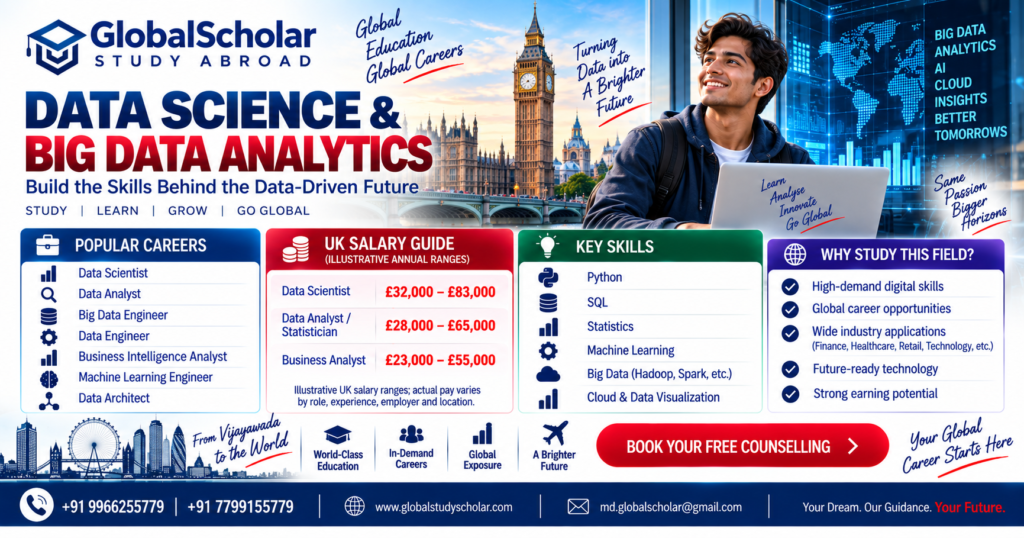
Data Science & Big Data Analytics in the UK 2026 Data has become one of the most important resources for modern businesses. Companies across finance, healthcare, retail, technology, manufacturing, logistics and other industries increasingly use data to understand customers, improve operations and make informed decisions. For students who enjoy technology, statistics, programming and problem-solving, studying Data Science and Big Data Analytics in the UK can provide a pathway into a wide range of data-focused careers. The UK’s National Careers Service describes data scientists as professionals who use software, AI and machine learning to analyse and interpret large amounts of data. It currently lists a salary range of £32,000 for starters to £83,000 for experienced professionals for the data scientist occupation. At the same time, UK government research highlights continuing demand for data and AI-related capabilities, including data management, programming and data analytics/statistics. GlobalScholar Study Abroad, Vijayawada helps Indian students explore suitable UK data science, analytics and related postgraduate programmes based on their academic profile, budget and career goals. What Is Data Science? Data Science combines several disciplines to extract useful information and insights from data. It can involve: A Data Scientist may work with large datasets to identify patterns, develop models, answer business questions and support decision-making. What Is Big Data Analytics? Big Data Analytics focuses on processing and analysing very large, complex or rapidly generated datasets. Modern organisations can collect information from: Big Data technologies help organisations process this information and turn it into useful insights. Why Study Data Science in the UK? 1. Strong Digital Skills Environment The UK continues to invest in digital, data and AI capabilities. The UK government’s AI Labour Market Survey found that 97% of surveyed organisations identified at least one AI-related skills gap. Among the technical gaps identified were data management, programming and data analytics/statistics. This demonstrates why students with strong data and analytical foundations can be relevant to an evolving technology labour market. 2. Multiple Career Pathways Data science isn’t limited to one job title. Graduates can explore roles such as: 3. Cross-Industry Applications Data skills can be applied across many industries. Finance Healthcare Retail Technology Manufacturing Logistics Popular Data Science Courses in the UK Students can choose programmes according to their academic background and career plans. MSc Data Science A broad postgraduate pathway covering areas such as: MSc Big Data Analytics Focuses on analysing large and complex datasets using modern technologies. MSc Data Analytics More focused on extracting insights from data and supporting business decision-making. MSc Business Analytics Combines data analytics with business strategy. MSc Artificial Intelligence & Data Science Combines AI, machine learning and data science. MSc Data Science & Machine Learning A more technical pathway combining statistical methods, programming and machine learning. Key Skills You Can Build The flyer highlights several important technical skills. Python Python is widely used for: SQL SQL is essential for working with relational databases and extracting information from structured data. Statistics Statistics provides the foundation for: Machine Learning Machine learning enables systems to learn patterns from data and make predictions or classifications. Big Data Students may encounter technologies and frameworks used to process large datasets, such as Hadoop and Spark. Cloud & Data Visualisation Modern data professionals may also work with cloud platforms and visualisation tools to store, process and communicate data. Data Science Career Opportunities in the UK Data Scientist Data Scientists analyse data, develop models and generate insights to support business or research decisions. The UK’s National Careers Service currently lists £32,000 to £83,000 as the salary range for the data scientist occupation. Data Analyst Data Analysts collect, clean, analyse and interpret information to help organisations understand performance and make decisions. Big Data Engineer Big Data Engineers develop and maintain systems that process large volumes of data. Data Engineer Data Engineers build and maintain the infrastructure required to collect, transform and store data. Business Intelligence Analyst BI Analysts turn business data into reports, dashboards and insights. Machine Learning Engineer Machine Learning Engineers develop and deploy machine-learning systems and models. Data Architect Data Architects design the structure and infrastructure used to store, organise and manage organisational data. Data Science Salary in the UK The flyer includes these illustrative salary ranges: Role Illustrative Annual Salary Data Scientist £32,000 – £83,000 Data Analyst / Statistician £28,000 – £65,000 Business Analyst £23,000 – £55,000 For Data Scientist, the £32,000–£83,000 range aligns with the current UK National Careers Service information. However, salary figures for other roles can vary considerably according to occupation, employer, location, experience and specialisation. These figures should not be treated as guaranteed graduate salaries. Data Science vs Data Analytics These terms are related but are not exactly the same. Data Science Data Analytics Broader technical field More focused on analysing data Machine learning Reporting and analysis Statistical modelling Business insights Predictive modelling Descriptive analysis Programming Data interpretation AI applications Dashboards and reporting There is significant overlap between the two fields, and the exact distinction varies between universities and employers. Data Science vs Big Data Analytics Data Science Often focuses on: Big Data Analytics More heavily focuses on: A student interested in highly technical data systems may prefer Big Data, while someone interested in modelling and predictive analytics may prefer Data Science. Eligibility for Data Science Courses in the UK Requirements vary by university and programme. For a Master’s degree, universities may consider applicants with bachelor’s degrees in fields such as: Some universities may also consider applicants from non-computing backgrounds if they demonstrate appropriate mathematical or analytical preparation. Typical application documents can include: Always check the exact requirements of the university and course. Do I Need Programming for Data Science? Programming is highly useful for technical Data Science programmes. Common programming skills include: Students who are new to programming should check whether their chosen course expects prior programming experience. Some programmes are designed as conversion courses, while others expect a stronger technical background. Is Data Science a Good Career? Data Science can be a strong option for students who enjoy: It can also provide
Artificial Intelligence & Machine Learning in the UK 2026 | Courses, Jobs & Salaries
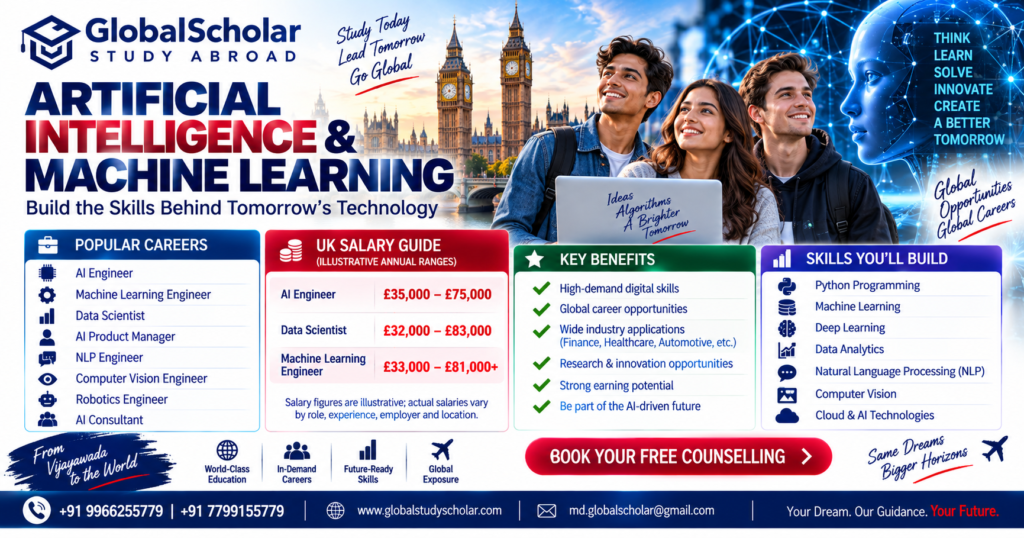
Artificial Intelligence & Machine Learning in the UK 2026 Artificial Intelligence (AI) and Machine Learning (ML) are transforming the way organisations develop products, analyse information, automate processes and make decisions. For students interested in technology, programming, data and innovation, studying Artificial Intelligence and Machine Learning in the UK can provide an opportunity to develop technical and analytical skills while studying in a major international education and technology market. UK government research published in 2026 identified significant AI skills gaps. In the 2025 AI Labour Market Survey, 97% of surveyed organisations identified at least one AI skills gap, with gaps particularly evident in understanding AI concepts and algorithms, data management, programming and data analytics. This makes AI and Machine Learning an important area for students considering technology-focused careers. Why Study AI & Machine Learning in the UK? 1. Growing Demand for AI Skills AI adoption is changing job roles and the skills employers need. Skills England’s 2026 assessment says demand is increasingly shifting toward AI-related capabilities, alongside skills such as judgement, problem-solving, collaboration and responsible use of AI. Students who develop both technical AI skills and broader problem-solving abilities can be better positioned to adapt as technology evolves. 2. International Education Experience Studying AI in the UK can provide exposure to: Students can explore how AI is applied across different industries rather than studying technology in isolation. 3. Multiple Industry Applications AI and Machine Learning are used across sectors including: This means an AI qualification does not necessarily limit graduates to one industry. Popular AI & Machine Learning Courses in the UK Students can choose different programmes depending on their academic background and career goals. Artificial Intelligence Covers areas such as: Machine Learning Focuses more deeply on: Artificial Intelligence & Machine Learning A combined pathway covering both AI theory and practical machine-learning applications. Data Science & AI Combines: Computer Science with AI Can be suitable for students wanting a broader computing foundation alongside AI specialisation. AI & Robotics Combines AI with robotics, automation, perception and intelligent systems. Skills You Can Build A strong AI and Machine Learning programme can help students develop skills in several areas. Python Programming Python is widely used for: Machine Learning Students can learn how algorithms identify patterns and make predictions from data. Deep Learning Deep learning involves neural-network approaches used in areas such as computer vision, language processing and other AI applications. Data Analytics Students learn to analyse and interpret data to support decisions and build models. Natural Language Processing NLP enables computers to process and work with human language. Applications include: Computer Vision Computer vision enables systems to interpret images and video. Applications include: Cloud & AI Technologies Modern AI systems often rely on cloud infrastructure for: Popular AI Career Opportunities An AI and Machine Learning qualification can lead to different technology and business roles. AI Engineer AI engineers develop and deploy artificial-intelligence systems. Typical areas include: Machine Learning Engineer Machine Learning Engineers develop, train and deploy machine-learning models. Data Scientist Data Scientists use statistics, programming and analytical techniques to extract insights from data. AI Product Manager AI Product Managers connect technology, business requirements and user needs to develop AI-enabled products. NLP Engineer NLP professionals work on systems that process and understand human language. Computer Vision Engineer Computer Vision Engineers develop systems that analyse and interpret visual information. Robotics Engineer Robotics professionals combine software, AI, sensors and engineering to develop intelligent machines. AI Consultant AI consultants can help organisations identify opportunities to implement AI and improve processes. AI Jobs in the UK The UK AI labour market is developing rapidly, but students should understand that high demand does not mean every graduate is guaranteed a job. The UK’s 2026 AI Labour Market Survey reported substantial skills shortages, including gaps in AI concepts and algorithms, programming, data analytics and data management. The report also found that 57% of surveyed organisations planned to adopt agentic AI within the following three years, suggesting that AI capabilities will continue to evolve. At the same time, Skills England notes that the effect of AI on future employment remains uncertain and that roles are changing rather than simply disappearing. For students, this means the best approach is to build strong fundamentals + practical experience + adaptable skills. AI Salary Guide in the UK Your flyer provides the following illustrative annual salary ranges: Career Illustrative Salary AI Engineer £35,000 – £75,000 Data Scientist £32,000 – £83,000 Machine Learning Engineer £33,000 – £81,000+ These are illustrative ranges, not guaranteed salaries. Actual salary can vary depending on: Students should check current salary information for their specific occupation before making financial or career decisions. AI & Machine Learning Across Industries One of the biggest advantages of AI is its wide range of applications. Finance AI can support: Healthcare AI applications can include: Automotive AI is used in: Retail AI can support: Cybersecurity AI can help identify: AI & Machine Learning Eligibility Eligibility depends on the university and course. For many postgraduate AI or Machine Learning programmes, applicants may need a relevant bachelor’s degree in areas such as: Some universities may accept students from other academic backgrounds if they can demonstrate appropriate mathematical, programming or analytical preparation. For undergraduate programmes, students generally apply after completing their secondary or higher-secondary education, subject to the university’s specific requirements. Always check the exact entry requirements for the selected university and course. English Language Requirements International students normally need to meet the university’s English-language requirements. Depending on the university, accepted evidence may include: Requirements and minimum scores vary by university and programme. Students should verify the current English-language requirements before applying. Tuition Fees and Living Costs The cost of studying AI in the UK varies significantly. Your overall budget can include: Tuition Fees Fees depend on: Living Costs Students should budget for: Additional Costs You may also need to consider: Do not assume that all UK AI programmes have the same tuition fees. Is Artificial Intelligence a Good Career Choice? AI can be an attractive career field for students
Master’s in Aviation in the UK 2026 | Courses, Fees, Jobs & Salaries
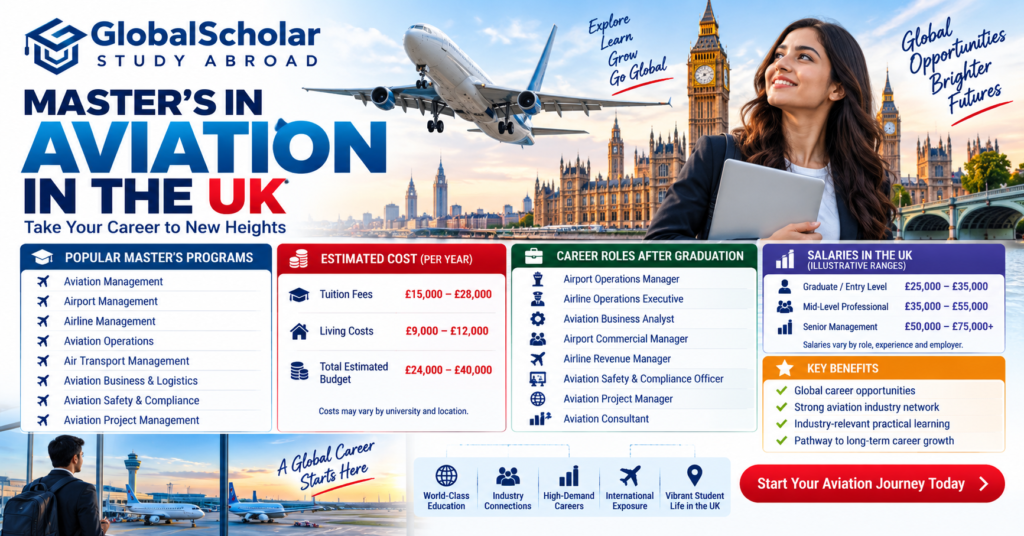
Master’s in Aviation in the UK 2026 The aviation industry offers career opportunities far beyond becoming a pilot. Airports, airlines, cargo companies, aviation consultancies and air transport organisations require professionals who understand operations, management, commercial strategy, safety, logistics and business development. For graduates interested in this side of the industry, studying a Master’s in Aviation in the UK can provide an opportunity to develop advanced business and aviation knowledge in one of the world’s major aviation markets. UK postgraduate options include programmes in Aviation Management, Air Transport Management, Aviation Operations and Management, Airport Management and International Tourism & Aviation Management. Current 2026 listings include one-year and longer postgraduate options, depending on the university and study mode. GlobalScholar Study Abroad, Vijayawada helps Indian students explore suitable UK aviation programmes according to their academic background, budget and career objectives. What Is a Master’s in Aviation? A Master’s in Aviation is a postgraduate qualification focusing on the management, operational and commercial aspects of the aviation industry. Depending on the university, students may study: For example, current UK aviation programmes cover areas such as airline operations, airport management, aviation law, safety regulations, finance, marketing, project management and aviation analytics. Why Study Aviation in the UK? 1. International Aviation Environment The UK has a well-established aviation ecosystem involving airports, airlines, logistics companies, regulators, consultancies and related businesses. Students can study aviation from an international perspective and understand how different parts of the air transport industry operate. 2. One-Year Master’s Options Many UK postgraduate programmes can be completed in approximately one year, although the duration varies by university and programme. For example, the University of Surrey currently lists its MSc Air Transport Management as a one-year full-time programme for 2026/27. Buckinghamshire New University also lists a one-year full-time MSc in Aviation Operations and Management. Other programmes, particularly those including internships or specific study structures, may take longer. 3. Industry-Focused Learning Aviation programmes can include: For example, Coventry University’s aviation-management programme highlights simulations, industry data and projects, while BNU’s aviation programme includes practical learning, case studies and real-world projects. 4. Global Career Perspective Aviation is an international industry. Skills developed through aviation management can potentially be relevant to airports, airlines, cargo operations, aviation consultancies and other air-transport organisations. Popular Master’s Programmes in Aviation Students do not necessarily need to choose a programme with exactly the title “Master’s in Aviation.” MSc Aviation Management Focuses on the business and management side of aviation. MSc Air Transport Management Focuses on the wider air transport industry, including airline and airport management, commercial planning and strategy. The University of Surrey’s current MSc Air Transport Management, for example, focuses on specialist knowledge and skills for the evolving air-transport business and provides exposure to commercial aviation-analysis tools. MSc Aviation Operations and Management Combines aviation operations with strategic and leadership skills. BNU’s 2026 programme is designed around aviation operations, management and leadership and is offered as a one-year full-time distance-learning MSc. Airport Management Suitable for students interested in: Airline Management Can cover: International Tourism & Aviation Management Combines aviation with tourism and service-industry management. The University of West London currently lists a 2026/27 postgraduate programme in International Tourism and Aviation Management, including an option with an internship. Estimated Cost of Studying Aviation in the UK The flyer provides an indicative annual budget of: Expense Indicative Amount Tuition fees £15,000 – £28,000 Living costs £9,000 – £12,000 Total estimated budget £24,000 – £40,000 These figures should be treated as planning estimates, not fixed UK-wide costs. Actual costs depend on: For example, published 2026/27 international fees vary between UK aviation-related programmes. University College Birmingham lists an international fee of £17,500 for its MSc Aviation Management, while other universities have different fee structures. Your actual budget should include: Tuition + Accommodation + Food + Transport + Visa Costs + Travel + Insurance/health-related costs + Personal Expenses Students should obtain the latest fee information directly from their chosen university before making financial plans. Master’s in Aviation UK Eligibility Entry requirements vary between universities. A typical postgraduate applicant may need: For example, University College Birmingham currently lists a 2:2 degree or international equivalent for its MSc Aviation Management, while some programmes may have different academic requirements or consider relevant professional experience. Some specialised programmes may also have additional requirements. Always check the exact entry criteria for your chosen university. English Language Requirements International students normally need to satisfy the university’s English-language requirement. The accepted test and required score can vary by university and course. For example, the University of West London’s 2026 International Tourism and Aviation Management listing specifies IELTS 6.5 or above, with 6.5 in each component, for international applicants. Students should therefore avoid assuming that the same IELTS requirement applies to every UK aviation programme. Career Opportunities After a Master’s in Aviation A Master’s in Aviation or Aviation Management can prepare graduates for a range of aviation-related business and operational roles. Airport Operations Manager Responsible for supporting and coordinating airport operational activities. Airline Operations Executive Works with airline operational processes, coordination and planning. Aviation Business Analyst Analyses operational and commercial information to support aviation-business decisions. Airport Commercial Manager Works with commercial activities, business development and revenue-related areas within an airport. Airline Revenue Manager Works with demand, pricing, revenue and commercial analysis. Aviation Project Manager Manages projects involving airports, airlines, aviation businesses or related organisations. Aviation Safety & Compliance Officer Works on safety, compliance and regulatory requirements, subject to the relevant role-specific qualifications. Aviation Consultant Provides research, analysis and strategic advice to aviation organisations. Aviation Jobs in the UK The aviation sector includes opportunities across: The University of Westminster’s Air Transport Planning and Management programme, for example, identifies potential career areas across airlines, airports, government departments and aviation-related businesses such as aircraft manufacturing, finance and consultancy. Aviation Salaries in the UK The flyer provides the following illustrative salary ranges: Career Level Illustrative Salary Graduate / Entry Level £25,000 – £35,000 Mid-Level Professional £35,000 – £55,000 Senior Management £50,000 – £75,000+ These figures are illustrative only and are not
Master’s in Aviation Management in the UK 2026 | Courses, Jobs & Salaries
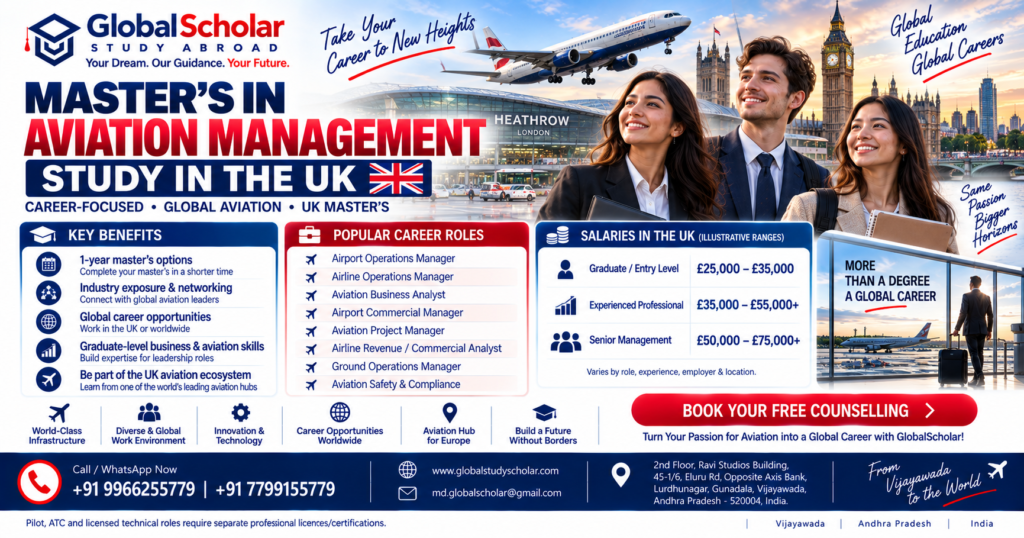
Master’s in Aviation Management in the UK 2026 The aviation industry is much more than flying aircraft. Behind every airport, airline and air transport network are thousands of professionals managing operations, commercial strategy, passenger services, logistics, safety, revenue and business development. For graduates interested in combining aviation with management and business, a Master’s in Aviation Management in the UK can be an attractive postgraduate study option. The UK has a long-established aviation sector and offers postgraduate programmes covering areas such as aviation management, air transport management and international tourism and aviation management. Current 2026/27 course listings include programmes at universities such as Teesside University, University College Birmingham, Coventry University and the University of Westminster. GlobalScholar Study Abroad, Vijayawada helps students explore suitable UK universities and aviation-management programmes based on their academic background, budget and career goals. What Is a Master’s in Aviation Management? A Master’s in Aviation Management is a postgraduate programme designed for students who want to understand the business, operational and strategic side of aviation. Depending on the university, the curriculum may cover: For example, the University of Westminster’s MSc Air Transport Planning and Management is designed around management, operations and commercial planning within airlines, airports, government departments and aviation-related businesses. Why Study Aviation Management in the UK? 1. One-Year Master’s Options One of the major attractions for international students is that many UK master’s programmes can be completed in one year. For example: This can allow students to gain a postgraduate qualification in a relatively short period compared with some other international destinations. 2. Aviation Industry Exposure The UK has a significant aviation ecosystem, with major airports, airlines, aviation businesses, logistics companies and related service providers. A UK aviation-management course can give students opportunities to study real-world aviation challenges through: For example, University College Birmingham’s MSc Aviation Management includes an international live industry project and an optional work-placement component. 3. Global Career Perspective Aviation is inherently international. Professionals may work with organisations operating across multiple countries, making knowledge of international aviation markets, business strategy and operations particularly relevant. Popular Master’s Courses in Aviation Students don’t have to choose a programme literally called “MSc Aviation Management.” Related programmes include: MSc Aviation Management Focuses on management and business within the aviation industry. MSc Air Transport Management Focuses on the wider air transportation system, including airlines, airports, policy, sustainability and commercial operations. Coventry University currently offers an MSc Air Transport Management with a professional-placement option. MSc Airport Management Focuses on airport operations, passenger services, commercial activities and airport strategy. MA/MSc International Tourism and Aviation Management Combines aviation with tourism and destination management. Aviation Business Management Suitable for students interested in the commercial and strategic side of aviation. Aviation Engineering and Management A more technical pathway combining aviation engineering with management. This is different from a purely business-focused aviation-management master’s. UK Universities Offering Aviation-Related Master’s Courses Course availability, fees and intakes change, so students should verify the latest information directly with the university. Some current examples include: Teesside University MSc Aviation Management For 2026/27, Teesside lists an international tuition fee of £17,000 and a January or September start. University College Birmingham MSc Aviation Management For 2026/27, the listed international tuition fee is £17,500. The programme includes optional placement opportunities and an international live industry project. Coventry University MSc Air Transport Management The 2026/27 programme is available as a one-year full-time course, with an option extending to two years with professional placement. University of Westminster MSc Air Transport Planning and Management The 2026/27 listing shows a one-year full-time option with an international fee of £18,000. Sheffield Hallam University MSc International Tourism and Aviation Management The 2026/27 international fee for the standard full-time programme is listed at £18,600. These figures demonstrate why students should compare universities rather than assuming that every UK aviation master’s has the same tuition fee. Tuition Fees for Aviation Management in the UK The flyer highlights UK aviation-management master’s programmes as a career-focused postgraduate option. For 2026/27, examples of published international tuition fees include: University Programme Indicative International Fee Teesside University MSc Aviation Management £17,000 University College Birmingham MSc Aviation Management £17,500 University of Westminster MSc Air Transport Planning & Management £18,000 Sheffield Hallam University MSc International Tourism & Aviation Management £18,600 Important: Fees are university- and programme-specific and can change for future intakes. Students should also budget for: Eligibility for a Master’s in Aviation Management Eligibility depends on the university and programme. Many UK aviation-management master’s courses expect applicants to hold a recognised bachelor’s degree. For example, University College Birmingham states that its MSc Aviation Management normally requires a 2:2 degree classification or international equivalent, while also considering certain applicants with relevant managerial experience. Sheffield Hallam’s MSc International Tourism and Aviation Management normally requires an honours degree at 2:2 or equivalent, although it may consider applicants with substantial management experience in some circumstances. Typical application documents may include: Requirements vary, so students should check the exact university requirements before applying. English Language Requirements International students normally need to demonstrate their English-language ability according to the university and UK visa requirements. Some universities may accept IELTS or other approved evidence, while individual institutions may have their own accepted alternatives. For a UK Student visa, degree-level study generally requires English ability equivalent to CEFR B2, although a Higher Education Provider may assess English itself in permitted circumstances. Therefore, students should not assume that one English-test rule applies to every university. Career Opportunities After Aviation Management A Master’s in Aviation Management can prepare students for business and operational roles across the aviation sector. Potential career areas include: ✈️ Airport Operations Manager Responsible for coordinating airport operational activities. ✈️ Airline Operations Manager Works with airline operational planning and coordination. 📊 Aviation Business Analyst Analyses business, operational and commercial information to support decision-making. 🏢 Airport Commercial Manager Works with commercial activities and revenue-generating areas within an airport. 📋 Aviation Project Manager Manages projects involving aviation businesses, airports, airlines or related organisations. 💰 Airline Revenue / Commercial Analyst Works with revenue, demand, pricing
Study Aviation Abroad 2026: Courses, Budget, Benefits, Jobs & Salaries
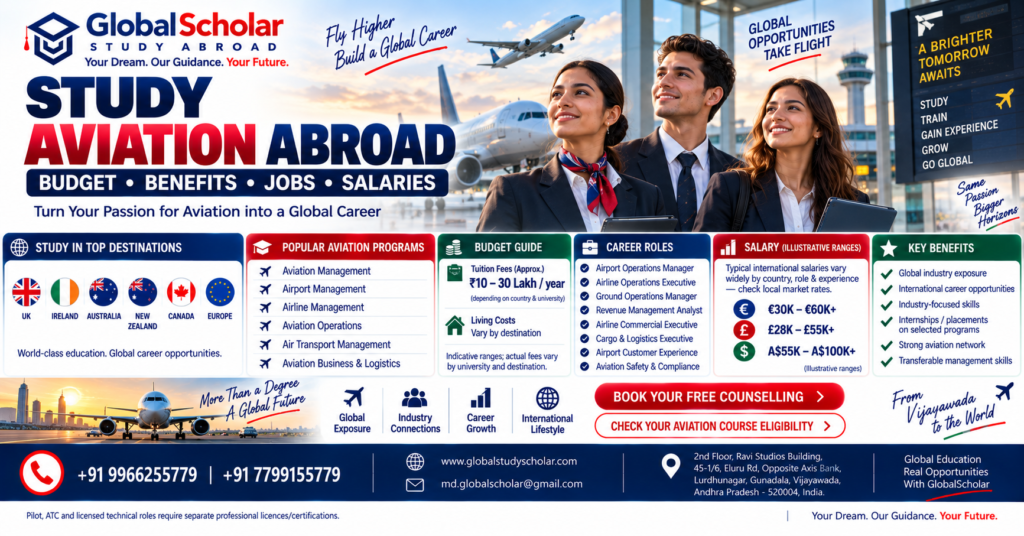
Aviation is a global industry connecting people, businesses and destinations across the world. If you are interested in airports, airlines, air transport, aviation operations, logistics or aviation business, studying aviation abroad can provide an international learning experience and exposure to different aviation markets. For Indian students, countries such as the UK, Ireland, Australia, New Zealand, Canada and selected European destinations offer aviation-related programmes covering areas such as aviation management, airport management, airline management, air transport management and aviation business. At GlobalScholar Study Abroad, Vijayawada, we help students explore suitable aviation courses abroad based on their academic background, budget, career goals and preferred destination. What Is Aviation Management? Aviation management combines aviation industry knowledge with business and management skills. Instead of focusing only on aircraft or technical engineering, aviation management programmes can cover areas such as: For example, current UK programmes listed through UCAS include subjects such as airport management, air cargo services, air transport operations, aviation finance, revenue management and airline strategy. Why Study Aviation Abroad? 1. Global Aviation Exposure Studying overseas can expose students to international airports, airlines, aviation regulations, passenger operations and global business practices. This can be valuable for students who want to build careers in international aviation environments. 2. Industry-Focused Education Many aviation programmes combine classroom learning with practical projects, industry interaction, case studies, field visits or placement opportunities. For example, some UK aviation courses advertise industry links, airport visits, guest lectures and work-related learning opportunities. 3. International Career Opportunities Aviation is an international industry, and aviation-management graduates can explore careers across airports, airlines, cargo companies, travel businesses, aviation consultancies and related organisations. 4. Transferable Management Skills Students can develop skills in: These skills can be useful beyond aviation as well. Popular Aviation Courses Abroad Students can choose from different aviation specialisations depending on their academic qualifications and career objectives. 1. Aviation Management A broad programme covering the management and business side of aviation. Possible subjects include: 2. Airport Management Airport management programmes focus on how airports operate efficiently and safely. Students may study: 3. Airline Management This pathway focuses more specifically on airline businesses. Possible areas include: The International Air Transport Association (IATA) also highlights management roles and competencies within airline management as an important career-development area. 4. Air Transport Management This option is particularly relevant for students interested in the wider air transportation industry. Courses can cover: For example, the University of Westminster currently offers an MSc in Air Transport Planning and Management covering management, operations and commercial planning within airlines, airports and aviation-related businesses. 5. Aviation Business & Logistics Students interested in aviation combined with logistics can explore programmes involving: Best Countries to Study Aviation Abroad The best destination depends on your academic profile, budget, preferred course and long-term career plans. 🇬🇧 UK The UK is one of the popular destinations for aviation and airport management programmes. Students can find bachelor’s and master’s programmes covering airline management, airport management, aviation management and air transport. Current UK course listings include programmes at institutions such as London Metropolitan University, University of West London, University of Surrey and other universities. Suitable for: 🇮🇪 Ireland Ireland can be considered by students interested in aviation, business, logistics and related fields. Students should check the individual university’s current programme availability, entry requirements and international student eligibility before applying. 🇦🇺 Australia Australia offers programmes across aviation, airport operations, aviation management and related areas. Students should compare tuition fees, living expenses, course structure and post-study options before choosing a university. 🇳🇿 New Zealand New Zealand can be considered for aviation-related education and management programmes, depending on the student’s academic background and preferred specialisation. 🇨🇦 Canada Canada offers education options in aviation management, airport operations, business and transportation-related fields. Students should carefully check the current eligibility and immigration rules for their chosen programme before making a decision. 🇪🇺 Europe Several European countries offer aviation, air transport, airport management, logistics and related programmes. The right destination depends on: Aviation Course Budget Abroad The flyer provides an indicative tuition range of approximately ₹10–30 lakh per year. However, students should understand that actual tuition fees can vary significantly depending on: For example, current UK aviation course listings show different fee structures between universities, demonstrating why students should check the specific university’s current international fee before budgeting. Your overall budget should include: Tuition Fees + Living Costs + Visa Costs + Insurance + Travel + Accommodation + Other Expenses At GlobalScholar, we can help students create a destination-specific budget before starting the application process. Aviation Course Eligibility Eligibility varies by university and programme. Bachelor’s / Undergraduate Generally, universities may consider: Some universities may also offer foundation-year routes for students who do not meet the direct undergraduate entry requirements. For example, London Metropolitan University offers an aviation-management degree with a foundation year. Master’s / Postgraduate Usually, students need: Requirements differ, so students should always check the specific course before applying. Career Opportunities After Aviation Management An aviation-management qualification can lead to various business and operational roles. Possible career paths include: Airport Operations Manager Responsible for coordinating airport operations and supporting efficient passenger and operational processes. Airline Operations Executive Works with airline operational activities and coordination. Ground Operations Manager Can be involved in ground-handling and airport-side operational activities. Revenue Management Analyst Works with pricing, demand and revenue-related analysis. Airline Commercial Executive Works in areas such as airline business development, commercial planning and strategy. Cargo & Logistics Executive Can work in air cargo, freight and aviation logistics. Airport Customer Experience Executive Focuses on passenger service and experience. Aviation Safety & Compliance Supports safety, compliance and operational standards, subject to the relevant qualifications and role requirements. Aviation Jobs & Salaries The flyer includes the following illustrative international salary ranges: Market Illustrative Range Europe €30K – €60K+ UK £28K – £55K+ Australia A$55K – A$100K+ These should not be treated as guaranteed starting salaries. Actual salaries can vary substantially depending on: Students should check current local salary data when evaluating a specific career. Key Benefits of Studying Aviation Abroad 🌍