
Master’s in Aviation in the UK 2026 | Courses, Fees, Jobs & Salaries
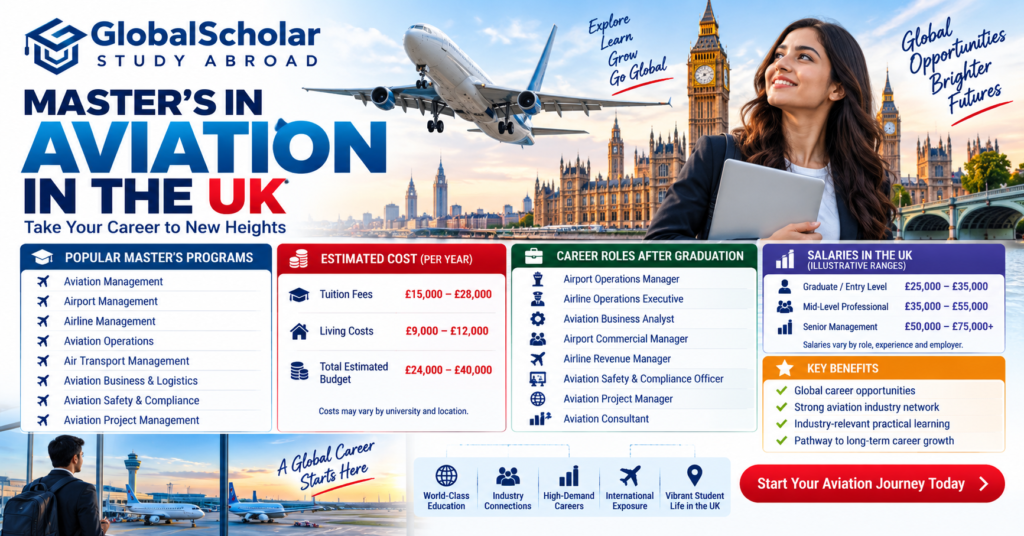
Master’s in Aviation in the UK 2026 The aviation industry offers career opportunities far beyond becoming a pilot. Airports, airlines, cargo companies, aviation consultancies and air transport organisations require professionals who understand operations, management, commercial strategy, safety, logistics and business development. For graduates interested in this side of the industry, studying a Master’s in Aviation in the UK can provide an opportunity to develop advanced business and aviation knowledge in one of the world’s major aviation markets. UK postgraduate options include programmes in Aviation Management, Air Transport Management, Aviation Operations and Management, Airport Management and International Tourism & Aviation Management. Current 2026 listings include one-year and longer postgraduate options, depending on the university and study mode. GlobalScholar Study Abroad, Vijayawada helps Indian students explore suitable UK aviation programmes according to their academic background, budget and career objectives. What Is a Master’s in Aviation? A Master’s in Aviation is a postgraduate qualification focusing on the management, operational and commercial aspects of the aviation industry. Depending on the university, students may study: For example, current UK aviation programmes cover areas such as airline operations, airport management, aviation law, safety regulations, finance, marketing, project management and aviation analytics. Why Study Aviation in the UK? 1. International Aviation Environment The UK has a well-established aviation ecosystem involving airports, airlines, logistics companies, regulators, consultancies and related businesses. Students can study aviation from an international perspective and understand how different parts of the air transport industry operate. 2. One-Year Master’s Options Many UK postgraduate programmes can be completed in approximately one year, although the duration varies by university and programme. For example, the University of Surrey currently lists its MSc Air Transport Management as a one-year full-time programme for 2026/27. Buckinghamshire New University also lists a one-year full-time MSc in Aviation Operations and Management. Other programmes, particularly those including internships or specific study structures, may take longer. 3. Industry-Focused Learning Aviation programmes can include: For example, Coventry University’s aviation-management programme highlights simulations, industry data and projects, while BNU’s aviation programme includes practical learning, case studies and real-world projects. 4. Global Career Perspective Aviation is an international industry. Skills developed through aviation management can potentially be relevant to airports, airlines, cargo operations, aviation consultancies and other air-transport organisations. Popular Master’s Programmes in Aviation Students do not necessarily need to choose a programme with exactly the title “Master’s in Aviation.” MSc Aviation Management Focuses on the business and management side of aviation. MSc Air Transport Management Focuses on the wider air transport industry, including airline and airport management, commercial planning and strategy. The University of Surrey’s current MSc Air Transport Management, for example, focuses on specialist knowledge and skills for the evolving air-transport business and provides exposure to commercial aviation-analysis tools. MSc Aviation Operations and Management Combines aviation operations with strategic and leadership skills. BNU’s 2026 programme is designed around aviation operations, management and leadership and is offered as a one-year full-time distance-learning MSc. Airport Management Suitable for students interested in: Airline Management Can cover: International Tourism & Aviation Management Combines aviation with tourism and service-industry management. The University of West London currently lists a 2026/27 postgraduate programme in International Tourism and Aviation Management, including an option with an internship. Estimated Cost of Studying Aviation in the UK The flyer provides an indicative annual budget of: Expense Indicative Amount Tuition fees £15,000 – £28,000 Living costs £9,000 – £12,000 Total estimated budget £24,000 – £40,000 These figures should be treated as planning estimates, not fixed UK-wide costs. Actual costs depend on: For example, published 2026/27 international fees vary between UK aviation-related programmes. University College Birmingham lists an international fee of £17,500 for its MSc Aviation Management, while other universities have different fee structures. Your actual budget should include: Tuition + Accommodation + Food + Transport + Visa Costs + Travel + Insurance/health-related costs + Personal Expenses Students should obtain the latest fee information directly from their chosen university before making financial plans. Master’s in Aviation UK Eligibility Entry requirements vary between universities. A typical postgraduate applicant may need: For example, University College Birmingham currently lists a 2:2 degree or international equivalent for its MSc Aviation Management, while some programmes may have different academic requirements or consider relevant professional experience. Some specialised programmes may also have additional requirements. Always check the exact entry criteria for your chosen university. English Language Requirements International students normally need to satisfy the university’s English-language requirement. The accepted test and required score can vary by university and course. For example, the University of West London’s 2026 International Tourism and Aviation Management listing specifies IELTS 6.5 or above, with 6.5 in each component, for international applicants. Students should therefore avoid assuming that the same IELTS requirement applies to every UK aviation programme. Career Opportunities After a Master’s in Aviation A Master’s in Aviation or Aviation Management can prepare graduates for a range of aviation-related business and operational roles. Airport Operations Manager Responsible for supporting and coordinating airport operational activities. Airline Operations Executive Works with airline operational processes, coordination and planning. Aviation Business Analyst Analyses operational and commercial information to support aviation-business decisions. Airport Commercial Manager Works with commercial activities, business development and revenue-related areas within an airport. Airline Revenue Manager Works with demand, pricing, revenue and commercial analysis. Aviation Project Manager Manages projects involving airports, airlines, aviation businesses or related organisations. Aviation Safety & Compliance Officer Works on safety, compliance and regulatory requirements, subject to the relevant role-specific qualifications. Aviation Consultant Provides research, analysis and strategic advice to aviation organisations. Aviation Jobs in the UK The aviation sector includes opportunities across: The University of Westminster’s Air Transport Planning and Management programme, for example, identifies potential career areas across airlines, airports, government departments and aviation-related businesses such as aircraft manufacturing, finance and consultancy. Aviation Salaries in the UK The flyer provides the following illustrative salary ranges: Career Level Illustrative Salary Graduate / Entry Level £25,000 – £35,000 Mid-Level Professional £35,000 – £55,000 Senior Management £50,000 – £75,000+ These figures are illustrative only and are not
Master’s in Aviation Management in the UK 2026 | Courses, Jobs & Salaries
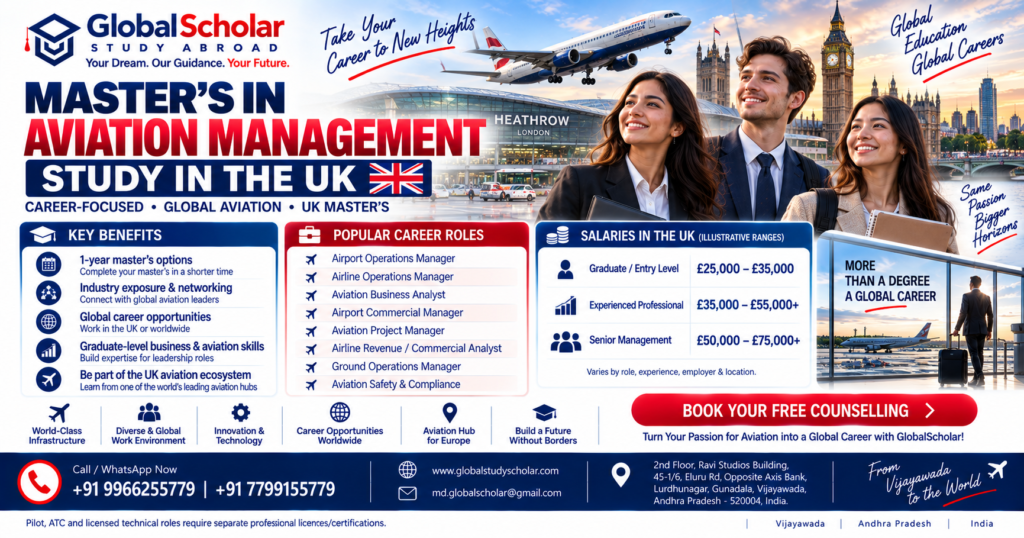
Master’s in Aviation Management in the UK 2026 The aviation industry is much more than flying aircraft. Behind every airport, airline and air transport network are thousands of professionals managing operations, commercial strategy, passenger services, logistics, safety, revenue and business development. For graduates interested in combining aviation with management and business, a Master’s in Aviation Management in the UK can be an attractive postgraduate study option. The UK has a long-established aviation sector and offers postgraduate programmes covering areas such as aviation management, air transport management and international tourism and aviation management. Current 2026/27 course listings include programmes at universities such as Teesside University, University College Birmingham, Coventry University and the University of Westminster. GlobalScholar Study Abroad, Vijayawada helps students explore suitable UK universities and aviation-management programmes based on their academic background, budget and career goals. What Is a Master’s in Aviation Management? A Master’s in Aviation Management is a postgraduate programme designed for students who want to understand the business, operational and strategic side of aviation. Depending on the university, the curriculum may cover: For example, the University of Westminster’s MSc Air Transport Planning and Management is designed around management, operations and commercial planning within airlines, airports, government departments and aviation-related businesses. Why Study Aviation Management in the UK? 1. One-Year Master’s Options One of the major attractions for international students is that many UK master’s programmes can be completed in one year. For example: This can allow students to gain a postgraduate qualification in a relatively short period compared with some other international destinations. 2. Aviation Industry Exposure The UK has a significant aviation ecosystem, with major airports, airlines, aviation businesses, logistics companies and related service providers. A UK aviation-management course can give students opportunities to study real-world aviation challenges through: For example, University College Birmingham’s MSc Aviation Management includes an international live industry project and an optional work-placement component. 3. Global Career Perspective Aviation is inherently international. Professionals may work with organisations operating across multiple countries, making knowledge of international aviation markets, business strategy and operations particularly relevant. Popular Master’s Courses in Aviation Students don’t have to choose a programme literally called “MSc Aviation Management.” Related programmes include: MSc Aviation Management Focuses on management and business within the aviation industry. MSc Air Transport Management Focuses on the wider air transportation system, including airlines, airports, policy, sustainability and commercial operations. Coventry University currently offers an MSc Air Transport Management with a professional-placement option. MSc Airport Management Focuses on airport operations, passenger services, commercial activities and airport strategy. MA/MSc International Tourism and Aviation Management Combines aviation with tourism and destination management. Aviation Business Management Suitable for students interested in the commercial and strategic side of aviation. Aviation Engineering and Management A more technical pathway combining aviation engineering with management. This is different from a purely business-focused aviation-management master’s. UK Universities Offering Aviation-Related Master’s Courses Course availability, fees and intakes change, so students should verify the latest information directly with the university. Some current examples include: Teesside University MSc Aviation Management For 2026/27, Teesside lists an international tuition fee of £17,000 and a January or September start. University College Birmingham MSc Aviation Management For 2026/27, the listed international tuition fee is £17,500. The programme includes optional placement opportunities and an international live industry project. Coventry University MSc Air Transport Management The 2026/27 programme is available as a one-year full-time course, with an option extending to two years with professional placement. University of Westminster MSc Air Transport Planning and Management The 2026/27 listing shows a one-year full-time option with an international fee of £18,000. Sheffield Hallam University MSc International Tourism and Aviation Management The 2026/27 international fee for the standard full-time programme is listed at £18,600. These figures demonstrate why students should compare universities rather than assuming that every UK aviation master’s has the same tuition fee. Tuition Fees for Aviation Management in the UK The flyer highlights UK aviation-management master’s programmes as a career-focused postgraduate option. For 2026/27, examples of published international tuition fees include: University Programme Indicative International Fee Teesside University MSc Aviation Management £17,000 University College Birmingham MSc Aviation Management £17,500 University of Westminster MSc Air Transport Planning & Management £18,000 Sheffield Hallam University MSc International Tourism & Aviation Management £18,600 Important: Fees are university- and programme-specific and can change for future intakes. Students should also budget for: Eligibility for a Master’s in Aviation Management Eligibility depends on the university and programme. Many UK aviation-management master’s courses expect applicants to hold a recognised bachelor’s degree. For example, University College Birmingham states that its MSc Aviation Management normally requires a 2:2 degree classification or international equivalent, while also considering certain applicants with relevant managerial experience. Sheffield Hallam’s MSc International Tourism and Aviation Management normally requires an honours degree at 2:2 or equivalent, although it may consider applicants with substantial management experience in some circumstances. Typical application documents may include: Requirements vary, so students should check the exact university requirements before applying. English Language Requirements International students normally need to demonstrate their English-language ability according to the university and UK visa requirements. Some universities may accept IELTS or other approved evidence, while individual institutions may have their own accepted alternatives. For a UK Student visa, degree-level study generally requires English ability equivalent to CEFR B2, although a Higher Education Provider may assess English itself in permitted circumstances. Therefore, students should not assume that one English-test rule applies to every university. Career Opportunities After Aviation Management A Master’s in Aviation Management can prepare students for business and operational roles across the aviation sector. Potential career areas include: ✈️ Airport Operations Manager Responsible for coordinating airport operational activities. ✈️ Airline Operations Manager Works with airline operational planning and coordination. 📊 Aviation Business Analyst Analyses business, operational and commercial information to support decision-making. 🏢 Airport Commercial Manager Works with commercial activities and revenue-generating areas within an airport. 📋 Aviation Project Manager Manages projects involving aviation businesses, airports, airlines or related organisations. 💰 Airline Revenue / Commercial Analyst Works with revenue, demand, pricing