
MSc Psychology in the UK 2026: Course, Eligibility, Careers & Study Guide
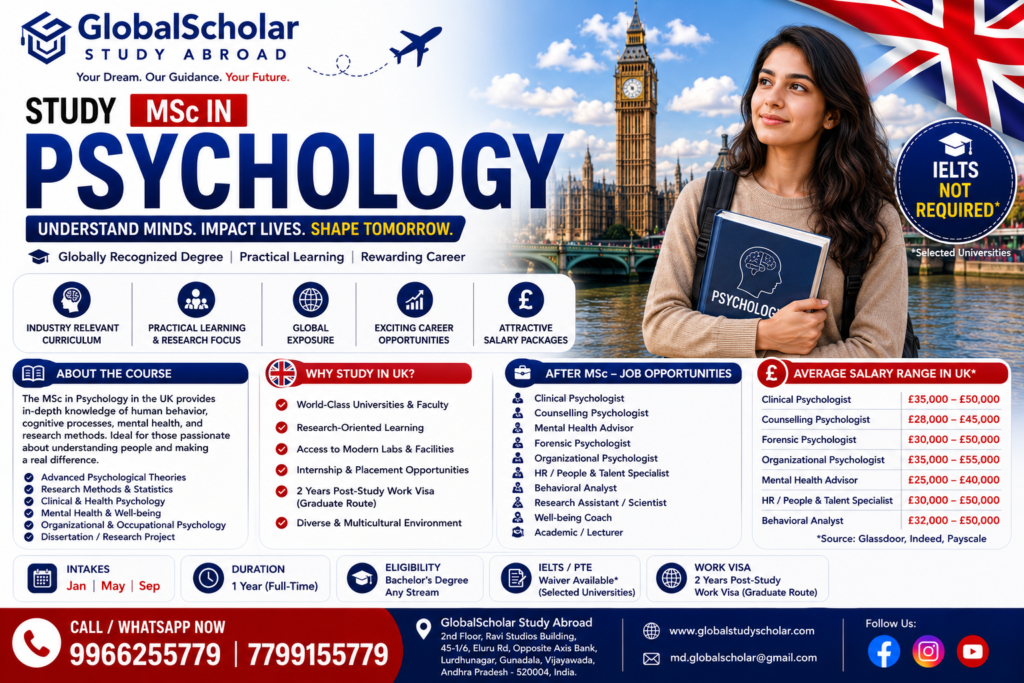
If you are interested in understanding human behaviour, mental health, cognitive processes and psychological research, studying an MSc Psychology in the UK can be a valuable postgraduate option. UK universities offer psychology programmes covering areas such as research methods, mental health, organisational psychology, health psychology and behavioural science. For international students, a Psychology Master’s in the UK can provide exposure to research-led teaching, modern academic facilities and a multicultural learning environment. GlobalScholar Study Abroad, Vijayawada helps students explore suitable UK universities, understand eligibility, prepare applications and receive guidance throughout the admission and visa process. Why Study MSc Psychology in the UK? The UK has a well-established higher education sector and offers postgraduate psychology programmes with different academic and career specialisations. Key advantages include: An MSc Psychology in the UK can be particularly useful for students who want to develop their understanding of psychological theory while gaining experience in research, statistics and evidence-based approaches. What Is an MSc Psychology? An MSc Psychology is a postgraduate degree designed to provide advanced knowledge of psychology and related areas. Depending on the university and programme, students may study topics such as: The exact modules differ between universities, so students should always check the curriculum and professional accreditation before applying. MSc Psychology UK – Course Duration Many UK universities offer psychology Master’s programmes that can be completed in one year of full-time study. The flyer for this programme highlights: Duration: 1 Year – Full-TimeIntakes: January | May | September However, available intakes and course duration vary by university. Some universities may offer only September entry, while others may have January or additional intakes. Students should check the current university intake before submitting an application. MSc Psychology UK Eligibility A common entry route is a recognised Bachelor’s degree. The exact academic requirements depend on the university and the specific psychology programme. Typical requirements may include: Some psychology Master’s programmes may accept students from related or different academic backgrounds, while others require a psychology degree or specific prerequisite subjects. Therefore, “Bachelor’s degree in any stream” should not be treated as universal eligibility. GlobalScholar can check the requirements of individual universities before application. IELTS Requirement for MSc Psychology in the UK The flyer highlights “IELTS Not Required – Selected Universities.” This should be understood as university- and applicant-specific, rather than a blanket rule. For UK Student visa purposes, degree-level students generally need to demonstrate English at CEFR B2, although a Higher Education Provider may assess English itself in qualifying circumstances. Students may also be able to prove English through an eligible degree taught in English or an approved English-language test. So, if you are searching for: MSc Psychology UK without IELTSorPsychology Master’s in UK without IELTS the correct approach is to check whether your chosen university accepts your previous English-medium education or another approved method of demonstrating English proficiency. MSc Psychology UK Curriculum The curriculum varies between universities, but students may encounter subjects such as: 1. Advanced Psychological Theories Students explore major psychological theories and contemporary developments in psychology. 2. Research Methods Research methodology is an important part of postgraduate psychology education. Students learn how to design, evaluate and interpret psychological research. 3. Statistics Psychology involves significant use of quantitative and qualitative research methods. Students may develop skills in analysing and interpreting research data. 4. Clinical & Health Psychology Some programmes introduce students to psychological factors associated with health, illness and wellbeing. 5. Mental Health & Wellbeing Students can explore psychological perspectives on mental health, wellbeing and behavioural development. 6. Organisational & Occupational Psychology This area examines behaviour in workplace environments, including employee wellbeing, motivation, leadership and organisational behaviour. 7. Dissertation / Research Project Many Master’s programmes include an independent research project where students investigate a specific psychological question using appropriate research methods. Career Opportunities After MSc Psychology in the UK An MSc Psychology can support careers across several areas depending on your previous qualification, experience, specialisation and professional accreditation. Possible career areas include: The flyer also highlights roles such as Clinical Psychologist, Counselling Psychologist and Forensic Psychologist. However, an important distinction is necessary: a general MSc Psychology does not automatically qualify a graduate to work as a UK Clinical Psychologist or Counselling Psychologist. These are regulated/protected professional titles with specific training and registration requirements. For example, the UK route to becoming a Clinical Psychologist normally involves professional doctoral-level training. Therefore, students who specifically want to become a Clinical Psychologist in the UK should choose their academic pathway carefully and check HCPC/BPS requirements before enrolling. Psychology Careers in the UK Psychology graduates can explore opportunities in several sectors. Mental Health Graduates may pursue support, research or related roles in mental health services, depending on their qualifications and experience. Human Resources Psychology provides useful knowledge of behaviour, motivation, communication and workplace relationships, making it relevant to HR and people-management careers. Organisational Psychology Students interested in workplace behaviour can explore organisational and occupational psychology pathways. Research Students with strong research and analytical skills can explore research assistant, research coordinator and related positions. Education Psychology knowledge can also be useful in educational support, student wellbeing and behavioural-development environments, subject to the role’s specific requirements. Behavioural Science Behavioural science is another area where psychology graduates can apply research, analytical and behavioural knowledge. Can I Work While Studying MSc Psychology in the UK? Eligible international students studying a full-time degree-level course at a qualifying higher education provider can generally work up to 20 hours per week during term time and full-time outside term time, subject to their Student visa conditions. Students should always check the work conditions attached to their individual visa. Working while studying can help students gain experience and manage some living expenses, but students should not rely on part-time work as their primary source of funding for tuition and living costs. UK Graduate Route After MSc Psychology The UK Graduate Route can allow eligible international students to stay in the UK after successfully completing an eligible course. However, the rules have changed. For applications made on or before 31