Study in Italy Without IELTS 2026: MOI, Courses, Eligibility & Admission Guide
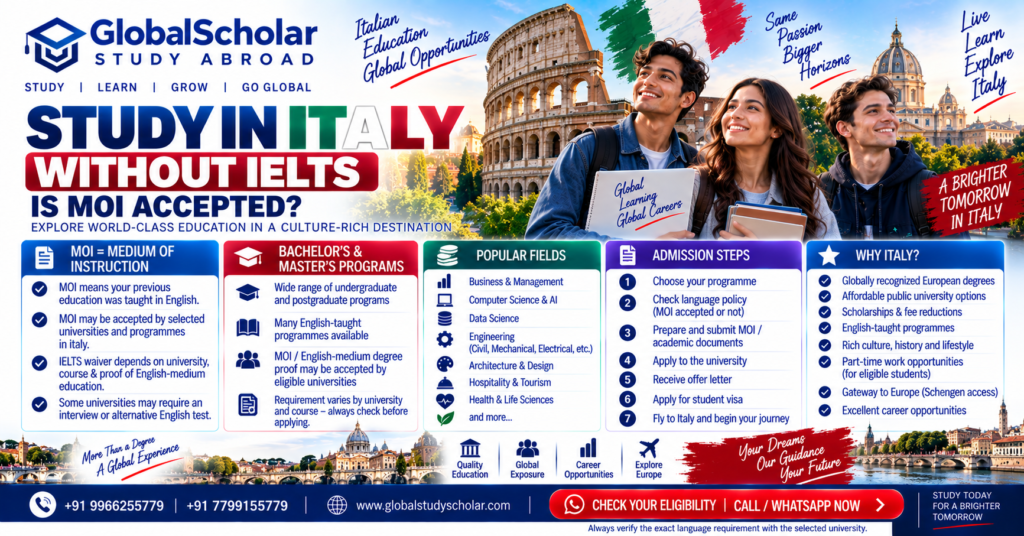
Study in Italy Without IELTS is a popular search topic among Indian students planning to pursue higher education in Europe. Some Italian universities and programs may accept alternative evidence of English proficiency, including proof that previous education was taught in English, but IELTS is not automatically waived across all Italian universities or courses. The exact language requirement depends on the university, program and level of study. Italian higher-education institutions are responsible for verifying language proficiency according to the language in which the chosen course is delivered. This guide explains how MOI (Medium of Instruction) can work, what students should check, popular courses, admission steps, scholarships and the Italy student visa process for 2026. What Does “Study in Italy Without IELTS” Mean? “Without IELTS” does not mean that every student can study in Italy without proving English proficiency. Instead, it can mean that a particular university or program accepts an alternative form of English-language evidence instead of an IELTS certificate. One possible form of evidence is an MOI certificate. MOI means Medium of Instruction An MOI certificate generally confirms that your previous education was conducted in English. For example, a student who completed their Bachelor’s degree through English-medium instruction may be able to submit documentation confirming this, if the selected university accepts it. The university may still ask for another form of language assessment, interview or recognized language certificate. Therefore, students should always confirm the university’s current language policy before applying. Is IELTS Mandatory for Italy? There is no single IELTS rule that applies to every Italian university and every course. Universitaly states that higher-education institutions determine entry requirements for individual programs, including language skills according to the language of the course. For an English-taught program, the university may require evidence of English proficiency. Depending on the institution, acceptable evidence may include: The important point is that acceptance of MOI is university- and course-specific. Can Indian Students Study in Italy Without IELTS Using MOI? In some cases, an Indian student may be able to use an English-medium education certificate/MOI if the selected university and program accept it. The process can look like this: Previous English-medium education → MOI certificate → University assessment → Admission decision However, MOI acceptance should be confirmed before submitting the application. Students should check: This is important because university admission requirements and visa requirements are separate considerations. MOI for Italy: What Is It? An MOI – Medium of Instruction certificate is a document issued by an educational institution confirming the language used for teaching a student’s previous qualification. A typical MOI may mention: The medium of instruction for the student’s program was English. The exact wording and format can vary. Students should obtain an official document from their previous institution and check whether the Italian university accepts it. Bachelor’s and Master’s Programs in Italy The flyer highlights Bachelor’s and Master’s study options. Bachelor’s Programs Students who have completed their required secondary education can explore first-cycle Bachelor’s programs. Universitaly describes first-cycle Bachelor’s programs as generally three years, although some single-cycle programs, such as certain professional disciplines, have longer durations. Possible fields include: Master’s Programs Students who already hold a Bachelor’s degree can explore second-cycle Master’s programs. Universitaly generally describes second-cycle Master’s programs as two years. Popular fields include: The specific academic background required depends on the university and program. Popular Courses to Study in Italy Without IELTS 1. Business & Management Business programs may include: Students should check whether the selected course is taught entirely in English and what language evidence is required. 2. Computer Science & Artificial Intelligence Technology programs can include: These programs may be suitable for students with relevant academic backgrounds and an interest in technology careers. 3. Data Science Data-focused programs may cover: Admission requirements vary according to the curriculum and academic prerequisites. 4. Engineering Italy offers programs across engineering disciplines such as: Some programs can have specific mathematics, science or subject requirements. 5. Architecture & Design Students can explore: Some architecture and design programs may have entrance examinations, portfolios or other selection procedures. 6. Hospitality & Tourism Italy can also be considered by students interested in: The language and admission requirements depend on the selected institution. 7. Health & Life Sciences Possible areas include: Some health programs are regulated or have limited places and may involve specific admission tests. How MOI-Based Admission Works If you want to study in Italy without IELTS using MOI, follow a careful process. Step 1: Select an English-Taught Program Start by identifying an English-taught course that matches your academic background. Step 2: Check the University’s Language Policy Look specifically for information about: Step 3: Obtain Your MOI Request an official Medium of Instruction certificate from your previous educational institution. Step 4: Submit Your Academic Documents Depending on the university, this may include: Step 5: Complete Any Interview or Assessment Some universities may conduct an interview or another English-language assessment. Step 6: Receive the Admission Decision The university evaluates your academic and language documentation. Step 7: Complete the Required Pre-Enrolment Process For visa-required Bachelor’s and Master’s applicants, pre-enrolment is handled through the Universitaly portal after the relevant university process. Step 8: Apply for the Student Visa After the applicable pre-enrolment validation, students can proceed with the visa application process. Important: MOI Does Not Automatically Guarantee a Visa This is one of the most important points for students considering Italy without IELTS. Even if a university accepts your MOI and grants admission, this does not automatically guarantee a student visa. The current Italian international-student procedures state that the final decision on a study visa belongs to the competent diplomatic-consular authority. University validation or pre-enrolment does not constitute a guarantee of visa issuance. Students should therefore prepare all required visa documentation carefully. Italy Admission Requirements Requirements vary by university and course. Common documents can include: Universitaly confirms that individual institutions can set requirements relating to previous qualifications, subjects, grades, admission tests, interviews and language skills. Italy Tuition Fees There is no single tuition fee for all Italian universities. Fees can
Study in Italy 2026: Courses, Fees, Scholarships & Admission Guide
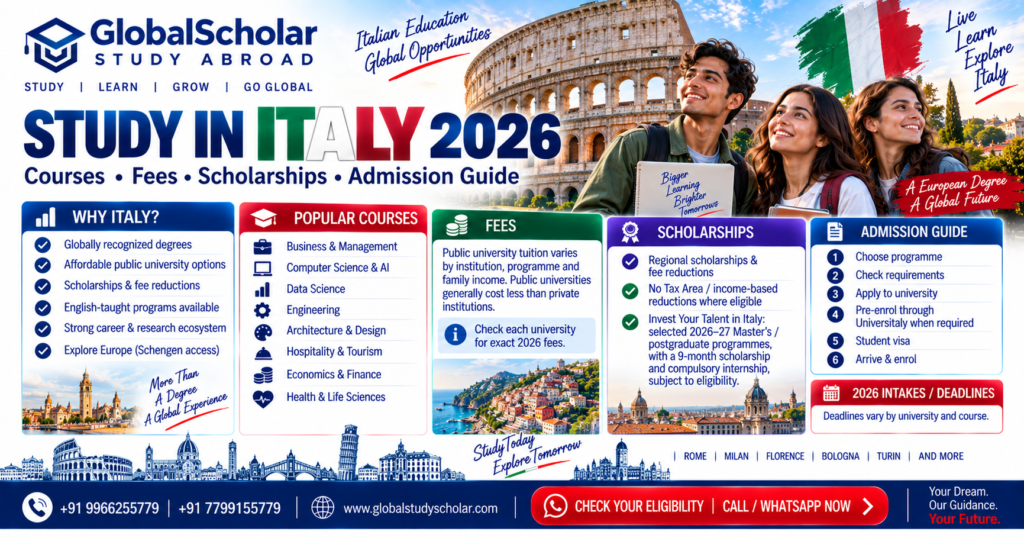
Study in Italy 2026 is an attractive option for international students looking for European higher education, internationally oriented programs and scholarship or tuition-reduction opportunities. Italy offers public and private universities across fields such as business, computer science, artificial intelligence, data science, engineering, architecture, hospitality, finance and health sciences. For students from India, the application process requires careful planning because admission requirements, tuition fees, scholarship eligibility and visa procedures can vary by university and course. This guide explains the major points students should know before planning to study in Italy in 2026. Why Study in Italy? Italy combines a long-established higher education system with universities and institutions across many academic disciplines. The official Universitaly portal allows students to search courses, compare institutions and access information about admission, tuition fees, scholarships and entry procedures. 1. Recognized European Education Italian universities offer Bachelor’s, Master’s, single-cycle and doctoral programs across a wide range of subjects. A standard first-cycle Bachelor’s degree generally lasts three years, while a second-cycle Master’s degree generally lasts two years. Some single-cycle programs have longer durations, such as five or six years. 2. Public University Options Italy has a large public university sector. Public universities generally have different fee structures from private institutions, and tuition can depend on factors such as the institution, degree program and family-income information. This makes it important to evaluate the actual fee structure of each university rather than assuming one fixed tuition amount for all students. 3. Scholarships and Fee Reductions International students may find several forms of financial support, including: Universitaly notes that regional bodies and higher-education institutions offer scholarships and benefits subject to their respective eligibility requirements. International students may need an ISEE-equivalent assessment (ISEE Parificato) for certain income-based benefits. 4. English-Taught Programs Students can find English-taught programs in areas such as: However, the language of instruction and required English or Italian proficiency must be checked for each individual course. 5. European Student Experience Studying in Italy gives students an opportunity to experience Italian culture, cities, history and a wider European environment while completing their higher education. Popular Courses to Study in Italy The GlobalScholar flyer highlights several popular academic areas. Business & Management Business-related programs can include: These courses can prepare students for careers in management, consulting, business development, marketing and related fields. Computer Science & Artificial Intelligence Technology-focused programs can include: Students interested in technology should compare the curriculum, programming requirements, specialization and practical components of each course. Data Science Data-focused programs may cover: These programs can be relevant for students planning careers in technology, analytics and data-driven business roles. Engineering Italy offers engineering programs across multiple disciplines, including: Admission requirements vary according to the university and program. Architecture & Design Students interested in creative and technical disciplines can explore: Some programs may have portfolios, entrance tests or other specific admission requirements. Hospitality & Tourism Italy is also an important destination to consider for students interested in: The exact programs and entry requirements differ by institution. Economics & Finance Students can explore programs in: Health & Life Sciences Depending on academic background and admission requirements, students can explore areas such as: Some health programs, particularly regulated or limited-enrolment courses, have additional admission procedures. Italy Tuition Fees 2026 One of the most important points when planning to study in Italy is that there is no single nationwide tuition fee for all international students. According to the official Study in Italy information, tuition at Italian universities depends on several factors, including whether the institution is public or private, the degree course and declared family income. Some universities also provide exemptions or reductions under their own rules. Public Universities Public university fees can be influenced by: Private Universities Private institutions generally have their own fee structures, which can differ considerably from public universities. Therefore, students should obtain the exact 2026/27 fee information from their selected university and program before making financial decisions. Scholarships to Study in Italy Scholarships are an important part of the Italy study-abroad process. Students may find funding through regional authorities, universities and the Italian government. Regional Scholarships Italian regions have organizations responsible for student welfare and financial support. Depending on the region and scholarship scheme, support can involve financial assistance and other student benefits. Eligibility conditions vary. University Scholarships Individual universities may offer: The conditions and application deadlines are university-specific. MAECI Scholarships The Italian Ministry of Foreign Affairs and International Cooperation (MAECI) also offers scholarships for eligible foreign students and Italian citizens residing abroad under its annual calls. For the 2026/27 call, the official Study in Italy information specifies eligible study categories and scholarship conditions. Applying for a MAECI scholarship is separate from applying for university admission. Students should always check the current official call for: No Tax Area and Tuition Reductions Some Italian universities and regional systems provide tuition reductions or exemptions based on family economic circumstances. Universitaly describes the No Tax Area as a mechanism through which eligible students from lower-income households can receive reductions or, depending on the applicable rules, potentially have university fees reduced to zero. International students may need an ISEE Parificato or other documentation to establish their economic circumstances. This means students should not assume that every international student automatically receives free tuition. Eligibility and documentation requirements apply. Eligibility to Study in Italy Admission requirements depend on the university, course and level of study. Bachelor’s Degree Students applying for a first-cycle program generally need a secondary-school qualification that is comparable to the qualification required for entry into higher education in Italy. Universitaly states that higher education institutions establish specific requirements, which can include previous qualifications, subjects and grades, admission tests, interviews and language skills. Typical Documents Students may be asked for: Master’s Degree Students normally need a relevant Bachelor’s degree or comparable qualification. Depending on the course, universities may assess: Some programs may require an interview or entrance assessment. English Language Requirements The language requirement depends on the language of instruction. For an English-taught program, the university may require evidence of English proficiency. For