
LLM in the UK 2026: Courses, Eligibility, Specialisations, Careers & Study Guide
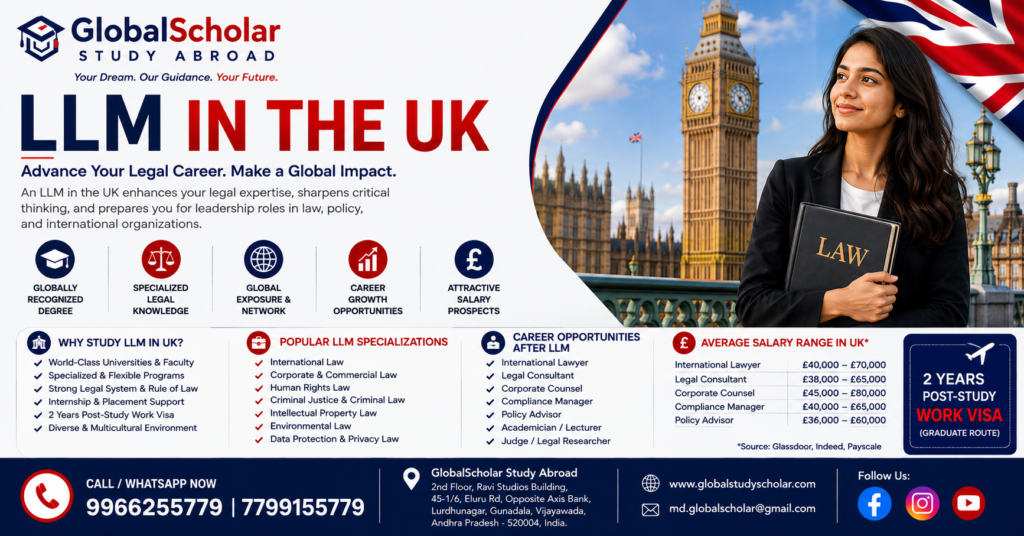
An LLM in the UK is a popular postgraduate option for law graduates who want to develop specialist legal knowledge, gain international exposure and explore career opportunities in areas such as international law, corporate law, human rights, intellectual property, commercial law and data protection. The UK has a long-established legal education system and offers a wide range of LLM courses in the UK for domestic and international students. Depending on the university, students can choose general LLM programmes or specialise in a particular area of law. For students from Vijayawada, Andhra Pradesh and across India, GlobalScholar Study Abroad can assist with university selection, application preparation, admission guidance and UK study planning. What Is an LLM in the UK? LLM stands for Master of Laws. It is a postgraduate-level law qualification designed for students who want to develop advanced knowledge in a particular legal subject or broaden their understanding of law. An LLM in the UK can be useful for: The exact purpose and professional value of an LLM depends on the course and the student’s career objective. Why Study LLM in the UK? The UK is an attractive destination for postgraduate law education because students can choose from a broad range of legal specialisations and university programmes. Key advantages include: For students searching for LLM courses in the UK, the most important consideration should be whether the course matches their previous legal education and long-term career plans. Popular LLM Specialisations in the UK The GlobalScholar LLM flyer highlights several popular areas of specialisation. 1. International Law International Law focuses on legal relationships between countries, international organisations and individuals. Students may explore areas such as: This can be relevant to students interested in international organisations, policy, legal research and cross-border legal work. 2. Corporate & Commercial Law Corporate and Commercial Law focuses on legal issues involving businesses and commercial transactions. Topics may include: This specialisation can be useful for students interested in corporate legal departments, law firms and compliance-related careers. 3. Human Rights Law Human Rights Law examines legal protections and fundamental rights at national and international levels. Students can explore topics involving: 4. Criminal Justice & Criminal Law This area examines legal principles relating to criminal offences, criminal procedure and the administration of justice. Students interested in criminal justice, legal research and policy may find this specialisation relevant. 5. Intellectual Property Law Intellectual Property Law deals with the protection of creations and innovations. It can cover: The specialisation can be particularly relevant to businesses operating in technology, media, entertainment and innovation. 6. Environmental Law Environmental Law focuses on legal frameworks relating to environmental protection and sustainability. Students may study: 7. Data Protection & Privacy Law With organisations collecting and processing increasing amounts of personal information, privacy and data protection have become important legal areas. Students can explore: LLM UK Course Duration The duration of an LLM in the UK varies depending on the university and study mode. Many full-time LLM programmes are completed in one year, although some programmes may have different structures. Students should check: before applying. LLM UK Eligibility Eligibility varies between universities and individual programmes. A common route is a Bachelor’s degree in Law or a related qualification. However, some LLM programmes may consider applicants with different academic backgrounds or relevant professional qualifications. For example, the University of Portsmouth’s LLM Law entry requirements for September 2026/January 2027 include a second-class honours degree or equivalent professional experience/qualifications, with international qualifications assessed for UK equivalence. Typical application requirements may include: Important: An LLM should not be advertised as universally open to graduates from every stream. Eligibility is university-specific. Can I Study LLM in the UK Without IELTS? Some universities may accept alternative evidence of English proficiency or provide exemptions in specific circumstances. However, IELTS is not universally waived for every LLM applicant. For example, one current UK LLM programme lists IELTS 6.5 with no component below 5.5, while also specifying circumstances in which IELTS or an equivalent certificate is not required. Therefore, students searching for: LLM UK without IELTSLLM in UK without IELTSLLM courses in UK without IELTS should have their individual academic and English-language background checked against the selected university’s requirements. LLM in the UK for Indian Students An LLM in the UK for Indian students can be an option for graduates who want international legal education and exposure to different legal systems. Before choosing an LLM, Indian students should consider: An LLM can strengthen specialist knowledge, but an LLM alone does not automatically qualify an international graduate to practise as a lawyer in the UK. Career Opportunities After LLM in the UK The GlobalScholar flyer highlights several potential career areas. International Lawyer Graduates with an international law specialisation may explore roles involving cross-border legal matters, international organisations, policy and legal research. Legal Consultant Legal consultants provide specialist legal or regulatory knowledge depending on their role and qualifications. Corporate Counsel Corporate legal teams advise organisations on legal and regulatory matters. Compliance Manager Compliance professionals help organisations understand and follow relevant laws, regulations and internal policies. Policy Advisor Policy professionals research legislation, regulation and public policy and help organisations develop appropriate responses. Legal Researcher Legal researchers investigate legislation, case law, legal principles and academic materials. Academic / Lecturer Students interested in academia can pursue further research and teaching pathways, subject to the relevant academic and institutional requirements. Important: Does an LLM Make You a Solicitor in the UK? No. An LLM is a postgraduate academic qualification. It is not, by itself, a licence to practise as a solicitor or barrister. For someone seeking qualification as a solicitor of England and Wales through the SQE route, the SRA currently requires: The SRA states that QWE can include relevant legal work such as paralegal work, placements and pro bono legal work, provided the requirements are met. Therefore, students should decide whether their goal is: LLM for specialisation and academic development or professional qualification to practise law in England and Wales. These are related but different pathways. Can Indian Lawyers Work
MSc Artificial Intelligence in the UK 2026: Course, Eligibility, Careers & Study Guide
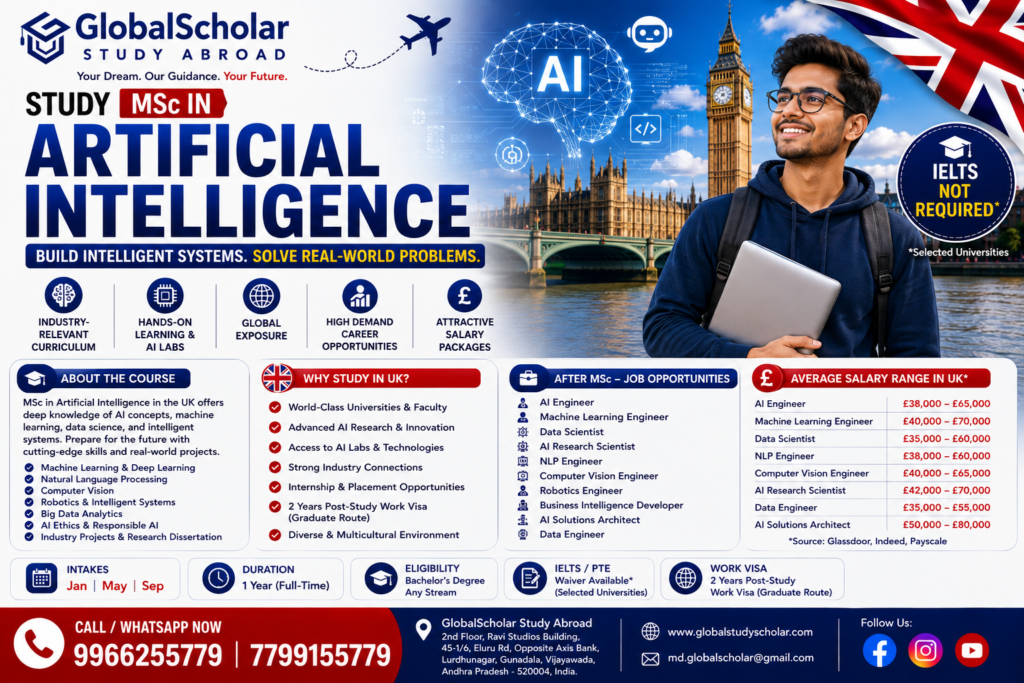
Artificial Intelligence is transforming industries ranging from technology and finance to healthcare, manufacturing, retail and professional services. For students looking to build advanced technical skills, an MSc Artificial Intelligence in the UK can provide an opportunity to study machine learning, deep learning, data science, natural language processing and intelligent systems. A Master’s in Artificial Intelligence UK can be particularly suitable for graduates who want to develop specialist knowledge and prepare for careers in AI engineering, machine learning, data science, computer vision, robotics and related fields. The UK is also actively assessing AI skills shortages and future workforce requirements. A 2026 UK government-supported AI labour-market survey reported significant skills gaps among surveyed organisations, while projections indicate substantial growth in AI-related employment through 2035. For students from Vijayawada, Andhra Pradesh and across India, GlobalScholar Study Abroad provides guidance for selecting suitable UK universities and planning the admission journey. Why Study MSc Artificial Intelligence in the UK? The UK has a strong ecosystem of universities, research institutions and technology businesses working in areas related to artificial intelligence. Key benefits of studying AI in the UK include: The UK’s current AI labour-market research also highlights shortages in AI skills. In the 2025 survey, 97% of surveyed organisations identified at least one AI skills gap, while 35% reported difficulty filling AI roles. This makes specialist education and practical skills increasingly relevant for students considering Artificial Intelligence courses in the UK. What Is an MSc Artificial Intelligence? An MSc Artificial Intelligence is a postgraduate programme that focuses on the technologies and methods used to develop intelligent computer systems. Depending on the university, students may study: The exact modules vary between universities, so students should compare individual course structures before applying. MSc Artificial Intelligence UK Course Duration Many full-time MSc AI courses in the UK can be completed in one year. The programme advertised in the GlobalScholar flyer highlights: Duration: 1 Year – Full-TimeIntakes: January | May | September However, not every UK university offers all three intakes. Course duration and available start dates depend on the university and programme. Students should confirm the latest intake availability before applying. MSc Artificial Intelligence UK Eligibility The eligibility criteria for an Artificial Intelligence Master’s in the UK vary from university to university. The GlobalScholar flyer highlights: Bachelor’s Degree – Any Stream However, students should understand that this is not a universal requirement across all UK MSc Artificial Intelligence programmes. Many technical AI programmes may expect students to have previous knowledge of areas such as: Some universities may consider applicants from broader academic backgrounds if they can demonstrate relevant quantitative, computing or professional experience. Common documents include: GlobalScholar can help students identify programmes that match their academic background. IELTS Requirement for MSc Artificial Intelligence UK The flyer states: IELTS / PTE Waiver Available – Selected Universities This should be understood as university- and applicant-specific. Some UK universities may accept alternative evidence of English proficiency, previous English-medium education or other approved routes, depending on their policies. Therefore, students searching for: MSc Artificial Intelligence UK without IELTSMSc AI in UK without IELTSArtificial Intelligence courses in UK without IELTS should check the specific university’s English-language requirements before applying. A waiver or alternative English assessment should never be assumed to apply to every UK university. MSc Artificial Intelligence UK Curriculum A typical MSc Artificial Intelligence UK programme can combine theoretical knowledge with practical application. 1. Machine Learning & Deep Learning Students learn how algorithms can identify patterns in data and make predictions or decisions. Topics may include: 2. Natural Language Processing NLP focuses on enabling computers to understand and process human language. Applications include: The UK AI labour-market survey found that the use of NLP among surveyed organisations has increased substantially in recent years, demonstrating the growing importance of language-related AI skills. 3. Computer Vision Computer vision enables machines to interpret visual information. Students may explore: 4. Robotics & Intelligent Systems This area combines AI with robotics and automation to develop systems capable of sensing, learning and making decisions. 5. Big Data & Analytics Students may learn how large datasets can be processed and analysed to support intelligent decision-making. 6. AI Ethics & Responsible AI Modern AI programmes increasingly address ethical issues such as: 7. Industry Project & Dissertation Many Master’s programmes include an independent project or dissertation where students apply their knowledge to a real research or industry-related problem. Career Opportunities After MSc Artificial Intelligence UK An MSc Artificial Intelligence in the UK can open career pathways across technology, data, research and digital industries. Potential roles include: AI Engineer AI Engineers develop and implement intelligent software systems using machine learning and other AI technologies. Machine Learning Engineer Machine Learning Engineers build, train and deploy machine-learning models. Data Scientist Data Scientists use statistical, analytical and computational methods to extract insights from data. AI Research Scientist AI Research Scientists work on developing and evaluating new AI methods and technologies. NLP Engineer NLP Engineers work with technologies that process and understand human language. Computer Vision Engineer Computer Vision Engineers develop systems capable of analysing images and video. Robotics Engineer Robotics professionals combine software, hardware and AI to develop intelligent automated systems. Data Engineer Data Engineers design and maintain systems used to collect, process and store data. AI Solutions Architect AI Solutions Architects help organisations design technology solutions that incorporate AI capabilities. Business Intelligence Developer AI and data knowledge can also support careers involving business intelligence, analytics and data-driven decision-making. AI Jobs in the UK The UK’s AI sector is experiencing significant skills development and recruitment challenges. The 2025 AI Labour Market Survey reported that 35% of surveyed organisations struggled to fill AI roles, with lack of work experience and insufficient technical skills among the major barriers. Another UK government-supported projection estimates that jobs directly involving AI activities could increase from around 158,000 in 2024 to 3.9 million by 2035, although these are projections rather than guaranteed employment outcomes. This highlights why students should focus not only on obtaining an MSc Artificial Intelligence degree, but also
MSc Psychology in the UK 2026: Course, Eligibility, Careers & Study Guide
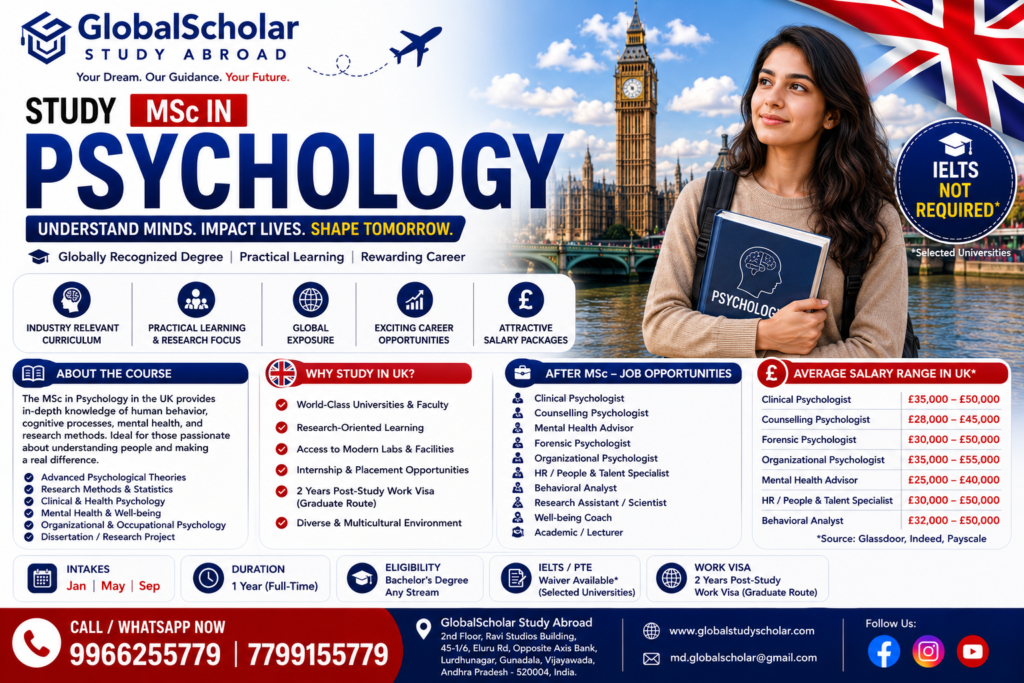
If you are interested in understanding human behaviour, mental health, cognitive processes and psychological research, studying an MSc Psychology in the UK can be a valuable postgraduate option. UK universities offer psychology programmes covering areas such as research methods, mental health, organisational psychology, health psychology and behavioural science. For international students, a Psychology Master’s in the UK can provide exposure to research-led teaching, modern academic facilities and a multicultural learning environment. GlobalScholar Study Abroad, Vijayawada helps students explore suitable UK universities, understand eligibility, prepare applications and receive guidance throughout the admission and visa process. Why Study MSc Psychology in the UK? The UK has a well-established higher education sector and offers postgraduate psychology programmes with different academic and career specialisations. Key advantages include: An MSc Psychology in the UK can be particularly useful for students who want to develop their understanding of psychological theory while gaining experience in research, statistics and evidence-based approaches. What Is an MSc Psychology? An MSc Psychology is a postgraduate degree designed to provide advanced knowledge of psychology and related areas. Depending on the university and programme, students may study topics such as: The exact modules differ between universities, so students should always check the curriculum and professional accreditation before applying. MSc Psychology UK – Course Duration Many UK universities offer psychology Master’s programmes that can be completed in one year of full-time study. The flyer for this programme highlights: Duration: 1 Year – Full-TimeIntakes: January | May | September However, available intakes and course duration vary by university. Some universities may offer only September entry, while others may have January or additional intakes. Students should check the current university intake before submitting an application. MSc Psychology UK Eligibility A common entry route is a recognised Bachelor’s degree. The exact academic requirements depend on the university and the specific psychology programme. Typical requirements may include: Some psychology Master’s programmes may accept students from related or different academic backgrounds, while others require a psychology degree or specific prerequisite subjects. Therefore, “Bachelor’s degree in any stream” should not be treated as universal eligibility. GlobalScholar can check the requirements of individual universities before application. IELTS Requirement for MSc Psychology in the UK The flyer highlights “IELTS Not Required – Selected Universities.” This should be understood as university- and applicant-specific, rather than a blanket rule. For UK Student visa purposes, degree-level students generally need to demonstrate English at CEFR B2, although a Higher Education Provider may assess English itself in qualifying circumstances. Students may also be able to prove English through an eligible degree taught in English or an approved English-language test. So, if you are searching for: MSc Psychology UK without IELTSorPsychology Master’s in UK without IELTS the correct approach is to check whether your chosen university accepts your previous English-medium education or another approved method of demonstrating English proficiency. MSc Psychology UK Curriculum The curriculum varies between universities, but students may encounter subjects such as: 1. Advanced Psychological Theories Students explore major psychological theories and contemporary developments in psychology. 2. Research Methods Research methodology is an important part of postgraduate psychology education. Students learn how to design, evaluate and interpret psychological research. 3. Statistics Psychology involves significant use of quantitative and qualitative research methods. Students may develop skills in analysing and interpreting research data. 4. Clinical & Health Psychology Some programmes introduce students to psychological factors associated with health, illness and wellbeing. 5. Mental Health & Wellbeing Students can explore psychological perspectives on mental health, wellbeing and behavioural development. 6. Organisational & Occupational Psychology This area examines behaviour in workplace environments, including employee wellbeing, motivation, leadership and organisational behaviour. 7. Dissertation / Research Project Many Master’s programmes include an independent research project where students investigate a specific psychological question using appropriate research methods. Career Opportunities After MSc Psychology in the UK An MSc Psychology can support careers across several areas depending on your previous qualification, experience, specialisation and professional accreditation. Possible career areas include: The flyer also highlights roles such as Clinical Psychologist, Counselling Psychologist and Forensic Psychologist. However, an important distinction is necessary: a general MSc Psychology does not automatically qualify a graduate to work as a UK Clinical Psychologist or Counselling Psychologist. These are regulated/protected professional titles with specific training and registration requirements. For example, the UK route to becoming a Clinical Psychologist normally involves professional doctoral-level training. Therefore, students who specifically want to become a Clinical Psychologist in the UK should choose their academic pathway carefully and check HCPC/BPS requirements before enrolling. Psychology Careers in the UK Psychology graduates can explore opportunities in several sectors. Mental Health Graduates may pursue support, research or related roles in mental health services, depending on their qualifications and experience. Human Resources Psychology provides useful knowledge of behaviour, motivation, communication and workplace relationships, making it relevant to HR and people-management careers. Organisational Psychology Students interested in workplace behaviour can explore organisational and occupational psychology pathways. Research Students with strong research and analytical skills can explore research assistant, research coordinator and related positions. Education Psychology knowledge can also be useful in educational support, student wellbeing and behavioural-development environments, subject to the role’s specific requirements. Behavioural Science Behavioural science is another area where psychology graduates can apply research, analytical and behavioural knowledge. Can I Work While Studying MSc Psychology in the UK? Eligible international students studying a full-time degree-level course at a qualifying higher education provider can generally work up to 20 hours per week during term time and full-time outside term time, subject to their Student visa conditions. Students should always check the work conditions attached to their individual visa. Working while studying can help students gain experience and manage some living expenses, but students should not rely on part-time work as their primary source of funding for tuition and living costs. UK Graduate Route After MSc Psychology The UK Graduate Route can allow eligible international students to stay in the UK after successfully completing an eligible course. However, the rules have changed. For applications made on or before 31