
Public Universities in Italy 2026 | Low Tuition Fees & Scholarships
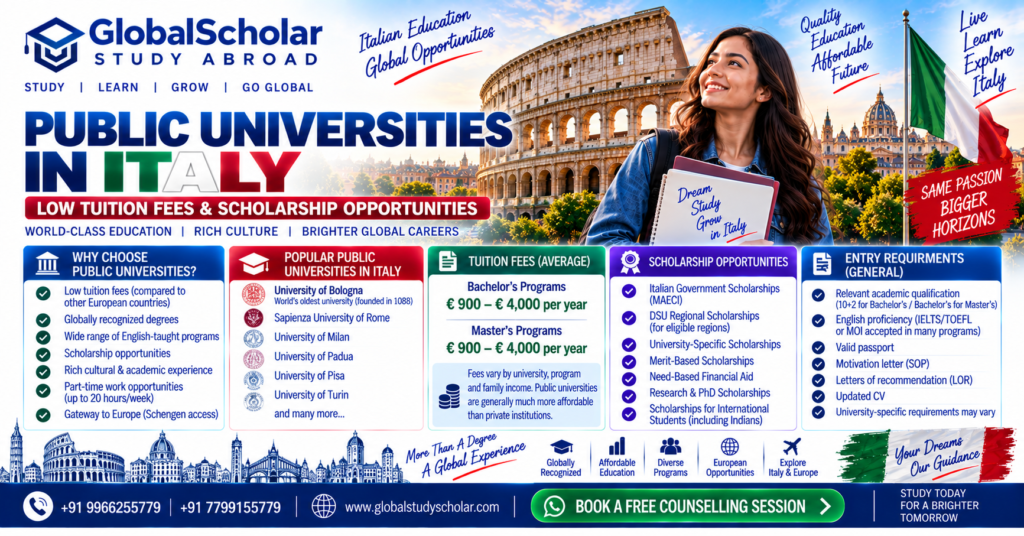
Thinking about studying in Italy at an affordable public university? Italy offers international students the opportunity to study at established public universities, access a wide range of academic programs, apply for scholarships and experience European culture and education. For Indian students planning to study abroad in 2026, public universities in Italy can be an option worth exploring because tuition fees can be influenced by the university, programme and family-income assessment. Italian universities and regional authorities also offer different scholarships, fee reductions and student-support benefits for eligible students. At GlobalScholar Study Abroad, we help students understand university options, course requirements, documentation, applications and the Italy study process. Why Choose Public Universities in Italy? Public universities in Italy are part of the country’s established higher-education system and offer programmes across fields such as business, engineering, computer science, data science, architecture, healthcare, humanities and more. Some important reasons international students consider public universities in Italy include: 1. Affordable Tuition Options Tuition at Italian universities varies according to the institution, programme and other factors. Official Italian guidance states that public universities generally charge lower fees than private universities, while some institutions may provide exemptions or reductions based on eligibility. The tuition range shown in the GlobalScholar flyer is approximately €900–€4,000 per year for selected Bachelor’s and Master’s programmes. This should be treated as an indicative range rather than a universal fee for every Italian public university. Always check the exact fee structure of your selected university and programme before applying. 2. Globally Recognized Degrees Italian universities offer Bachelor’s, Master’s and doctoral-level programmes across a wide range of academic disciplines. Italy is also part of the European higher-education system, making it attractive to students looking for an international academic experience. 3. English-Taught Programmes A growing number of Italian universities offer programmes taught fully or partly in English, particularly at Master’s and postgraduate levels. Students should check the individual programme page carefully because language requirements, teaching language and admission conditions can vary between programmes. 4. Scholarship Opportunities International students may be able to apply for scholarships and financial support offered by: Universitaly provides information about regional scholarship bodies and university-specific scholarships. Eligibility and application deadlines vary. 5. Cultural and Academic Experience Italy combines university education with a rich cultural environment. Students can experience historic cities, museums, architecture, food, art and European lifestyle while completing their studies. 6. Part-Time Work Opportunities According to Italy’s Ministry of Foreign Affairs, a study residence permit allows international students to work part-time for up to 20 hours per week, with a maximum of 1,040 hours per year. Part-time employment should be considered supplementary support and not treated as a guaranteed source of funding for tuition or living expenses. Popular Public Universities in Italy Italy has many public universities across different regions and academic disciplines. The GlobalScholar flyer highlights several well-known institutions, including: University of Bologna The University of Bologna is one of Italy’s historic universities and offers programmes across numerous academic fields. Sapienza University of Rome Located in Rome, Sapienza offers a broad range of Bachelor’s, Master’s and research programmes across multiple disciplines. University of Milan The University of Milan offers programmes covering areas including science, humanities, economics, healthcare and other academic fields. University of Padua The University of Padua is another established Italian university with a wide range of academic and research programmes. University of Pisa The University of Pisa offers programmes in areas including science, engineering, humanities and other disciplines. University of Turin The University of Turin provides a broad academic portfolio covering areas such as business, economics, science, medicine, humanities and social sciences. These are examples rather than a ranking. Students should compare individual programmes, admission requirements, tuition fees, location, teaching language and scholarship opportunities before selecting a university. You can use the official Universitaly portal to explore Italian higher-education institutions and individual programmes. Tuition Fees at Public Universities in Italy One of the most important questions for international students is: How much does it cost to study at a public university in Italy? There is no single tuition fee applicable to every public university. According to official Study in Italy information, university tuition depends on factors such as: Public universities generally have lower fees than private universities. Some universities can also provide exemptions or reductions according to their regulations. Indicative Tuition Range The GlobalScholar flyer presents the following indicative range: Programme Indicative Tuition Bachelor’s Programmes €900 – €4,000 per year Master’s Programmes €900 – €4,000 per year Important: These figures are not a universal national fee. Actual tuition can be higher or lower depending on the university, programme and student’s circumstances. Before paying any amount, students should obtain the official fee information from the selected university. Scholarships at Public Universities in Italy Scholarships can significantly reduce the overall cost of studying abroad for eligible students. Italy has several types of scholarship and financial-support opportunities. 1. Regional Scholarships Regional authorities in Italy provide student-support schemes through regional right-to-study organisations. Depending on the specific regional programme and eligibility, benefits may include financial assistance, accommodation, meals or other student services. Universitaly provides a region-by-region overview of right-to-study organisations. 2. University-Specific Scholarships Individual universities may provide their own scholarships, tuition reductions or other benefits. Eligibility can depend on: Students should check the official scholarship page of their selected university. 3. Merit-Based Scholarships Some institutions offer financial support based on academic performance or other merit criteria. The requirements can vary significantly, so students should check each scholarship announcement before applying. 4. Need-Based Financial Aid Financial circumstances can also be considered under certain Italian scholarship and fee-support systems. For international students, documentation relating to family income may be required. Universitaly notes that international students may need an ISEE Parificato for certain benefits. 5. Research and PhD Scholarships Students applying for doctoral programmes may find university-funded or other research-related scholarships. Universitaly currently notes that doctoral scholarships are available for eligible students, including international students holding the required second-cycle qualification. 6. Italian Government Scholarships Italy also offers government scholarship programmes for eligible international students.