
STUDY ABROAD APPLICATION PROCESS 2026: STEP-BY-STEP GUIDE FROM ADMISSION TO VISA
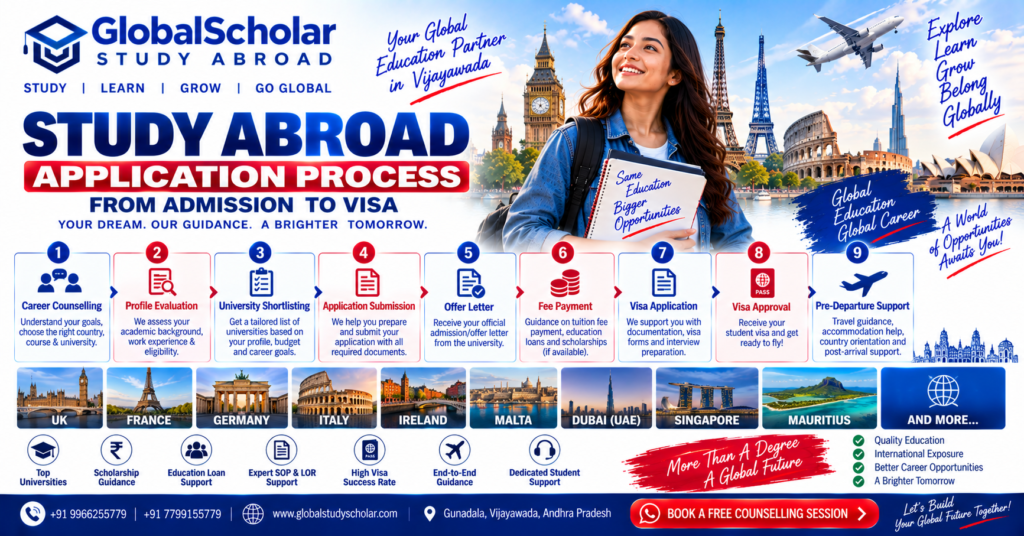
Planning to study abroad is an exciting step toward international education, global exposure and new career opportunities. However, the Study Abroad Application Process involves several important stages, from choosing the right course and university to submitting documents, receiving an offer letter, completing fee requirements and applying for a student visa. For Indian students, understanding each stage before starting the application can make the journey more organised and easier to manage. The exact requirements vary by country, university, course, qualification and student profile, so students should always check the latest requirements of their chosen institution and destination. At GlobalScholar Study Abroad, Vijayawada, students can receive guidance through the different stages of their international education journey, from initial counselling and profile evaluation to university applications, visa documentation and pre-departure support. What Is the Study Abroad Application Process? The Study Abroad Application Process is the series of steps a student normally follows to apply for an international course and prepare for studying overseas. While the process can vary between destinations, it commonly includes: Some destinations may have additional requirements such as interviews, entrance tests, language tests, financial evidence, medical checks or country-specific application procedures. Step 1: Career Counselling and Course Selection The first step is understanding your academic background, career interests and long-term goals. Before selecting a country, students should consider: Choosing a course simply because it is popular may not always be appropriate. The course should match the student’s academic background and future objectives. At GlobalScholar, the initial counselling stage can help students understand available study options and identify suitable courses and destinations. Step 2: Profile Evaluation After counselling, the next stage is profile evaluation. A student’s profile may be assessed based on: Different universities have different admission criteria. A programme that accepts one academic profile may not necessarily accept another. Therefore, students should evaluate their profile before applying to universities. Step 3: University and Course Shortlisting Once the profile is evaluated, suitable universities and courses can be shortlisted. Students should compare: Course curriculum Check the modules, subjects, practical components and learning outcomes. University requirements Review academic, language and document requirements. Tuition fees Compare the total tuition cost and understand payment schedules. Location Consider the city, transportation, accommodation and living expenses. Career opportunities Research the career relevance of the course and the opportunities available after graduation. Scholarships Check whether the university, government or regional authorities offer scholarships or fee reductions. Intake Confirm whether the selected course is available for the preferred intake. The goal is not simply to select the most famous university. The goal is to identify programmes that fit the student’s profile, budget and academic objectives. Step 4: Prepare Your Documents Document preparation is one of the most important stages of the Study Abroad Application Process. Depending on the destination and programme, students may need documents such as: Documents should be clear, accurate and consistent. If documents are not in the required language, certified translations may be required depending on the destination and application authority. For example, UK visa guidance states that supporting evidence may need certified translations when documents are not in English or Welsh. Step 5: University Application Submission After preparing the documents, the application can be submitted to the selected university or through the relevant official application platform. The application may include: Students should carefully check every field before submitting the application. A spelling mistake in a name, incorrect academic information or inconsistent dates can create unnecessary problems during the admission process. Step 6: Wait for the University Decision After submission, the university reviews the application. Possible outcomes may include: A conditional offer may require the student to satisfy specific conditions before final admission. For example, the university may request: Students should carefully read the conditions mentioned in the offer letter. Step 7: Offer Letter and Admission Confirmation Once an offer is received, students should review all details carefully. Check: Students should understand the university’s terms before making a payment. An admission offer does not automatically mean that a visa will be granted. Visa decisions are made by the relevant immigration authority or consular authority according to its own rules. Step 8: Fee Payment and Financial Planning After accepting an offer, the student may need to pay a tuition deposit or other required fee. Before making a payment, students should understand: Students who require an education loan should start the process early because loan approval and disbursement can take additional time. Proper financial planning can help students prepare for tuition and living expenses before travelling. Step 9: Student Visa Application The Study Abroad Visa Process is a separate stage from university admission. The visa requirements depend on the destination country. Students may need documents such as: For the UK, students apply online for a Student visa and may need to prove their identity through the UK Immigration: ID Check app or provide fingerprints and a photograph at a visa application centre. For France, international students from countries covered by the Études en France procedure, including India, follow the relevant Campus France process before the visa stage. France-Visas is the official visa application system. Therefore, students should never assume that the visa process is identical for every country. Step 10: Visa Documentation and Interview Preparation Some student visa applications may involve an interview or additional verification. Students should be prepared to clearly explain: Students should provide truthful and consistent information throughout the application. The information in the university application, visa application and supporting documents should be accurate and consistent. Step 11: Visa Decision After submitting the visa application and completing the required procedures, students wait for the immigration authority’s decision. The outcome can depend on: A visa should never be described as guaranteed. For the UK, GOV.UK advises applicants to allow sufficient time for a decision and states that travel should not be booked before the visa decision is received. Step 12: Pre-Departure Preparation Once the visa is approved, students can begin preparing for their journey. Important pre-departure tasks may include: Accommodation Arrange university accommodation or suitable