
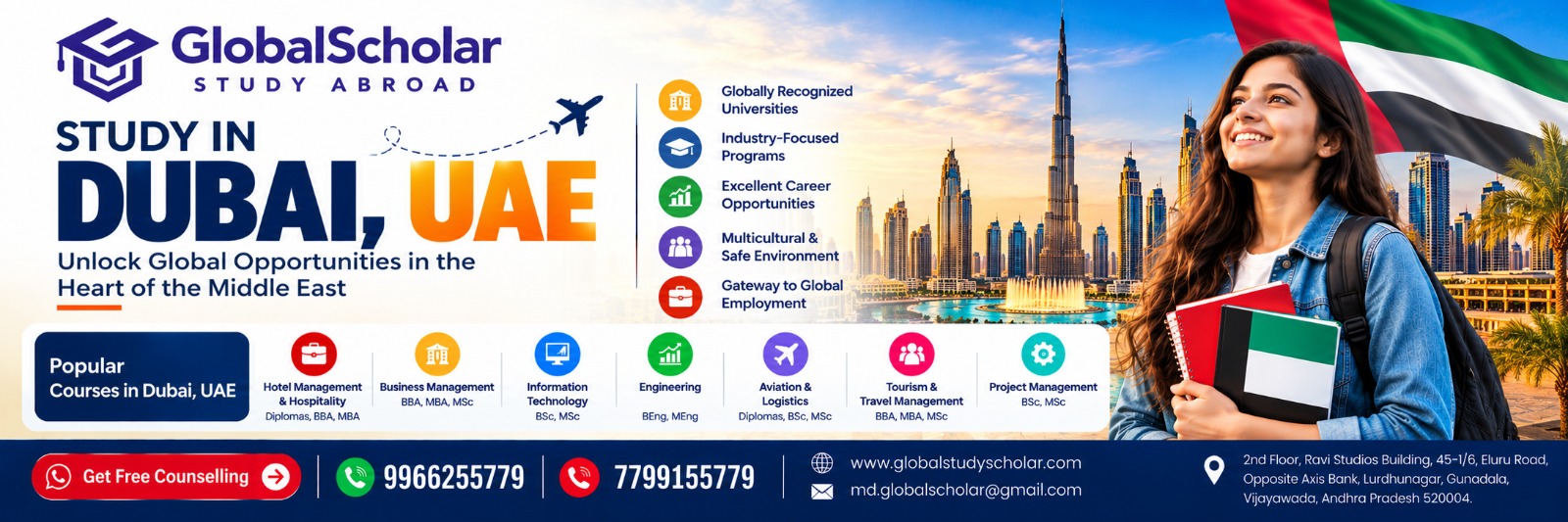
Study in Dubai, UAE for Indian Students 🇦🇪
Discover International Education and Global Career Opportunities in Dubai
Dubai, United Arab Emirates (UAE), is an increasingly popular destination for international students seeking an international learning environment, modern educational facilities, multicultural experiences, and career-focused academic programs. Known for its global business environment, hospitality sector, tourism industry, and growing technology ecosystem, Dubai offers students opportunities to explore a wide range of educational pathways.
Students can investigate undergraduate degrees, postgraduate qualifications, MBA programs, business management courses, information technology, engineering, hospitality management, tourism, finance, digital marketing, and selected vocational qualifications.
At GLOBALSCHOLAR Study Abroad, we help students explore suitable study opportunities in Dubai by providing guidance on course selection, institution selection, admission requirements, application documentation, tuition fee planning, scholarship information, and student visa preparation.
Whether you have completed your 12th standard, graduated from an Indian university, or want to pursue a specialised postgraduate qualification, our team can help you understand available options and prepare for your international education journey.
If you are searching for study abroad consultants in Vijayawada, Andhra Pradesh, or Telangana, GLOBALSCHOLAR Study Abroad can guide you through the main steps involved in planning to study in Dubai.
Why Study in Dubai?
Dubai offers an international education environment with access to institutions and academic programs across several fields. Students should choose their institution based on recognition, course suitability, affordability, and future academic or professional goals.
1. International Learning Environment
Dubai is home to students and professionals from many countries. Studying in this multicultural environment can help students develop communication skills, cultural awareness, and international perspectives.
2. Wide Range of Academic Programs
Students can explore courses in business administration, accounting, finance, information technology, engineering, hospitality, tourism, logistics, media, and other disciplines.
The availability of courses depends on the institution, qualification level, and intake.
3. Business and Industry Exposure
Dubai has an established business environment across trade, finance, logistics, tourism, hospitality, technology, and professional services.
Some academic programs offer projects, practical assignments, industry engagement, or internships. Students should confirm whether these opportunities are included in the course and whether additional eligibility requirements apply.
4. Hospitality and Tourism Education
Dubai’s tourism and hospitality sectors make it a destination worth exploring for students interested in hotel administration, hospitality operations, tourism management, events, and food service.
Students should compare the practical training arrangements and course recognition of their preferred institutions.
5. Modern Educational Facilities
Many institutions offer contemporary classrooms, digital learning resources, libraries, laboratories, and student support services.
Facilities vary by campus and program, so students should review the institution’s resources before applying.
6. Undergraduate and Postgraduate Pathways
Students may find bachelor’s degrees, master’s degrees, MBA programs, professional qualifications, and selected diploma courses, depending on the institution.
Applicants should check admission eligibility and whether their previous qualifications meet the requirements of their preferred program.
7. International Career Development
Studying in Dubai can help students build academic knowledge, professional skills, and international exposure.
Career outcomes depend on the qualification, individual performance, labour market conditions, employer requirements, and applicable UAE work authorisation rules. Employment is not guaranteed by admission to a course.
8. Multiple Entry Periods
Some institutions offer more than one intake throughout the year, providing flexibility for students planning their applications.
The available intake dates depend on the institution and course.
Popular Courses to Study in Dubai
Dubai offers academic and professional programs across different fields. The following courses are examples of options students may investigate.
Undergraduate Courses in Dubai
Students who have completed Class 12 or an equivalent qualification can explore eligible bachelor’s programs.
Popular options include:
- Bachelor of Business Administration (BBA)
- Bachelor of Business Management
- Bachelor of Accounting and Finance
- Bachelor of Marketing
- Bachelor of International Business
- Bachelor of Computer Science
- Bachelor of Information Technology
- Bachelor of Software Engineering
- Bachelor of Data Science
- Bachelor of Civil Engineering
- Bachelor of Mechanical Engineering
- Bachelor of Electrical Engineering
- Bachelor of Hospitality Management
- Bachelor of Hotel Management
- Bachelor of Tourism Management
- Bachelor of Aviation Management
- Bachelor of Logistics and Supply Chain Management
- Bachelor of Media and Communication
- Bachelor of Graphic Design
Admission depends on academic results, prerequisite subjects, English language proficiency, and other institution-specific criteria.
Postgraduate Courses in Dubai
Students who have completed a bachelor’s degree may investigate postgraduate programs to develop specialised knowledge and advance their professional education.
Popular options include:
- Master of Business Administration (MBA)
- MSc in Management
- MSc in International Business
- MSc in Finance
- MSc in Accounting
- MSc in Marketing
- MSc in Digital Marketing
- MSc in Business Analytics
- MSc in Data Science
- MSc in Information Technology
- MSc in Cybersecurity
- MSc in Engineering Management
- MSc in Project Management
- MSc in Supply Chain Management
- MSc in Human Resource Management
- MSc in Hospitality Management
- MSc in Tourism Management
- MSc in Artificial Intelligence
Some postgraduate programs require a relevant undergraduate degree, work experience, or specific prerequisite subjects.
MBA and Business Management Courses
Dubai is worth considering for students interested in management, entrepreneurship, international business, finance, and leadership.
Possible study areas include:
- Master of Business Administration
- International Business Management
- Strategic Management
- Human Resource Management
- Marketing Management
- Financial Management
- Business Analytics
- Entrepreneurship
- Project Management
- Operations Management
- Supply Chain Management
Students should compare the curriculum, duration, total tuition fees, institution recognition, and practical learning opportunities before selecting an MBA or management program.
Information Technology and Computer Science
Students interested in technology can explore programs in computing, software development, information systems, analytics, and emerging technologies.
Possible specialisations include:
- Computer Science
- Information Technology
- Software Engineering
- Cybersecurity
- Artificial Intelligence
- Data Science
- Cloud Computing
- Networking
- Business Information Systems
- Digital Transformation
Applicants should check whether their academic background meets the technical and mathematical prerequisites of their preferred program.
Hospitality and Hotel Management in Dubai
Dubai is an attractive destination to investigate for students interested in hospitality education and international hotel operations.
Possible courses include:
- Diploma in Hotel Management
- Diploma in Hospitality Management
- Bachelor of Hotel Management
- Bachelor of Hospitality Management
- International Hospitality Management
- Tourism Management
- Food and Beverage Management
- Restaurant Management
- Event Management
- Culinary Arts
- Resort Management
- Hospitality Business Administration
Depending on the institution, programs may include practical training, industry projects, or internship opportunities.
Students should confirm whether internships are compulsory, whether placements are guaranteed, whether they are paid or unpaid, and whether separate work authorisation is required.
Aviation and Logistics Courses
Dubai’s international transport and trade environment may interest students considering aviation, logistics, and supply chain-related education.
Potential study areas include:
- Aviation Management
- Airport Operations
- Logistics Management
- Supply Chain Management
- International Trade
- Transport Management
- Business Operations
Students should verify the recognition and professional relevance of any specialised aviation or logistics qualification before enrolling.
Types of Educational Institutions in Dubai
Dubai has different types of education providers. Understanding their differences can help students make informed decisions.
International University Campuses
Dubai hosts international branch campuses offering selected qualifications from overseas institutions.
Students should verify the awarding university, campus-specific approval, accreditation, and recognition of the particular program.
UAE Universities
Universities based in the UAE offer undergraduate, postgraduate, and selected research programs across a range of disciplines.
Students should check institutional licensing, program accreditation, entry requirements, and tuition fees.
Private Higher Education Institutions
Some private institutions offer business, management, technology, hospitality, and other academic programs.
Before applying, confirm the institution’s legal status, relevant regulatory approvals, qualification recognition, and international student admission conditions.
Vocational and Professional Education Providers
Selected providers offer practical or professional courses in fields such as business, hospitality, information technology, and management.
Students should check the qualification level, course duration, provider approval, and whether the program is suitable for their academic and career objectives.
How to Choose the Right Institution
Compare the following before making a decision:
- Institutional licensing and program accreditation.
- Qualification awarded and recognition.
- Course curriculum and duration.
- Admission requirements.
- Tuition fees and additional charges.
- Internship or practical training arrangements.
- Campus location and accommodation options.
- Student support services.
- Visa sponsorship and enrolment procedures.
Eligibility Requirements to Study in Dubai
Admission requirements depend on the institution, qualification level, course, and applicant’s academic history.
Undergraduate Admission Requirements
Students applying for bachelor’s programs may be asked to provide:
- Class 10 marksheets and certificates.
- Class 12 marksheets and certificates.
- Academic transcripts.
- English language proficiency results, where required.
- Evidence of prerequisite subjects, where applicable.
- Valid passport.
- Completed application forms.
- Additional supporting documents requested by the institution.
Some programs may require particular subjects, entrance assessments, or additional qualifications.
Postgraduate Admission Requirements
Students applying for master’s programs may need:
- Class 10 and Class 12 certificates.
- Bachelor’s degree certificate.
- Complete undergraduate transcripts.
- English language test results, if required.
- Updated CV or résumé, where applicable.
- Statement of Purpose or personal statement, where requested.
- Work experience documents, where relevant.
- Letters of Recommendation, if required.
- Other course-specific supporting documents.
MBA programs may prefer or require professional work experience, depending on the institution.
English Language Requirements
English-taught programs may require evidence of English proficiency.
Depending on the institution, accepted tests may include:
- IELTS Academic
- TOEFL iBT
- PTE Academic
- Other tests or evidence approved by the institution
Minimum scores vary. Some institutions may offer exemptions or alternative assessment methods for eligible applicants.
Students should verify the admission requirements directly with their selected institution.
Intakes to Study in Dubai
Dubai institutions may offer multiple admission periods depending on the course and academic calendar.
September Intake
September is a common starting period for many academic programs. Students should prepare their applications, academic documents, and financial arrangements well in advance.
January Intake
Selected institutions offer January entry for eligible programs. Students should check whether their preferred course is available during this period.
May or Summer Intake
Some institutions offer additional entry periods during the year, including selected Summer intakes.
Course availability varies, and not every program accepts applications for each intake.
When Should You Apply?
As a general planning guideline, start researching approximately 4–8 months before your preferred intake, or earlier if your course, institution, or visa process requires more preparation time.
This allows time to compare institutions, prepare academic documents, obtain an offer, arrange funding, and complete the applicable student residence or visa procedures.
Cost of Studying in Dubai for Indian Students
The cost of studying in Dubai depends on the institution, qualification, course duration, campus location, and accommodation arrangements.
The following figures are broad estimates in UAE dirhams (AED) for initial planning. They are not official quotations, and actual fees may be significantly different.
Estimated Annual Tuition Fees
- Selected diploma programs: approximately AED 12,000–35,000.
- Undergraduate programs: approximately AED 25,000–75,000.
- Postgraduate programs: approximately AED 30,000–90,000 or more.
- MBA and specialised programs: approximately AED 40,000–120,000 or more.
Some institutions charge considerably higher fees. Confirm the total program cost, annual increases, registration charges, and any additional fees before accepting an offer.
Estimated Living Expenses
Students should budget for:
- Accommodation and utilities.
- Food and groceries.
- Public transport.
- Mobile phone and internet.
- Books and study materials.
- Health insurance.
- Personal expenses.
- Emergency funds.
A broad initial estimate might be AED 3,000–7,000 or more per month, depending on accommodation, location, and lifestyle.
Accommodation can account for a substantial portion of the total budget.
Additional Expenses
Other costs may include:
- Application fees.
- English language examination fees.
- Student visa or residence permit charges.
- Medical fitness examination fees, where applicable.
- Emirates ID-related charges, where applicable.
- Health insurance.
- Airfare.
- Accommodation deposits.
- Initial settlement expenses.
How to Plan Your Study Budget
Before accepting an offer, compare:
- Total tuition fees for the full program.
- Estimated living expenses.
- Accommodation and deposit requirements.
- Visa, residence, and medical-related costs.
- Health insurance expenses.
- Travel and initial settlement costs.
- Confirmed scholarship awards or financial assistance.
Students should request an official fee schedule and review refund policies before making payments.
Scholarships to Study in Dubai
Some UAE institutions offer scholarships, merit awards, tuition discounts, or other financial assistance to eligible students.
Availability depends on the institution, academic results, program, and scholarship conditions.
Merit-Based Scholarships
Some institutions offer awards based on academic performance, achievements, or other selection criteria.
University-Specific Scholarships
Universities may offer financial assistance for selected undergraduate and postgraduate programs.
Students should check the application process, deadlines, award amounts, and renewal conditions directly with the institution.
Academic Excellence Awards
Eligible students with strong academic records may be considered for selected awards, subject to institutional policies.
Scholarship Application Tips
- Maintain strong academic results.
- Research available scholarships before applying.
- Submit all required supporting documents.
- Meet the published deadlines.
- Check whether the award covers full or partial tuition.
- Review any minimum academic performance conditions for retaining the award.
Scholarships are not guaranteed. Students should prepare a realistic financial plan without relying on unconfirmed funding.
Dubai Student Visa and Residence Procedures
International students generally need an appropriate visa or residence arrangement to study in Dubai. The applicable process depends on the institution, sponsorship arrangements, course, and the student’s circumstances.
Step 1: Select a Suitable Institution
Research institutions and programs that match your academic background, career goals, and budget.
Verify the institution’s licensing, course recognition, and international student admission arrangements.
Step 2: Apply for Admission
Submit the required academic certificates, transcripts, passport details, English language results, and other supporting documents.
Step 3: Receive an Offer Letter
If accepted, review the course details, tuition fees, payment deadlines, admission conditions, and any scholarship information.
Step 4: Complete Enrolment Requirements
Follow the institution’s instructions regarding acceptance, tuition payments, deposits, and documentation.
Step 5: Confirm Visa Sponsorship Arrangements
Depending on the institution and applicable rules, a university or another eligible sponsor may arrange the student’s visa or residence application.
Confirm who is responsible for the application and what costs are involved.
Step 6: Prepare the Required Documents
Depending on the applicable process, students may need:
- Valid passport.
- Admission or acceptance letter.
- Passport-size photographs.
- Academic documents.
- Evidence of tuition payment, where required.
- Health insurance documentation.
- Medical fitness documentation, where applicable.
- Other supporting documents requested by the sponsor or authorities.
Step 7: Complete the Relevant Entry or Residence Procedures
Follow the instructions provided by the institution, sponsor, and relevant UAE authorities. Additional procedures may apply after arrival, including medical fitness testing, Emirates ID processing, or residence formalities.
Step 8: Understand Your Visa Conditions
Before travelling, confirm the validity of your visa or residence status, permitted activities, renewal requirements, and any restrictions.
Visa issuance depends on the relevant authorities. Admission does not guarantee visa approval.
Important: Student visa and residence procedures vary by sponsor and can change. Confirm the latest requirements through your institution and the relevant official UAE authorities before making travel arrangements.
Can International Students Work While Studying in Dubai?
Employment opportunities for international students depend on the applicable UAE regulations, the student’s visa or residence status, and the necessary work authorisations.
Part-Time Employment
Eligible students may be able to undertake certain work arrangements when the relevant permits and approvals are obtained.
Students should confirm the applicable rules with their institution and the competent authorities before accepting employment.
Internships and Practical Training
Some academic programs include internships or practical learning activities. Students should confirm whether the placement is part of the course, whether it is paid or unpaid, and whether separate approval or authorisation is necessary.
Important Considerations
- Do not assume a student visa automatically authorises employment.
- Verify the required permits before starting work.
- Do not rely on part-time employment to fund all tuition expenses.
- Understand the terms of employment and applicable workplace rules.
- Check whether your course includes guaranteed or optional placement opportunities.
Accommodation Options for International Students in Dubai
Finding suitable accommodation is an important part of preparing to study in Dubai.
Student Accommodation
Some institutions offer student residences or assistance with finding suitable accommodation.
Availability, facilities, costs, and eligibility differ by institution.
Shared Accommodation
Students may rent a room in shared accommodation, subject to local regulations and the terms of the rental arrangement.
Check the rent, deposit, utilities, location, and contract conditions before committing.
Private Apartments
Students may investigate private apartments or other rental properties depending on their budget and circumstances.
Review the rental agreement and any applicable registration requirements before making payments.
Homestay or Managed Accommodation
Selected providers may offer managed student accommodation or homestay arrangements. Confirm the services, costs, and location before accepting an arrangement.
Accommodation Planning Tips
- Research housing options before travelling.
- Compare rent and transport expenses.
- Check the distance from your institution.
- Confirm whether utilities and internet are included.
- Review the rental agreement carefully.
- Use verified accommodation providers.
- Avoid transferring money to unverified individuals.
Student Life in Dubai
Studying in Dubai gives students the opportunity to experience an international city with diverse cultures, modern infrastructure, and a wide range of educational and recreational facilities.
Depending on the institution, students may have access to libraries, student clubs, sports facilities, academic support, career services, and campus activities.
Academic Environment
Students should be prepared for assignments, presentations, group projects, examinations, independent learning, and course-specific assessments.
Understanding academic policies, attendance expectations, and assessment methods can help students adapt to university life.
Cultural Adjustment
Students should familiarise themselves with local customs, laws, public behaviour requirements, transport systems, and the expectations associated with living in the UAE.
Financial Management
Students should prepare a realistic budget for rent, food, transport, insurance, and personal expenses.
Maintaining emergency savings and tracking regular spending can help students manage their finances responsibly.
Documents Required to Study in Dubai
Document requirements vary according to the institution, course, qualification level, and visa sponsorship arrangement.
Academic Documents
- Class 10 marksheets and certificates.
- Class 12 marksheets and certificates.
- Bachelor’s degree certificate, where applicable.
- Academic transcripts.
- Provisional degree certificate, if applicable.
- Other relevant qualifications.
Personal Documents
- Valid passport.
- Passport-size photographs, if required.
- Completed application forms.
- Updated CV or résumé, where applicable.
- Other identification documents requested by the institution.
English Language Documents
- IELTS Academic, TOEFL iBT, PTE Academic, or another accepted English proficiency result, where required.
Application Documents
- Statement of Purpose or personal statement, if requested.
- Work experience certificates, where applicable.
- Letters of Recommendation, if required.
- Portfolio or other supporting documents for selected programs.
Visa and Residence Documents
Depending on the application, students may need:
- Admission or acceptance letter.
- Passport and identification documents.
- Photographs meeting official specifications.
- Tuition payment evidence, where requested.
- Health insurance details.
- Medical fitness documents, where applicable.
- Sponsor-related forms and supporting documents.
- Other documents required by the institution or competent authority.
Prepare a personalised checklist based on the requirements of your selected institution and sponsor.
Why Choose GLOBALSCHOLAR Study Abroad?
At GLOBALSCHOLAR Study Abroad, we help students explore international education opportunities and understand the steps involved in applying to institutions in Dubai.
Personalised Academic Profile Assessment
We help students review their academic background, qualifications, preferred course, intended intake, and general budget to explore potentially suitable options.
Course Selection Guidance
Students can investigate undergraduate, postgraduate, business, technology, hospitality, tourism, and other eligible programs based on their interests and academic background.
Institution Selection Assistance
We help students compare relevant institutions, course structures, admission requirements, tuition fees, and application deadlines.
Admission Application Support
We guide students in organising academic records and preparing the application documents requested by their chosen institution.
English Language Test Guidance
We help students understand the language requirements of their preferred programs and identify accepted tests.
Scholarship Information
Students can explore published scholarship opportunities and understand the eligibility conditions.
Financial Planning Guidance
We help students identify the main expenses associated with tuition, accommodation, living costs, insurance, and travel.
Student Visa Documentation Guidance
We provide general guidance on organising supporting documents and understanding the main stages of the relevant visa or residence application process.
Pre-Departure Guidance
Students can prepare for travel, accommodation arrangements, initial expenses, and other practical aspects of studying overseas.
Our aim is to help students make informed decisions and prepare their applications responsibly.
Study in Dubai from Vijayawada, Andhra Pradesh
Students from Vijayawada, Guntur, Eluru, Machilipatnam, Rajahmundry, Kakinada, Visakhapatnam, Tirupati, and other parts of Andhra Pradesh and Telangana can explore study opportunities in Dubai with GLOBALSCHOLAR Study Abroad.
If you are searching for:
- Study in Dubai consultants in Vijayawada.
- Dubai education consultants near me.
- Dubai university admission guidance in Andhra Pradesh.
- Study in Dubai for Indian students.
- Dubai student visa guidance.
- Dubai university application support.
- MBA courses in Dubai.
- Hospitality management courses in Dubai.
- Hotel management diploma courses in Dubai.
- Information technology courses in Dubai.
Our team can help you understand the application process, explore suitable programs, and identify the next steps based on your academic background.
We recommend beginning early to allow sufficient time for course research, application preparation, financial planning, and visa documentation.
Frequently Asked Questions About Studying in Dubai
1. Is Dubai a good destination for Indian students?
Dubai may be suitable for students interested in business, technology, hospitality, tourism, engineering, and other fields. Students should compare the recognition, cost, and suitability of their selected institution before applying.
2. How much does it cost to study in Dubai?
Costs vary by institution and course. Tuition fees may range from approximately AED 12,000 to AED 90,000 or more per year, depending on the qualification. Living expenses, insurance, travel, and other costs must also be included in the budget.
3. What is the minimum percentage required to study in Dubai?
There is no single minimum percentage for every institution. Eligibility depends on the course, qualification level, previous academic results, and institution-specific criteria.
4. Is IELTS compulsory to study in Dubai?
Not every institution requires IELTS. Some accept alternative English language tests or other approved evidence. Students should check the requirements of their preferred program.
5. Can I study in Dubai after completing my 12th standard?
Yes. Students who have completed Class 12 or an equivalent qualification may apply for eligible undergraduate or other suitable programs.
6. Can I study in Dubai after completing my bachelor’s degree in India?
Yes. Indian graduates can explore postgraduate programs if they meet the academic, English language, and other entry requirements.
7. Which intakes are available in Dubai?
September and January are common entry periods for many programs, while selected institutions offer additional intakes. Availability depends on the institution and course.
8. Are scholarships available for Indian students?
Some institutions offer scholarships or tuition discounts to eligible international students. Availability and award conditions vary.
9. Can international students work while studying in Dubai?
Some eligible students may be able to work under the applicable rules and authorisation requirements. Students must confirm their employment eligibility before accepting a job.
10. Can I stay in Dubai after completing my studies?
Further residence or employment options depend on the visa categories available, individual eligibility, employer arrangements, and current UAE immigration rules. A job or post-study residence status is not guaranteed.
11. Can I bring my spouse or dependants to Dubai?
Family sponsorship depends on the applicable eligibility, financial, and immigration requirements. Students should verify current rules before making plans.
12. How long does a degree take in Dubai?
Bachelor’s programs commonly take three to four years, while master’s programs often take one to two years. Duration varies by institution and qualification.
13. Is Dubai part of the UAE?
Yes. Dubai is one of the seven emirates that make up the United Arab Emirates.
14. Can I travel to other countries from Dubai with a student visa?
A UAE student residence status does not automatically grant entry to other countries. Travel requirements depend on the destination, nationality, and the travel documents held.
15. Does GLOBALSCHOLAR guarantee admission or a student visa?
No. GLOBALSCHOLAR provides study abroad guidance and application support. Admission decisions are made by educational institutions, and visa decisions are made by the relevant authorities.
Start Your Study in Dubai Journey with GLOBALSCHOLAR
Your international education journey begins with choosing a suitable course, understanding your eligibility, and preparing your application carefully.
Whether you are interested in business management, an MBA, information technology, engineering, hospitality management, hotel management, tourism, or another academic discipline, GLOBALSCHOLAR Study Abroad can help you explore relevant options and understand the application process.
Contact our team to discuss your academic profile, preferred course, intended intake, and estimated budget.
GLOBALSCHOLAR Study Abroad 🇦🇪
Office Address:
2nd Floor, Ravi Studios Building, 45-1/6, Eluru Road, Opposite Axis Bank, Lurdhunagar, Gunadala, Vijayawada, Andhra Pradesh – 520004.
Call / WhatsApp: 9966255779 | 7799155779
Email: md.globalscholar@gmail.com
Website: https://globalstudyscholar.com/
Plan your international education journey with GLOBALSCHOLAR Study Abroad.