
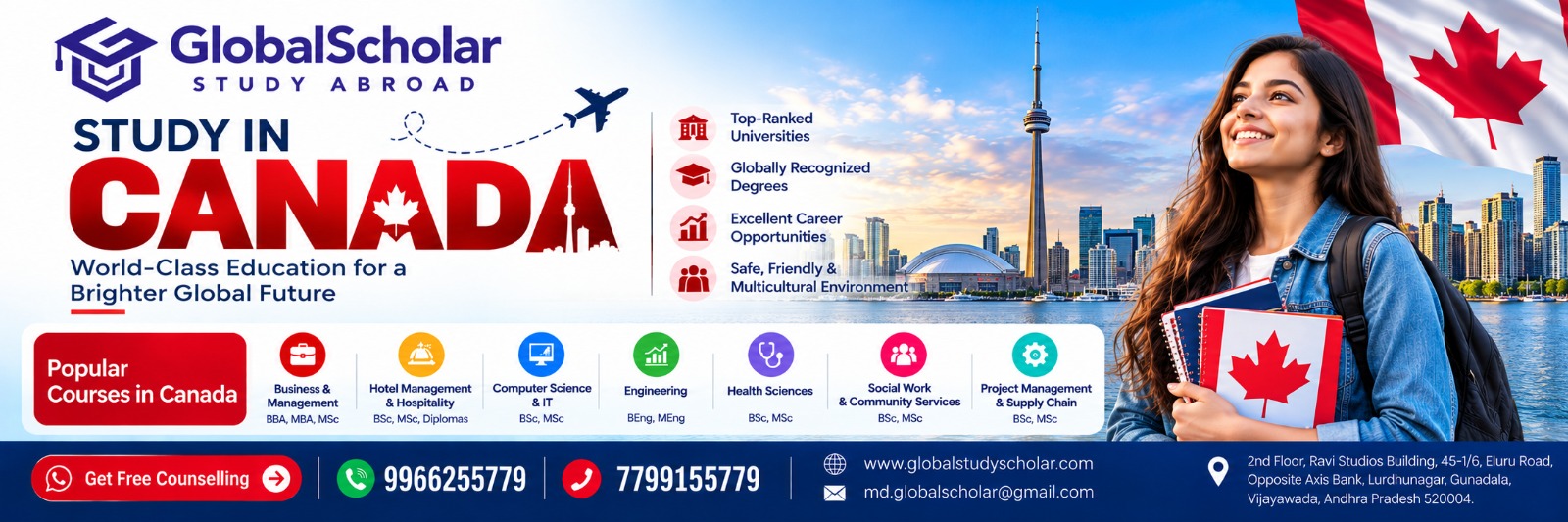
Are you planning to study in Canada for Indian students and looking for the right university, college or postgraduate programme? Canada offers a wide range of educational opportunities for international students in fields such as Business Management, Computer Science, Engineering, Hospitality, Healthcare, Finance, Data Science and Supply Chain Management.
Canada is known for its universities, colleges, research facilities, multicultural communities and diverse learning environment. Indian students can explore bachelor’s degrees, master’s degrees, doctoral programmes and selected diploma programmes according to their academic qualifications and career goals.
At GLOBALSCHOLAR Study Abroad, we help students understand Canadian education options, compare institutions, prepare admission documents and navigate the general study permit application process.
If you are looking for a Canada study abroad consultant in Vijayawada, GLOBALSCHOLAR can guide you through your study planning and help you understand the requirements for applying to suitable Canadian institutions.
Why Study in Canada?
Canada is an option for students seeking international education and exposure to different academic and professional environments. Before choosing a programme, students should compare the institution, course recognition, total cost and applicable immigration rules.
1. Wide Range of Courses
Canadian institutions offer programmes in business, technology, engineering, healthcare, hospitality, design, finance and many other disciplines. Students can select courses that align with their previous education and future plans.
2. Universities and Colleges
Students can explore public universities, public colleges, polytechnics and selected private institutions. Each institution has different admission criteria, tuition fees and programme structures.
3. Practical and Research-Based Learning
Depending on the programme, students may have access to laboratories, research projects, practical assignments, co-operative education or industry placements.
4. Multicultural Environment
Canada has diverse communities and international student populations. Students can develop communication skills, cultural awareness and experience living in a new country.
5. English and French Programmes
Many programmes are taught in English, while some are taught in French. Applicants should check the language of instruction and accepted language tests before applying.
6. Career-Focused Education
Some programmes are designed around professional skills and applied learning. Students should review the curriculum, industry connections and graduate outcomes when selecting a course.
7. Scholarships and Financial Support
Eligible students may find scholarships, entrance awards and research funding. Availability depends on the institution, programme, academic performance and scholarship conditions.
8. Post-Study Options for Eligible Graduates
Some graduates may qualify for a Post-Graduation Work Permit (PGWP), subject to current immigration requirements. Not every institution or programme qualifies, so students should check eligibility before enrolling.
Popular Courses to Study in Canada
Choosing the right course is an important step in your overseas education journey. GLOBALSCHOLAR can help you explore available options according to your academic background and intended career.
Business and Management
Business programmes may cover marketing, accounting, finance, human resources, operations and organisational strategy.
Popular options include:
- Bachelor of Business Administration
- Master of Business Administration
- Master of Management
- International Business
- Business Analytics
- Project Management
- Human Resource Management
Computer Science and Information Technology
Students interested in technology can explore programmes covering software development, computer systems, programming and information management.
Popular options include:
- Computer Science
- Information Technology
- Software Engineering
- Cybersecurity
- Cloud Computing
- Data Analytics
- Artificial Intelligence
Engineering and Technology
Engineering programmes may be available in civil, mechanical, electrical, computer, industrial and other disciplines.
Applicants should verify subject prerequisites, academic requirements and any relevant professional accreditation.
Hotel Management and Hospitality
Students interested in the hospitality industry can explore hotel management, hospitality operations, food and beverage services, tourism and accommodation management.
Possible programmes include:
- Hospitality Management
- Hotel and Restaurant Management
- Tourism Management
- Event Management
- Culinary Arts
- Food and Beverage Management
Students should verify the institution’s status, qualification awarded, internship arrangements and PGWP eligibility where relevant.
Healthcare and Health Sciences
Eligible students may explore health sciences, public health, healthcare administration, biotechnology and related fields. Clinical and regulated professional programmes can have additional admission and licensing requirements.
Finance and Accounting
Finance and accounting programmes may cover financial reporting, taxation, corporate finance, banking, auditing and investment analysis.
Supply Chain Management and Logistics
These programmes may focus on procurement, transportation, inventory, warehousing and supply chain planning.
Digital Marketing
Digital marketing courses may cover SEO, social media, content marketing, advertising, e-commerce and analytics.
Environmental Science
Students interested in sustainability can explore environmental management, ecology, renewable energy and related disciplines.
Study in Canada After 12th Class
Students who have completed Class 12 in India can explore eligible bachelor’s degree programmes and selected college programmes.
Admission requirements depend on the institution, course, academic performance and subjects studied.
Documents Commonly Required
- Class 10 marksheet and certificate.
- Class 12 marksheet and certificate.
- Valid passport.
- English language test results, where required.
- Additional academic documents requested by the institution.
- Portfolio or entrance assessment, where applicable.
Students interested in engineering, science or technology may need specific subjects such as mathematics or physics.
Before applying, confirm whether the institution accepts your qualification and whether the chosen programme meets your educational objectives.
Study in Canada After Graduation
Indian graduates can explore master’s degrees and selected postgraduate programmes in Canada.
Popular options include:
- MBA
- MSc Computer Science
- MSc Data Science
- Master of Engineering
- Master of Management
- Master of Finance
- Master of Public Health
- Master of Supply Chain Management
- Research-based master’s programmes
Common Admission Requirements
- Bachelor’s degree certificate.
- Complete academic transcripts.
- English or French language proficiency, where required.
- Statement of purpose, if requested.
- CV or résumé, where required.
- Letters of recommendation, where requested.
- Work experience, if applicable.
- Programme-specific prerequisites.
A postgraduate certificate is not necessarily equivalent to a master’s degree. Students should check the qualification level and programme eligibility before paying fees.
Universities and Colleges in Canada
Canada offers different types of higher education institutions.
Public Universities
Public universities provide undergraduate, postgraduate and doctoral programmes across a range of disciplines. Admission standards and tuition fees vary.
Public Colleges
Public colleges offer diplomas, certificates and selected degree programmes. Students should verify the institution and exact programme before applying.
Polytechnics
Polytechnics often provide applied education in technical, professional and industry-related fields.
Private Institutions
Private institutions offer various qualifications, but their recognition and immigration eligibility differ. Students should verify the status of both the institution and the programme.
What Is a Designated Learning Institution?
A Designated Learning Institution (DLI) is an institution approved by a provincial or territorial government to host international students. Most post-secondary international students need admission to a DLI to apply for a study permit.
Eligibility Requirements to Study in Canada
Academic Eligibility
Applicants must satisfy the academic requirements of their selected institution and programme.
English Language Requirements
Institutions may accept IELTS Academic, TOEFL or other approved evidence of English proficiency. The accepted test and minimum score depend on the programme.
French Language Requirements
French-taught programmes may require evidence of French language proficiency.
Financial Eligibility
Students must demonstrate sufficient funds to cover tuition, living expenses and transportation, as required by Canadian immigration rules.
Study Permit Eligibility
Applicants must meet the applicable study permit requirements. Admission to an institution does not guarantee study permit approval.
Intakes to Study in Canada
Canadian institutions may offer different admission periods depending on the course and academic calendar.
- September intake: A major intake at many institutions.
- January intake: Available for selected programmes.
- May intake: Offered by some institutions and programmes.
Not every course is available in every intake.
Students should check application deadlines, language test requirements, scholarship dates and study permit timelines directly with the institution.
Tuition Fees and Cost of Studying in Canada
The cost of studying in Canada varies according to the institution, programme, province and duration.
Expenses to Consider
- Tuition fees.
- Application fees.
- Institutional charges.
- Accommodation and utilities.
- Food and groceries.
- Transportation.
- Health insurance.
- Books and study materials.
- Winter clothing.
- Visa and biometric fees.
- Air travel.
- Personal and emergency expenses.
Request an official fee schedule from the institution and calculate the full programme cost before accepting an offer.
Financial Planning for Indian Students
Students should prepare a realistic budget that covers tuition, living expenses and transportation. Do not rely entirely on part-time employment to finance your education.
Scholarships to Study in Canada
Scholarships may help eligible international students reduce their education expenses.
Types of Scholarships
Merit-Based Scholarships: Awards based on academic performance or other published criteria.
Entrance Scholarships: Awards available to eligible new students at selected institutions.
Research Funding: Certain master’s and doctoral students may qualify for research or teaching assistantships.
Programme-Specific Awards: Financial support offered for selected programmes or academic departments.
Scholarship Application Tips
- Check the official eligibility requirements.
- Review application deadlines.
- Prepare academic transcripts.
- Arrange recommendation letters where required.
- Confirm renewal conditions.
- Understand which expenses are covered.
Scholarships are competitive and are not guaranteed. Confirm all award details directly with the institution.
Canada Study Permit Process for Indian Students
A Canadian study permit allows eligible foreign nationals to study in Canada under the applicable conditions. Most students need to apply before travelling.
Step 1: Choose a Suitable Course
Compare institutions, academic requirements, tuition fees, programme duration and long-term career relevance.
Step 2: Apply for Admission
Submit the required documents and complete the institution’s application process.
Step 3: Receive a Letter of Acceptance
You generally need a Letter of Acceptance (LOA) from a DLI to apply for a study permit.
Step 4: Check PAL/TAL Requirements
Many applicants need a Provincial Attestation Letter or Territorial Attestation Letter (PAL/TAL), although exemptions apply. Since January 1, 2026, eligible students entering degree-granting master’s or doctoral programmes at public DLIs are exempt from this requirement. Quebec has separate provincial procedures.
Step 5: Prepare Financial Documents
Prepare evidence showing that you can meet the applicable tuition, living and transportation expenses.
Step 6: Submit Your Study Permit Application
Follow the current IRCC application procedure and provide all required documents.
Step 7: Complete Biometrics or Medical Requirements
Depending on your circumstances, you may need to provide biometrics or complete a medical examination.
Step 8: Wait for the Decision
Processing times vary. Admission and application submission do not guarantee study permit approval.
Step 9: Prepare for Travel
If approved, follow the official instructions regarding travel documents and entry to Canada.
Can International Students Work While Studying in Canada?
Eligible international students may work while studying, subject to their study permit conditions and current immigration rules.
Under current IRCC rules, eligible students may generally work up to 24 hours per week off campus during regular academic sessions and full-time during regularly scheduled breaks, subject to the applicable requirements.
Not every student is eligible to work. Students should confirm their work conditions and obtain a Social Insurance Number when required.
Part-time work is not guaranteed and should not be treated as the main source of education funding.
Post-Graduation Work Permit in Canada
Some graduates may qualify for a Post-Graduation Work Permit (PGWP), which can allow eligible graduates to gain Canadian work experience.
PGWP eligibility depends on the institution, programme and applicable immigration requirements.
Students should verify:
- Whether the institution offers eligible programmes.
- Whether the specific programme qualifies.
- The programme’s duration and qualification level.
- Applicable language requirements.
- Field-of-study requirements, where relevant.
- Other current IRCC eligibility conditions.
Some non-degree programmes are subject to field-of-study rules. Eligible bachelor’s, master’s and doctoral degree graduates are generally exempt from the field-of-study requirement, but other conditions still apply.
Best Cities to Study in Canada
Toronto, Ontario
Toronto offers a wide selection of educational institutions, businesses and multicultural communities. Students should budget carefully for accommodation and daily expenses.
Vancouver, British Columbia
Vancouver offers universities, colleges and access to different industries. Housing costs can be significant.
Montreal, Quebec
Montreal offers higher education opportunities and a diverse cultural environment. Students should consider French language requirements and Quebec-specific procedures.
Ottawa, Ontario
Ottawa offers universities and colleges, along with opportunities to explore technology, public administration and other sectors.
Calgary, Alberta
Calgary offers educational institutions and access to industries including business, energy and technology.
Edmonton, Alberta
Edmonton provides higher education options across a range of academic fields.
Halifax, Nova Scotia
Halifax is a student-oriented city with universities and a range of educational programmes.
Winnipeg, Manitoba
Winnipeg offers colleges and universities and may suit students seeking a different urban environment from Canada’s largest metropolitan areas.
Compare the course, institution, accommodation costs and location before deciding where to study.
Accommodation for International Students in Canada
Students can explore different accommodation arrangements based on their budget and institution.
University Residences
Some universities and colleges offer on-campus accommodation or housing guidance. Availability and costs vary.
Shared Apartments
Sharing a rental property with other students may help manage expenses.
Private Rentals
Students can rent rooms or apartments, subject to the rental agreement and local regulations.
Homestay Accommodation
Homestays may be available in selected locations and can provide an opportunity to experience local life.
Before paying a deposit, verify the accommodation provider, contract terms, utility charges, location and cancellation conditions.
Student Life in Canada
Studying in Canada involves adapting to a new academic environment and lifestyle.
Weather
Canada has different climates across its provinces and territories. Students should prepare suitable clothing for the city where they will live.
Transportation
Public transport varies by city. Consider travel time and transportation costs when selecting accommodation.
Healthcare and Insurance
Health coverage rules differ by province and institution. Students should understand the insurance arrangements that apply to them.
Food and Daily Expenses
Food and personal expenses depend on location and lifestyle. Preparing meals at home may help manage costs.
Academic Responsibilities
Students must follow institutional requirements, maintain the enrolment required by their status and comply with their study permit conditions.
Documents Required to Study in Canada
Academic Documents
- Class 10 marksheet and certificate.
- Class 12 marksheet and certificate.
- Bachelor’s degree and transcripts, where applicable.
- Diploma certificates, where applicable.
- English or French test results, if required.
Admission Documents
- Valid passport.
- CV or résumé, where required.
- Statement of purpose, where required.
- Letters of recommendation, if requested.
- Work experience documents, where applicable.
- Portfolio or other programme-specific documents.
Study Permit Documents
- Letter of Acceptance.
- PAL/TAL or evidence of exemption, where applicable.
- Financial documents.
- Passport and application forms.
- Biometrics and medical documents, where applicable.
- Quebec-related documents, if required.
- Other supporting documents requested by IRCC.
The exact checklist depends on the applicant’s circumstances and current requirements.
Common Mistakes to Avoid When Applying to Canada
- Applying without checking the institution’s DLI status.
- Assuming every programme qualifies for a PGWP.
- Ignoring field-of-study requirements for applicable programmes.
- Underestimating tuition and living expenses.
- Depending entirely on part-time employment.
- Missing admission or scholarship deadlines.
- Submitting incomplete academic documents.
- Assuming an offer of admission guarantees a study permit.
- Paying unverified agents or accommodation providers.
- Believing that a job or permanent residence is guaranteed after graduation.
Careful research and advance preparation can help students make better-informed decisions.
How GLOBALSCHOLAR Study Abroad Helps You Study in Canada
GLOBALSCHOLAR Study Abroad provides guidance for students exploring international education opportunities.
Our Services
Student Profile Assessment: We review your academic background and study objectives.
Course Selection Guidance: We help you explore potentially suitable programmes based on your qualifications and interests.
Institution Guidance: We help you compare institutions, course structures and admission requirements.
Admission Application Support: We explain application steps and help you organise the required documents.
Documentation Guidance: We help you understand common academic and supporting document requirements.
Scholarship Information: We help you identify opportunities to investigate and understand their published conditions.
Study Permit Process Guidance: We explain the general application process and help you prepare the required documentation.
Pre-Departure Guidance: We help you plan for travel, accommodation and practical arrangements before departure.
Our services aim to help students understand their options and prepare their applications. Admission, scholarships, study permits, employment and permanent residence outcomes are not guaranteed.
Canada Study Abroad Consultants in Vijayawada, Andhra Pradesh
Are you searching for Canada study abroad consultants in Vijayawada?
GLOBALSCHOLAR Study Abroad helps students from Vijayawada and nearby areas explore international education opportunities. Our team can guide you in understanding potential courses, institution requirements and application procedures.
Whether you are planning to study Business Management, Computer Science, Engineering, Hospitality, Data Science or a postgraduate programme, we can help you explore suitable academic pathways.
Contact GLOBALSCHOLAR Study Abroad
Office Address:
2nd Floor, Ravi Studios Building, 45-1/6, Eluru Road, Opposite Axis Bank, Lurdhunagar, Gunadala, Vijayawada, Andhra Pradesh – 520004.
Phone / WhatsApp:
9966255779 | 7799155779
Email:
md.globalscholar@gmail.com
Website:
https://globalstudyscholar.com/
Contact GLOBALSCHOLAR Study Abroad to discuss your academic profile and explore suitable options for studying in Canada.
Frequently Asked Questions About Studying in Canada
1. Can Indian students study in Canada after Class 12?
Yes. Eligible students can apply to suitable undergraduate programmes and selected college programmes after completing Class 12. Entry requirements depend on the institution and course.
2. Can I study in Canada after graduation?
Yes. Eligible graduates can explore master’s degrees and other postgraduate programmes according to their academic background and the institution’s requirements.
3. Is IELTS compulsory for Canada?
Language requirements vary by institution and programme. Check the accepted tests and minimum scores before applying.
4. What is a Designated Learning Institution?
A DLI is an institution approved by a provincial or territorial government to host international students. DLI status does not automatically make every programme eligible for a PGWP.
5. What is a PAL or TAL?
A PAL or TAL is a provincial or territorial attestation document required for many study permit applications, subject to exemptions.
6. Can international students work part-time in Canada?
Eligible students may generally work up to 24 hours per week off campus during regular academic sessions, subject to the applicable rules and permit conditions.
7. Can I get a work permit after studying in Canada?
Some graduates may qualify for a PGWP if they meet the current eligibility requirements. Check both the institution and the specific programme before enrolling.
8. Are scholarships available in Canada?
Some institutions offer scholarships and other financial support. Eligibility, award amounts and deadlines vary, and funding is not guaranteed.
9. Can I get permanent residence after studying in Canada?
Some graduates may qualify for immigration pathways if they meet the relevant criteria. Studying in Canada does not automatically lead to permanent residence.
10. Does admission guarantee a Canadian study permit?
No. Study permit applications are assessed by Canadian immigration authorities, and approval is not guaranteed.
11. Can GLOBALSCHOLAR help with Canadian university applications?
GLOBALSCHOLAR can guide you through course exploration, document preparation and admission application steps, subject to the institutions and services available.
12. Where can I find Canada study abroad consultants near me?
Students in Vijayawada and surrounding areas can contact GLOBALSCHOLAR Study Abroad using the phone numbers, email address and office address provided on this page.
Start Your Canada Study Journey with GLOBALSCHOLAR
Planning to study in Canada? Start by identifying a programme that matches your academic qualifications, career goals, budget and long-term plans.
GLOBALSCHOLAR Study Abroad can help you explore study options, understand admission requirements and prepare for the next steps in your international education journey.
Contact GLOBALSCHOLAR Study Abroad today to discuss your plans to study in Canada.