
Study Abroad Country: How to Choose the Right One for Your Education and Career
Choosing the right study abroad country is one of the most important decisions you will make when planning your international education. With countries such as the UK, France, Germany, Ireland, Italy, Malta, Singapore, Dubai, USA, and other destinations offering international programmes, students have many options to consider. But the best country is not necessarily the most popular one. The right destination depends on your course, academic profile, budget, career goals, preferred lifestyle, English-language requirements, university options, and long-term plans. If you are planning to study abroad in 2027, this guide will help you understand how to compare countries and choose a destination that fits your individual education goals. Why Is Choosing the Right Study Abroad Country Important? Your destination can influence many aspects of your international education experience. It can affect: Therefore, students should not choose a country simply because their friends or relatives selected it. Instead, compare your options based on your own academic and career objectives. 10 Important Factors to Consider When Choosing a Study Abroad Country 1. Choose the Country Based on Your Course Your course should be one of the first things you consider. Different countries may have strong universities and programmes in different academic fields. For example, students may explore: Artificial Intelligence & Technology Countries such as the USA, UK, Germany, France, Ireland, and Singapore offer a range of technology-related programmes. Engineering Germany, the UK, France, the USA, Italy, and other destinations offer engineering programmes across different specialisations. Business & Management Students can explore Business Management, Finance, Marketing, International Business and MBA programmes across destinations such as the UK, France, Germany, Ireland, Italy, Malta, Singapore and Dubai. Data Science & Analytics Data Science, Business Analytics, Artificial Intelligence and related programmes are available at universities across several countries. Cybersecurity Students interested in information security can explore Cybersecurity, Information Security and related technology programmes. Healthcare & Life Sciences Healthcare, Public Health, Biotechnology and Life Sciences programmes are available across various international destinations. Important: Course availability, entry requirements and professional recognition vary by university and country. 2. Compare Tuition Fees Tuition fees can vary significantly between countries, universities and programmes. Before selecting a destination, calculate the total cost of education, not just the advertised tuition fee. Consider: A simple approach Total Study Abroad Budget = Tuition + Living Costs + Visa/Insurance + Travel + Personal Expenses A country with lower tuition fees may still be expensive if living costs are significantly higher. 3. Consider the Cost of Living Living expenses are another major factor when selecting a study abroad country. Students should research: The cost of living can also differ between cities within the same country. For example, studying in a major capital city may cost more than studying in a smaller student city. Therefore, compare university location + accommodation + daily expenses, rather than comparing countries alone. 4. Check University and Course Quality Don’t select a country only because it is popular. Look at the specific universities and programmes available to you. Before applying, check: A well-matched programme at a suitable university can be more important than simply choosing a popular destination. 5. Check Entry Requirements Every university has its own admission requirements. Depending on the course and qualification level, you may need: Some programmes may also require specific subjects or minimum grades. Always check the latest requirements for your selected university and course. 6. Check English-Language Requirements English-language requirements are an important part of many international applications. Depending on the institution, students may be asked for: However, not every university accepts every test. Even when a university accepts a particular test, the required score may vary by: Therefore, check the specific English-language requirement before taking a test. 7. Understand Student Visa Requirements Your study abroad destination also determines the student visa process you need to follow. Visa requirements can include: Visa rules can change, so students should always use the relevant government’s current official information when preparing their application. Admission to a university does not automatically guarantee a student visa. 8. Think About Your Career Goals Ask yourself: What do I want to do after completing my course? Your answer can help you shortlist countries. For example, if you are interested in: you should research which destinations and universities offer suitable programmes. Also consider whether the qualification is relevant to your intended career or further study. 9. Consider the Student Lifestyle Academic factors are important, but your overall student experience matters too. Consider: Think about the environment in which you would be comfortable living and studying for several years. 10. Consider Your Long-Term Plans Students have different goals. Some want to: Your long-term plan should influence your destination selection. Immigration, post-study work and employment policies are subject to change, so never choose a country solely based on assumptions about future immigration benefits. 🌍 Popular Study Abroad Countries for Indian Students Here is a general comparison of destinations that students may explore for 2027. Country Popular Study Areas What to Consider 🇬🇧 UK Business, Computing, Data Science, Engineering, Healthcare Tuition, university selection, visa requirements 🇩🇪 Germany Engineering, Technology, Renewable Energy, Business Programme language, eligibility, living costs 🇫🇷 France Business, Management, Engineering, Technology Course language, tuition, city and university 🇮🇪 Ireland Computing, Business, Data Analytics, Life Sciences Course availability, accommodation, costs 🇮🇹 Italy Engineering, Business, Design, Life Sciences University requirements, language, location 🇲🇹 Malta Business, Management, Computing, Hospitality Institution, programme and entry requirements 🇸🇬 Singapore Business, Computing, Finance, Hospitality Institution, tuition and living costs 🇦🇪 Dubai Business, Management, Computing, Hospitality Institution, programme and living expenses 🇺🇸 USA AI, Computer Science, Engineering, Business, Life Sciences University selection, tuition and visa requirements This is a general comparison, not a ranking. The best destination depends on your individual profile and chosen programme. 🇬🇧 Study in the UK The UK is a popular destination for international students. Students may explore programmes in: The UK has universities offering undergraduate, postgraduate and research programmes. Consider the UK if you are looking for: Always check the specific university, course and current student visa requirements.
In-Demand Courses Abroad in 2027: Best Courses for Indian Students

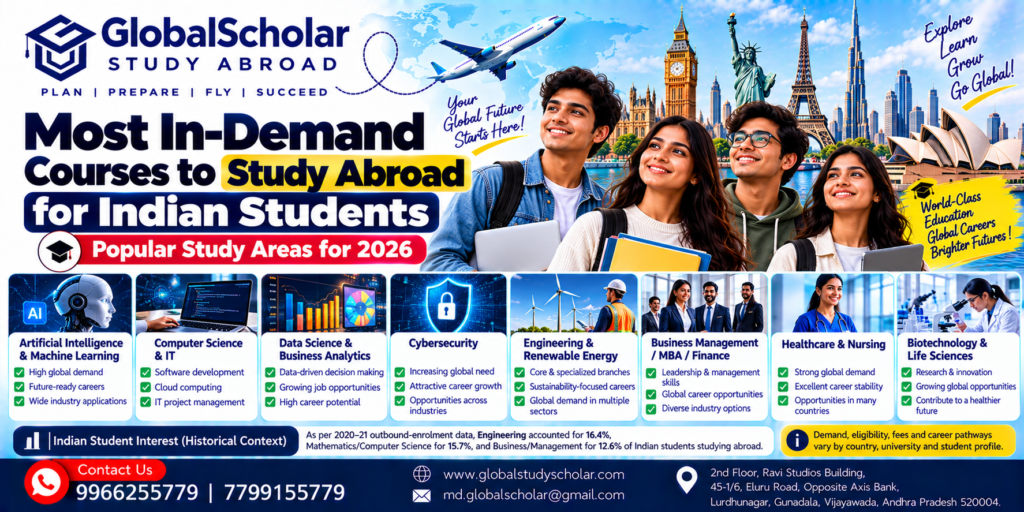
Choosing the right course is one of the most important decisions when planning to study overseas. The right programme can help students build relevant skills, gain international exposure and prepare for future career opportunities. With many universities and destinations available, understanding in-demand courses abroad can make the decision easier. For Indian students planning to study overseas in 2027, popular areas include Business and Management, Artificial Intelligence, Data Science, Cybersecurity, Computing, Engineering, Healthcare, Hospitality and Tourism, and Renewable Energy. However, course demand can vary by country, university, industry and student profile. At GlobalScholar Study Abroad, we help students compare courses, destinations, universities, eligibility requirements and application pathways before making an international education decision. Why Choose In-Demand Courses Abroad? Studying an in-demand course abroad can provide students with more than an international qualification. It can also offer opportunities to develop practical skills, experience different education systems and interact with students from different countries. However, students should not choose a course only because it is popular. A good course should match: Therefore, choosing in-demand courses abroad should be based on both market relevance and personal suitability. 1. Business and Management Business and Management remain broad study areas for international students. Students can explore programmes such as: Business programmes can be suitable for students who want to develop skills in leadership, communication, business strategy, finance, marketing and operations. Who Should Consider Business and Management? These courses may suit students who enjoy: Students should compare the curriculum, university, internship opportunities, location and career support before selecting a programme. 2. Artificial Intelligence and Machine Learning Artificial Intelligence has become an important area across technology, business and other industries. Students interested in this field can explore programmes such as: AI-related programmes may involve programming, mathematics, statistics, machine learning and data analysis. Students should carefully check the academic prerequisites because some advanced programmes may require mathematics, computing or programming experience. Career Areas Depending on qualifications and experience, graduates may explore roles related to: AI is therefore one of the important areas to consider when researching in-demand courses abroad. 3. Data Science and Business Analytics Data is increasingly important for organisations across different industries. Data-focused programmes can include: Students can learn how to collect, analyse and interpret data to support business and technical decisions. Skills You May Develop Depending on the programme, students may study: Students interested in data should check the course curriculum carefully because programmes can differ significantly in their technical depth. 4. Cybersecurity As organisations increasingly depend on digital systems, cybersecurity has become an important academic and professional area. Students can consider courses such as: A cybersecurity programme may cover areas such as network protection, security management, risk assessment and digital security. Who Can Consider Cybersecurity? Cybersecurity may be suitable for students interested in: Students should check whether the programme requires prior computing knowledge before applying. 5. Computer Science and Information Technology Computer Science continues to be a popular choice for students planning an international education. Possible programmes include: These programmes can provide students with technical and problem-solving skills. Popular Specialisations Depending on the university, students may find specialisations related to: When comparing universities, students should look beyond the course title and review the actual modules included in the programme. 6. Engineering Engineering remains a major international study area. Students can explore disciplines such as: Engineering programmes can combine theoretical knowledge with practical learning, laboratory work and project-based study, depending on the institution. Why Consider Engineering Abroad? International study can expose engineering students to different technologies, academic environments and industry practices. However, students should check professional accreditation and recognition requirements if they intend to work in a regulated engineering profession after graduation. 7. Healthcare and Life Sciences Healthcare and life sciences offer a wide range of academic pathways. Depending on the destination and university, students may explore: Students applying for regulated healthcare professions should pay particular attention to professional registration and licensing requirements in the destination country. A course that looks suitable academically may have additional professional requirements for employment. 8. Hospitality and Tourism Management Hospitality and Tourism can be an attractive option for students interested in international careers involving hotels, tourism, events and customer experience. Possible programmes include: Why Study Hospitality Abroad? Hospitality is an international industry. Studying abroad can allow students to experience different cultures and hospitality environments while developing professional skills. Depending on the programme, students may gain exposure to: For students interested in a practical and internationally oriented career, Hospitality Management can be one of the in-demand courses abroad worth researching. 9. Renewable Energy and Sustainability Sustainability and renewable energy are becoming increasingly important areas of study. Students can explore programmes related to: These courses can be particularly relevant for students interested in environmental challenges, energy systems and sustainable development. Before selecting a programme, students should review the modules and practical components carefully. How to Choose the Right Course Abroad in 2027 Choosing from many in-demand courses abroad can be confusing. Use the following process to make a better decision. Step 1: Understand Your Academic Background Start with your previous qualification. For example: 12th Grade Students May consider: Bachelor’s Degree Students May consider: Eligibility depends on the university and course. Step 2: Identify Your Career Interest Ask yourself: What type of work would I enjoy doing? For example: Technology → Computer Science, AI, Data Science or Cybersecurity Business → Management, Finance, Marketing or Business Analytics Engineering → Mechanical, Civil, Electrical or related engineering fields Hospitality → Hotel Management, Hospitality or Tourism Sustainability → Renewable Energy or Environmental Studies Your course should support your long-term career direction. Step 3: Compare Countries Different countries offer different academic systems, costs and immigration requirements. Popular destinations for Indian students include: For example, GLOBALSCHOLAR currently provides study-abroad information covering destinations including Europe, Ireland, Italy and Singapore. globalstudyscholar.com Students should compare: Why Course Selection Is More Important Than Just Choosing a Country Many students begin their study-abroad journey by asking: “Which country is best?” A better question is: “Which course and university are best for my profile
Study Abroad Consultant in Vijayawada: Your One-Stop Solution for Abroad Education

Planning to study abroad is an important decision. Students need to choose the right course, university and destination while also understanding admission requirements, documents, tuition fees and student visa procedures. For students in Vijayawada and Andhra Pradesh, having organised study abroad guidance can make the process easier to understand and manage. GlobalScholar Study Abroad provides guidance for students who are exploring international education opportunities, from course selection and university applications to visa documentation and pre-departure preparation. This guide explains the study abroad services available through GlobalScholar and the major steps students can consider when planning their international education journey. Study Abroad Consultancy in Vijayawada Choosing a university abroad involves more than simply selecting a country. Students should consider: A structured approach can help students compare their options before making an application. What Does a Study Abroad Consultant Do? A study abroad consultant can provide guidance at different stages of the international education process. Depending on the student’s requirements, guidance may include: The exact services available can vary by consultancy and student profile. 1. Personalized Counselling Every student has a different academic background and career goal. At GlobalScholar Study Abroad, the process can begin with understanding the student’s: Personalized counselling helps students identify study options that are relevant to their profile. Why Counselling Matters A student who has completed 12th grade may have different course options from a student who has already completed a bachelor’s degree. Similarly, students interested in hospitality, business, technology or other fields may require different university and course options. 2. University Selectionhttps://globalstudyscholar.com/study-destinations/ Choosing the right university is an important part of the study abroad process. Students should compare universities based on: Students should always review official university information before making their final decision. Compare Universities Carefully Don’t select a university only because it is popular. Instead, compare the specific course you want to study. Two universities offering courses with similar names can have different modules, teaching methods, assessment structures and practical opportunities. 3. Admission Assistance After selecting suitable courses and universities, students can begin the application process. The application process may involve: Requirements can vary between universities and courses. Common Study Abroad Documents Students may be asked for documents such as: Students should prepare clear and accurate documents before submitting applications. 4. Student Visa Guidance Admission to a university and approval of a student visa are separate processes. After receiving the required admission documents, students can prepare their visa application according to the requirements of their destination country. Visa preparation may involve: Students should always verify current visa requirements with the relevant government or immigration authority. Important No consultancy should present student visa approval as automatically guaranteed. Visa decisions are made by the relevant immigration authority based on the applicable rules and the applicant’s circumstances. 5. Pre-Departure Support Receiving your student visa is an important milestone, but preparation should continue before you travel. Pre-departure preparation can include guidance on: Pre-Departure Checklist Before leaving India, students should keep: ☐ Passport☐ Student visa☐ University documents☐ Admission/offer documents☐ Tuition payment receipts☐ Accommodation details☐ Flight details☐ Financial documents☐ Emergency contact information☐ Digital copies of important documents 6. Post-Arrival Support Moving to another country can be a major change for students. Post-arrival guidance can help students understand practical aspects of settling into their new environment. This may include general guidance regarding: Students should also make use of the official support services provided by their university. 7. Career Guidance Studying abroad is not only about obtaining a qualification. Students should think about how their chosen course connects with their career goals. Career planning may include understanding: Students should research current employment conditions and relevant regulations for their destination and profession. Popular Study Abroad Destinations Students from Vijayawada can explore international education opportunities across several destinations. GlobalScholar’s creative highlights destinations including: The right destination depends on the student’s course, eligibility, budget and personal preferences. Study in the UK Students can explore undergraduate and postgraduate programmes across different academic fields. Internal link:Study in UK Study in USA Students can explore a wide range of academic programmes and university options. Internal link:Study in USA Study in Canada Students can compare courses, universities and admission requirements. Internal link:Study in Canada Study in Australia Australia offers programmes across business, hospitality, technology, engineering and other fields. Internal link:Study in Australia Study in Germany Students interested in European education can explore suitable programmes based on their academic background. Study in France France offers international study opportunities across different academic fields. Study in Italy Students can explore Italian institutions and courses according to their academic interests. Study in Malta Malta is another European destination students can explore for international education. Study in Singapore Singapore offers study opportunities in fields such as business, hospitality, technology and other disciplines. Study in Dubai Dubai offers international education options across several academic areas. Study in Mauritius Students can explore study opportunities in Mauritius, including programmes related to hospitality, business and other fields. Popular Courses to Study Abroad Students can explore many different fields depending on their qualifications and interests. Hotel Management & Hospitality Students interested in hotels, tourism, resorts, food and beverage, events and hospitality operations can explore hotel management and hospitality programmes. Internal link:Hotel Management Course Business & Management Possible study areas include: Information Technology Possible areas include: Engineering Students can explore engineering programmes based on their previous qualifications and subject background. Tourism Management Students interested in tourism and travel can explore programmes related to: Why Students from Vijayawada Choose GlobalScholar Students looking for study abroad guidance in Vijayawada can use GlobalScholar Study Abroad to discuss their international education plans. The services shown in our study abroad campaign include: Personalized Counselling Guidance based on the student’s academic profile and goals. University Selection Support in identifying suitable courses and universities. Admission Assistance Application and offer letter guidance. Visa Guidance Support with understanding and preparing student visa documentation. Pre-Departure Support Preparation and orientation before travelling abroad. Post-Arrival Support General guidance for settling into the new study destination. Career Guidance Support in understanding internships and international
Study Abroad Admission Process: Step-by-Step Guide for Students
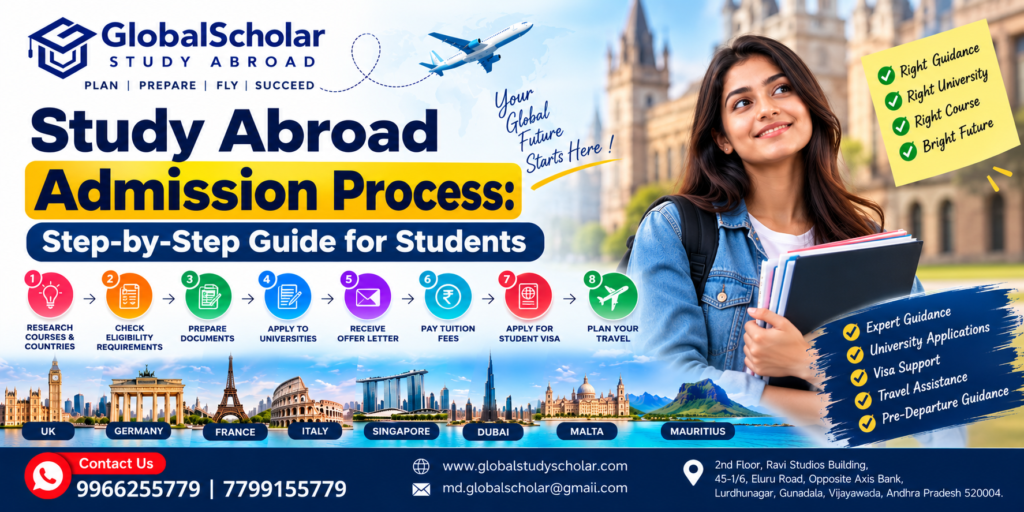
A complete guide to the study abroad admission process, covering course selection, eligibility, documents, university applications, offer letters, fees, student visas and travel.
How to Choose the Right Course to Study Abroad

Choosing the right course to study abroad is an important decision for students planning an international education. The course you select can influence your university options, study destination, budget, internship opportunities and future career path. Many students start by choosing a country or university. However, it is also important to first understand your interests, academic background and career goals. In this guide, we explain how to choose a course to study abroad by considering your interests, career opportunities, eligibility, tuition fees, return on investment, country and university. 1. Understand Your Interests The first step when choosing the right course to study abroad is understanding your interests. Think about the subjects you enjoy studying and the type of work you would like to do in the future. For example, students interested in hotels, tourism and customer service may explore hospitality and hotel management courses. Students interested in technology may consider IT and computer science programs. Your interests should be one of the factors you consider before selecting a course. 2. Explore Your Career Options Before selecting a course, research the career opportunities associated with it. Ask yourself: Understanding possible career paths can help you make a more informed decision. 3. Check Your Eligibility Every course and university can have different admission requirements. Before applying, check: Your academic background should match the requirements of the course you are considering. If you are unsure about eligibility, you can discuss your academic profile with a study abroad consultant before applying. 4. Compare Study Abroad Courses There are many types of study abroad courses available for international students. Depending on your academic background and career interests, you may explore areas such as: Hotel Management & Hospitality Students interested in hospitality, hotels, tourism, restaurants and related industries can explore international hotel management and hospitality programs. Business & Management Business-related programs can include areas such as business management, international business, marketing, finance and entrepreneurship. IT & Computer Science Students interested in technology can explore programs related to computer science, information technology, software and digital technologies. Engineering Engineering offers different specializations depending on the university and country. Healthcare & Life Sciences Students interested in healthcare and life sciences can explore relevant undergraduate and postgraduate programs based on their academic background and eligibility. Design & Creative Arts Design, media, communication and creative programs may be suitable for students interested in creative careers. The availability of specific programs, entry requirements and career opportunities varies by university and destination. 5. Compare Tuition Fees and Living Costs Your budget is another important factor when selecting a course abroad. Don’t consider tuition fees alone. Your overall study budget can include: Compare the total estimated cost before selecting a course and destination. You should also check whether scholarships or other financial support options are available for the specific university or program. 6. Consider the Return on Your Investment When comparing courses, look beyond the initial tuition fee. Consider the value of the education in relation to: A lower tuition fee does not automatically mean that a course is the right choice. Similarly, a higher tuition fee does not automatically mean better career outcomes. Compare the course structure, learning opportunities and your own career objectives before making a decision. 7. Choose the Right Country Your choice of country can affect your overall international education experience. Consider factors such as: Countries such as the UK, France, Germany, Italy, Malta, Singapore, Dubai and Mauritius offer different types of international education opportunities. However, the suitability of a destination depends on the student’s course, academic profile, budget and individual goals. 8. Select the Right University After identifying a suitable course and destination, compare universities. Check: Do not select a university based only on its name. Read the actual course information and compare the program details. 9. Check Course Duration Course duration can vary depending on the country, university and qualification. For example, you may find: Compare the duration of the course with your academic and career plans. A course with a suitable duration may help you plan your overall education budget and timeline more effectively. 10. Look at Practical Learning and Internships For some courses, practical experience can be an important part of the learning process. Before applying, check whether the program includes: The availability and conditions of internships or work opportunities depend on the specific institution, program and applicable regulations. Therefore, always verify the current details before making an application. 11. Match the Course With Your Academic Background Your previous education is an important part of course selection. For example, a student applying for a postgraduate program may need a relevant bachelor’s degree or other specific qualification. Before applying, prepare: The exact document requirements vary by institution and course. 12. Consider Your Long-Term Goals Don’t choose a course only because it is popular. Ask yourself: Where do I want this course to take me? Your answer can help you compare different programs. For example, if your goal is to build a career in hospitality, you may want to compare hotel management and hospitality programs. If you are interested in technology, you may explore IT or computer science programs. The right course should connect your education with your broader career objectives. Popular Course Areas for Study Abroad Students can explore many different academic fields depending on their qualifications and interests. Some common areas include: Always check the exact course availability and entry requirements with the institution before applying. How GlobalScholar Study Abroad Can Help Choosing the right course to study abroad can involve comparing multiple factors. GlobalScholar Study Abroad in Vijayawada provides guidance for students exploring international education opportunities. Our guidance can include: Students can discuss their academic background, preferred course, budget and destination preferences before deciding where and what to study. GlobalScholar Study Abroad Study Abroad Application Process A typical study abroad journey can include the following steps: Step 1: Understand Your Goals Identify your interests, academic background and career objectives. Step 2: Choose a Course Compare relevant courses based on curriculum, eligibility, duration and career objectives.
How to Choose the Right Study Abroad Country for Indian Students

Choosing the right Study Abroad Country is one of the most important decisions for an international student. The right destination depends on your course, budget, career plans, visa requirements, lifestyle and long-term goals. Students from Vijayawada and Andhra Pradesh can explore several international destinations, including the UK, USA, Germany, France, Italy, Malta, Singapore, Dubai, Mauritius and other countries. However, there is no single country that is suitable for every student. Instead, you should compare your options carefully and choose a Study Abroad Country that matches your academic background, financial plan and career goals. This guide explains the major factors you should consider before selecting a country for your international education journey. What Is a Study Abroad Country? A Study Abroad Country is a foreign country where an international student chooses to pursue education. Students may travel abroad for: The best destination depends on the student’s individual requirements. Why Is Choosing the Right Country Important? Your destination can affect many parts of your international education experience. For example, the country you select can influence: Therefore, choosing a country should not be based only on popularity. A better approach is to compare several destinations and identify the option that fits your personal situation. 10 Important Factors to Choose a Study Abroad Country Before selecting your destination, compare these important factors. 1. Choose a Study Abroad Country Based on Your Course Your first step should be identifying the course you want to study. Different countries have different strengths and course options. For example, students may explore: Start by identifying your preferred course. Then compare which countries offer suitable programmes. 2. Compare Tuition Fees Tuition fees are an important part of your study abroad budget. Before choosing a Study Abroad Country, compare: Don’t compare only the first-year tuition fee. Instead, calculate the estimated total cost of your programme. This can help you create a more realistic financial plan. 3. Compare Living Costs Tuition fees are only one part of your expenses. You may also need to budget for: Living costs can also vary between cities within the same country. For example, studying in a major city may have different accommodation and transportation costs compared with a smaller city. Therefore, compare the total cost of studying abroad, not just tuition fees. 4. Check Admission Requirements Every university or institution has its own admission requirements. Before choosing a country, check: Some courses may also have additional requirements. Always check the current requirements of the institution before submitting an application. 5. Check English-Language Requirements English-language requirements can differ by university, programme and destination. Depending on the institution, students may be asked to provide an accepted English-language qualification such as: Some institutions may accept alternative evidence of English proficiency. Therefore, don’t assume that the same English requirement applies to every university. Check the official course requirements before applying. 6. Understand Student Visa Requirements Visa requirements are another important factor when selecting a Study Abroad Country. Before applying, understand: Visa rules can change. Therefore, students should always verify the latest requirements through the relevant official government or immigration website before submitting a visa application. 7. Consider Career Opportunities Your study abroad decision should also consider your career plans. Ask yourself: What do I want to do after graduation? For example: Your answers can help you compare countries and courses more effectively. 8. Look at Internship and Practical Training Options Practical experience can be valuable for students. Depending on the course and institution, students may find: However, internship availability is course- and institution-specific. Some programmes may include an internship as part of the curriculum, while others may not. Therefore, check the actual course structure before making a decision. 9. Consider Lifestyle and Culture Studying abroad is not only about academics. You will also live in the destination for an extended period. Consider: Think about the environment in which you will feel comfortable studying and living. 10. Consider Your Long-Term Goals Your long-term plan should also influence your choice. Students may have different goals. For example: Goal 1: Complete a degree and return to India. Goal 2: Gain international work experience. Goal 3: Build an international professional network. Goal 4: Continue with higher education. Goal 5: Explore career opportunities after graduation, subject to the country’s immigration rules. Your destination should match your actual goals. Popular Study Abroad Countries for Indian Students Indian students can explore many destinations depending on their course, budget and eligibility. UK The UK is a popular destination for international students and offers a wide range of undergraduate and postgraduate programmes. Students can explore fields such as: The UK may be considered by students looking for a wide range of academic programmes. USA The USA offers a large selection of universities and academic programmes. Students can explore areas such as: Admission requirements, tuition costs and visa requirements vary between institutions. Germany Germany is another destination students may consider for international education. Students can explore: Students should carefully check the language, academic and financial requirements of their selected programme. France France can be considered by students interested in areas such as: Some programmes may be available in English, while others may require French proficiency. Italy Italy offers programmes across several academic areas. Students can explore: Course availability and admission requirements vary by institution. Malta Malta is another European destination that students may consider for selected programmes. Popular areas can include: Students should check institution-specific admission and visa requirements. Singapore Singapore is known for its education and international business environment. Students can explore programmes related to: Course availability depends on the institution and qualification. Dubai and UAE Dubai and the wider UAE offer a range of international education options. Students can explore: Students should compare institution accreditation, tuition fees, course structure and visa requirements before applying. Mauritius Mauritius can be considered by students looking for programmes in areas such as: Students should compare the institution and course carefully before making a decision. Study Abroad Country Comparison Checklist Before selecting a destination, create a simple comparison. Factor Country A Country
What Is Hotel Management? A Complete Guide for Students

Hotel Management is a professional field focused on managing hotels, resorts, restaurants and other hospitality businesses. It combines customer service, business management, operations, food and beverage, accommodation, marketing and leadership skills. For students who enjoy meeting people, working in a dynamic environment and building an international career, Hotel Management can offer several study and career pathways. A Hotel Management course can also provide practical learning through internships, industry projects and work experience, depending on the institution and programme. UK hospitality courses, for example, can include placements, internships and industry experience as part of some programmes. What Is Hotel Management? Hotel Management is the study and practice of managing the daily operations of a hotel or hospitality business. A hotel has many departments. Each department needs trained professionals to ensure smooth operations and good guest experiences. Hotel Management can include: The exact subjects depend on the course, university or college. Why Study Hotel Management? Students choose Hotel Management for different reasons. The hospitality industry offers a wide range of work environments. Graduates may work in hotels, resorts, restaurants, tourism businesses, events, airlines, cruise companies and other service-related organisations. Major benefits of studying Hotel Management include: The British Council’s Study UK information highlights hospitality, leisure and tourism courses as offering areas such as digital customer experience, sustainable tourism, events, logistics and hospitality operations. Hotel Management Courses Students can choose different types of Hotel Management Courses depending on their academic qualifications and career plans. Diploma in Hotel Management A diploma can provide practical knowledge of hospitality operations. Common areas may include: Diploma duration varies by institution. Bachelor’s Degree in Hotel Management A bachelor’s degree provides broader academic and practical knowledge. Typical subjects may include: Some programmes also include internships or industry placements. Master’s in Hospitality Management Students who already have a bachelor’s degree can consider postgraduate study. Possible areas include: Course names, entry requirements and duration vary between institutions. Hotel Management Specializations One of the biggest advantages of Hotel Management is the range of specializations available. Front Office Management Front office professionals interact directly with guests. Responsibilities can include: Food and Beverage Management This area focuses on restaurants, cafés, catering and food service operations. Students can learn about: Housekeeping Management Housekeeping is an important part of hotel operations. Students can learn about: Event Management Hospitality graduates can also move into events. Career areas may include: Tourism Management Tourism and hospitality are closely connected. Students interested in tourism can explore areas such as: Hotel Management Skills Students Can Develop A good Hotel Management Course can help students develop both technical and soft skills. Important skills include: Communication Hospitality professionals communicate with guests, colleagues, suppliers and managers. Customer Service Understanding customer expectations is important in hospitality. Teamwork Hotels operate through multiple departments. Therefore, teamwork is essential. Leadership Students can develop leadership skills through practical projects and industry experience. Problem Solving Hospitality professionals often need to respond quickly to guest requests and operational issues. Time Management Hotels operate continuously, so employees need to manage priorities efficiently. Business Skills Hotel managers also need knowledge of finance, marketing, operations and staff management. Hotel Management Internships and Practical Training Practical experience is an important part of hospitality education. Depending on the programme, students may have access to: However, internship availability, duration and payment depend on the institution, course and destination. For example, Study UK notes that hospitality programmes can offer work experience through placements, internships and industry connections. Students should always check the official course information before making an application. Study Hotel Management Abroad Students can explore Hotel Management Abroad in several destinations. Popular international study destinations include: UK The UK offers hospitality, leisure and tourism programmes at universities and specialist institutions. Study UK highlights a wide range of hospitality-related courses and industry experience opportunities. France France is well known for tourism, hospitality, food and luxury services. Students can explore hospitality and hotel-related programmes depending on their academic background. Switzerland Switzerland is strongly associated with hospitality education and has specialist hospitality institutions. Malta Students can explore hospitality and business-related programmes in Malta, subject to the institution’s admission requirements. Singapore Singapore offers hospitality and tourism programmes connected with its international tourism and service economy. Dubai and UAE Dubai has a large hospitality and tourism sector. Students can explore hotel management, hospitality and tourism programmes offered by institutions in the UAE. Mauritius Mauritius has a strong tourism and hospitality sector, with programmes related to hotel management and tourism. Italy Italy can be considered by students interested in hospitality, tourism, culinary arts and related fields. The right destination depends on the student’s academic background, budget, preferred course, language requirements, career plans and visa eligibility. Hotel Management Eligibility Eligibility depends on the course and institution. For undergraduate programmes, students may generally need to complete the required secondary or higher-secondary qualification. For postgraduate programmes, students normally need a relevant bachelor’s degree or another qualification accepted by the institution. Additional requirements can include: Requirements can vary significantly, so students should check the official institution requirements before applying. English Language Requirements for Hotel Management International students may need to demonstrate English-language proficiency. Depending on the institution and course, accepted tests can include: Some institutions may consider alternative evidence of English proficiency, depending on their rules. Students should not assume that one English-language requirement applies to every university. Hotel Management Fees The cost of studying Hotel Management varies widely. The total cost can depend on: Therefore, students should calculate the complete study budget rather than looking only at tuition fees. Scholarships may also be available at some institutions. Hotel Management Career Opportunities After completing a Hotel Management Course, graduates can explore different career areas. Possible roles include: Career progression depends on qualifications, experience, skills, employer and location. Hospitality education can also lead to careers outside traditional hotels. Study UK lists roles including hotel manager, tour manager, tourism officer, travel agency manager and other hospitality and tourism careers. Hotel Management Career Opportunities Abroad An international qualification and relevant experience can help students explore hospitality careers across different
Study in France with Paid Internship – January 2027 Intake

Study in France with a paid internship and explore an international education experience in Europe. For students planning to study in France in 2027, selected programmes may combine academic study with practical training or internship opportunities. The January 2027 intake can be an option for students who want to begin their studies early in the year. However, intake availability, programme duration, internship terms, tuition fees, language requirements and visa conditions depend on the institution and course. For students from Vijayawada and across India, early preparation can make the admission process easier. 6 Why Study in France in 2027? France is a popular destination for international students looking for European education and international exposure. Students can explore programmes across areas such as: In addition, France offers opportunities to experience European culture, develop international networks and gain exposure to different professional environments. January 2027 Intake in France The January 2027 intake shown in the GlobalScholar Study Abroad campaign is intended for selected programmes that have a January start date. Not every French institution offers a January intake. Therefore, students should check the exact intake date with the institution before applying. When planning for January 2027, students should consider: Early preparation is important because admission and visa processes can take time. Study in France with Paid Internship One of the key features promoted in the flyer is: 6 Months Study + 6 Months Paid Internship This structure is programme-specific. Students should not assume that every course in France follows a six-month study and six-month internship model. An internship can give students practical exposure related to their course. A programme with an internship may help students: The internship must follow the rules applicable to the specific programme and institution. Campus France explains that internships that form part of a degree programme have specific requirements, including an internship agreement. What Is a Paid Internship in France? A paid internship is an internship for which the student receives compensation when the applicable legal conditions are met. In France, internships that last more than two months generally require compensation under the applicable rules. The internship also requires an agreement between the educational institution and the organisation hosting the student. However, internship compensation should not be treated as guaranteed income for every programme. Students should check the internship agreement, duration, employer and programme terms before accepting an offer. Hotel Management and Hospitality Courses in France France can be an interesting destination for students interested in hospitality and tourism. Hospitality-related programmes may cover areas such as: Hotel Operations Students can learn about: Food and Beverage Possible subjects include: Tourism Students may study: Hospitality Business Business-focused hospitality programmes may cover: Course content varies by institution, so students should review the official programme curriculum before applying. Eligibility to Study in France Eligibility depends on the programme and institution. Students may need to meet requirements related to: For example, a postgraduate programme can have very different entry requirements from an undergraduate hospitality programme. Therefore, students should not rely on a general eligibility rule. The university or institution’s official requirements should be checked for each course. IELTS Requirements for France The flyer notes that IELTS requirements depend on the university or programme, and that MOI may be accepted by selected institutions. This is an important distinction. Some programmes may accept: However, acceptance varies. Before applying, students should confirm whether IELTS is required and whether an MOI letter is accepted for the selected programme. Can I Study in France Without IELTS? Some institutions or programmes may accept alternative proof of English proficiency, including an MOI document, where their admission policy allows it. However, “without IELTS” does not mean that every French institution accepts students without an English test. Students should verify: The final requirement depends on the selected institution and programme. Tuition Fees to Study in France Tuition fees vary significantly depending on the type of institution and programme. For public higher education institutions, Campus France lists differentiated registration fees for many non-EU students for the 2026/27 academic year at €2,902 for Licence-level programmes and €3,950 for Master’s programmes. Some students and programmes can be exempt from these differentiated fees. Private institutions can have substantially different fees. Campus France states that private higher education fees vary by institution and can be considerably higher than public university registration fees. For a January 2027 programme, check: Do not assume that the public-university fee applies to a private hospitality or business school. Scholarships in France Scholarships may be available depending on the institution, programme and student’s profile. Possible sources include: Campus France notes that certain international students can receive tuition-fee exemptions under specific circumstances, while institutions may also grant additional exemptions. Students should check scholarship deadlines separately from admission deadlines. Can International Students Work While Studying in France? Yes, eligible international students in France can work subject to the applicable rules. Campus France states that foreign students can work up to 964 hours per year, equivalent to around 20 hours per week. This work allowance is separate from a programme-required internship. Campus France explains that internships completed as part of a degree course do not count toward the 964-hour annual work limit. Important Part-time work should not be treated as a guaranteed way to pay all tuition or living expenses. Students should have sufficient funds for their education and living costs before travelling to France. Paid Internship vs Part-Time Work These two concepts are different. Paid Internship Part-Time Work Usually connected to the academic programme Separate employment Often requires an internship agreement Employment relationship Can provide course-related experience Can provide general work experience Terms depend on programme and employer Subject to student work rules May have specific compensation rules Subject to employment rules Understanding this difference is important when planning your finances and career expectations. Post-Study Options in France France has specific residence options for certain international graduates. Eligible non-EU graduates who have completed qualifying French higher education, including a Master’s or equivalent qualification, may apply for a residence card or VLS-TS for job search or
Study Abroad After 10th in 2026: Countries, Courses & Pathways for Indian Students
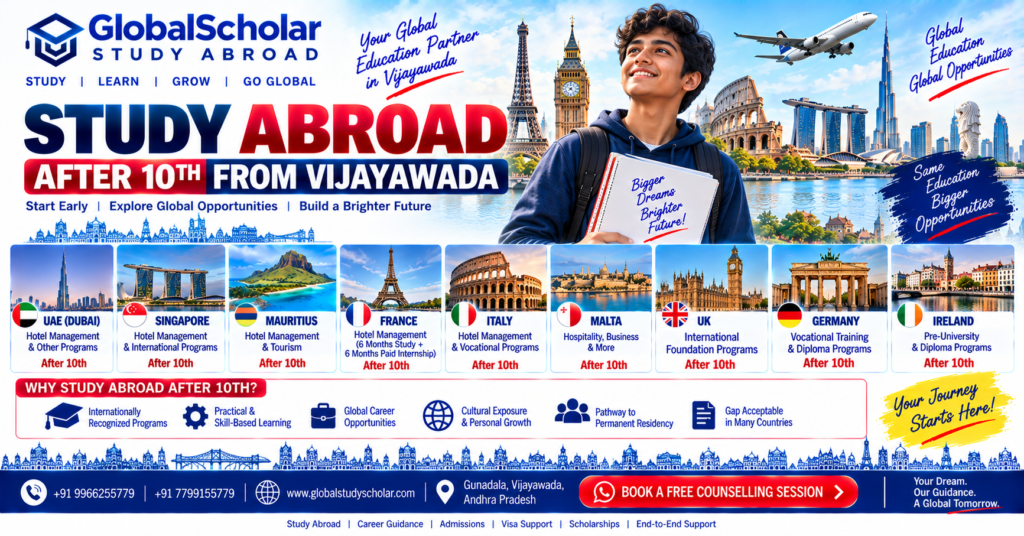
Studying abroad after 10th can open new education pathways for Indian students. Students can explore diploma programs, foundation courses, vocational training and other school-level study options in different countries. For students from Vijayawada and across Andhra Pradesh, early planning can help with course selection, eligibility, documents, finances and visa preparation. However, studying abroad immediately after Class 10 is not the same in every country. Age, qualification, course level, institution and visa rules can affect eligibility. Therefore, students should check the current requirements before making an application. 6 What Does Study Abroad After 10th Mean? Study abroad after 10th means starting an international education pathway after completing Class 10 instead of waiting until Class 12. Depending on the destination, students may find options such as: However, availability varies by country and institution. A course advertised as available after 10th may have additional age, academic or language requirements. Why Study Abroad After 10th? Many students start planning their international education soon after Class 10. 1. Explore International Education Early Students can become familiar with different education systems and career pathways at an early stage. 2. Focus on Practical Learning Some diploma and vocational programs focus on practical skills. These courses may suit students who prefer hands-on learning. 3. Explore Career-Focused Courses Students interested in hospitality, business, technology, vocational training or other fields can explore suitable programs based on their qualifications. 4. Gain International Exposure Living and studying in another country can provide exposure to different cultures, teaching methods and student communities. 5. Plan a Long-Term Education Pathway A diploma or foundation course may form part of a longer education plan. However, progression to another qualification is never automatic. The student must meet the progression requirements of the next institution or course. Countries to Explore After 10th The flyer from GlobalScholar Study Abroad highlights several destinations for students interested in studying abroad after Class 10. These include: Each destination has different admission and immigration rules. Therefore, students should assess each option separately. 1. Study in UAE After 10th The UAE, including Dubai, has education options across hospitality, business and other areas. For students interested in Hotel Management after 10th, some institutions may offer diploma or pathway programs. Entry requirements can vary by institution. Possible areas of study Before applying, students should check the institution’s academic requirements, minimum age, course duration and visa conditions. 2. Study in Singapore After 10th Singapore is another destination that students may explore for international education. Hospitality and international programs can be relevant for students interested in hotel management and tourism. Possible study areas Admission rules depend on the institution and qualification. Students should therefore check whether Class 10 is sufficient for the specific program. 3. Study in Mauritius After 10th Mauritius offers education options in areas such as hospitality, tourism and business. Students interested in Hotel Management after 10th can explore available diploma and pathway options. Possible areas Course eligibility, duration and progression opportunities depend on the institution. 4. Study Hotel Management in France After 10th France is well known for hospitality and tourism education. Students interested in hotel management can explore hospitality-related programs and practical training options. Some programs may offer a combination of classroom learning and practical experience. However, the exact course structure depends on the institution and program. Students should check: 5. Study in Italy After 10th Italy can be considered by students interested in hospitality, tourism and vocational education. Possible areas may include: Students must check the specific entry qualification required by the institution. A Class 10 qualification does not automatically make a student eligible for every Italian program. 6. Study in Malta After 10th Malta offers programs in areas such as hospitality, business and other fields. For students interested in hospitality, possible study areas can include: Course and visa eligibility depend on the selected institution, program level, age and student profile. Students should confirm the latest requirements before submitting an application. 7. Study in the UK After 10th The UK requires particular attention because visa eligibility depends on the student’s age and type of education. For students aged 16 or over, the UK Student route can cover further or higher education, including recognised foundation programs, subject to the relevant requirements. Students aged 4 to 17 who want to study at an independent school may qualify for the Child Student route, subject to its requirements. Therefore, students should not assume that every UK foundation or diploma course is available immediately after Class 10. UK pathways may include The student’s age, course, sponsor and academic qualification all matter. 8. Study in Germany After 10th Germany is particularly relevant for students interested in vocational education. Germany has both dual vocational training and school-based vocational training. Requirements vary between these pathways. For dual vocational training, German law does not set one specific school-leaving qualification for every occupation. However, individual companies can set their own requirements. School-based vocational training generally requires completed general school education and official recognition of the qualification. German language skills are also important. The official German government portal states that applicants generally need B1 German for vocational training when the institution has not already assessed their language skills or the applicant has not completed a preparatory German course. So, Germany can be an option to explore, but students should plan their qualification and German-language preparation carefully. 9. Study in Ireland After 10th Ireland is another destination that may be considered for international education pathways. Students can explore: Eligibility depends on the specific institution and program. Students should confirm whether their Class 10 qualification meets the entry requirement before applying. Popular Courses After 10th Abroad The right course depends on the student’s interests and long-term education plan. Hotel Management Hotel Management can be suitable for students interested in: Hospitality Management Hospitality programs can cover areas such as: Tourism Tourism courses can introduce students to: Business Business-related pathways may introduce students to: Vocational Training Vocational education focuses more strongly on practical skills. Germany, for example, has both company-based and school-based vocational training pathways. Study Abroad
🎓 EDUCATION LOAN FOR STUDY ABROAD 2026: COMPLETE GUIDE FOR INDIAN STUDENTS

Education Loan for Study Abroad can help Indian students manage the cost of international education, including tuition fees and, depending on the lender and approved loan structure, certain education-related expenses. Studying abroad involves more than tuition fees. Students may also need to plan for accommodation, travel, books, insurance and living expenses. An education loan can be one part of a student’s overall financial plan. In this guide, we explain how education loans for study abroad generally work, what expenses may be covered, eligibility and documents, collateral considerations, loan application steps, repayment and how GlobalScholar Study Abroad can help students understand their financing options. Important: Loan approval, interest rates, collateral requirements, margins, eligible expenses and repayment terms depend on the lender, loan scheme, university/course and applicant profile. Always confirm the current terms directly with the bank or financial institution before applying. What Is an Education Loan for Study Abroad? An education loan for study abroad is financing provided by a bank or eligible financial institution to help students fund higher education outside India. Depending on the lender and approved scheme, the loan may cover some combination of: For example, SBI’s published student-loan information includes tuition fees and certain study-related expenses among eligible costs, subject to the applicable scheme and conditions. The exact amount and expenses covered should always be confirmed with the lender. Why Consider an Education Loan for Overseas Education? Studying abroad can require significant financial planning. An education loan may help families manage education costs without paying the entire amount from savings at the beginning. Potential benefits include: 1. Managing tuition expenses Tuition can represent a major part of the total study-abroad budget. Approved loan funding may help cover eligible tuition expenses. 2. Supporting other education costs Depending on the lender, certain accommodation, travel, books and other education-related costs may also be considered. 3. Preserving savings Using financing for eligible education expenses may allow families to retain some savings for emergencies and other financial commitments. 4. Structured repayment Education loans generally provide a defined repayment structure, including applicable moratorium and EMI arrangements. 5. Multiple lender options Students can compare loan products from different banks and financial institutions based on their eligibility and requirements. What Can an Education Loan Cover? The exact coverage varies between lenders, but an overseas education loan may potentially cover several categories. Tuition Fees Tuition fees are generally one of the main expenses considered under education-loan schemes. The amount financed depends on the approved loan, course, institution and lender’s terms. Accommodation and Living Expenses Some loan schemes may consider eligible hostel, accommodation or reasonable living expenses. Students should ask the lender exactly which expenses qualify before including them in their financial plan. Travel Expenses Some study-abroad loan schemes may include travel or passage expenses. For example, published SBI student-loan documentation lists travel expenses/passage money for studies abroad among eligible expenses under the relevant scheme. Books and Study Equipment Books, equipment and other academic expenses may be eligible under certain loan schemes. Other Education-Related Costs Depending on the lender, approved expenses may include additional course-related costs. The final eligible amount is determined by the lender according to its applicable rules. Education Loan Eligibility for Study Abroad Eligibility differs between banks and financial institutions. Common factors that lenders may consider include: Students should not assume that meeting one bank’s criteria means they automatically qualify with every lender. Documents Required for an Education Loan Students are generally asked to provide personal, academic, admission and financial documents. The exact list varies by lender. Student Documents Parent or Co-Applicant Documents Depending on the lender: Property Documents If collateral is required, the lender may request relevant property documents. The bank or financial institution will provide the final document checklist. Collateral-Free Education Loans for Study Abroad One of the most common questions students ask is: “Can I get an education loan without collateral?” The answer depends on the lender, loan amount, course, institution, applicant profile and applicable scheme. Some lenders may offer collateral-free options for eligible students under specific conditions, while larger loan amounts may require collateral or additional security. For example, SBI’s published student-loan terms show a nil margin up to ₹4 lakh and a 15% margin above ₹4 lakh for studies abroad under the cited student-loan scheme; other SBI products and lenders can have different conditions. Therefore, students should not assume that every overseas education loan is collateral-free. What Is a Co-Applicant? A co-applicant is commonly a parent or guardian who participates in the education-loan application. The lender may assess the co-applicant’s: The exact co-applicant requirements vary by lender. How Much Education Loan Can I Get for Study Abroad? There is no single loan amount applicable to every student. The approved amount can depend on: For example, SBI publishes different limits under different education-loan products, including a standard student-loan limit and a separate Global Ed-Vantage product for eligible overseas study. This is why students should compare the specific loan product, rather than relying on a generic maximum loan figure. Education Loan Interest Rate Interest rates vary by: Students should compare: Always ask the lender for the current applicable rate and complete terms before accepting the loan. What Is a Loan Margin? A loan margin is the portion of the eligible education cost that may need to be contributed by the student or family rather than financed by the lender. For example, SBI’s published student-loan terms state that for studies abroad, the margin is 15% for amounts above ₹4 lakh under that particular scheme. This does not mean every bank applies a 15% margin. The applicable margin depends on the lender and loan product. Education Loan Repayment and Moratorium Education loans generally include a repayment structure that allows the student to complete the course before regular repayment begins. Under the IBA Model Educational Loan Scheme information published by the Ministry of Education, the repayment holiday/moratorium is described as the course period plus one year, followed by repayment over a specified period, subject to the applicable scheme. However, students should check the