
Study in France with Paid Internship – January 2027 Intake
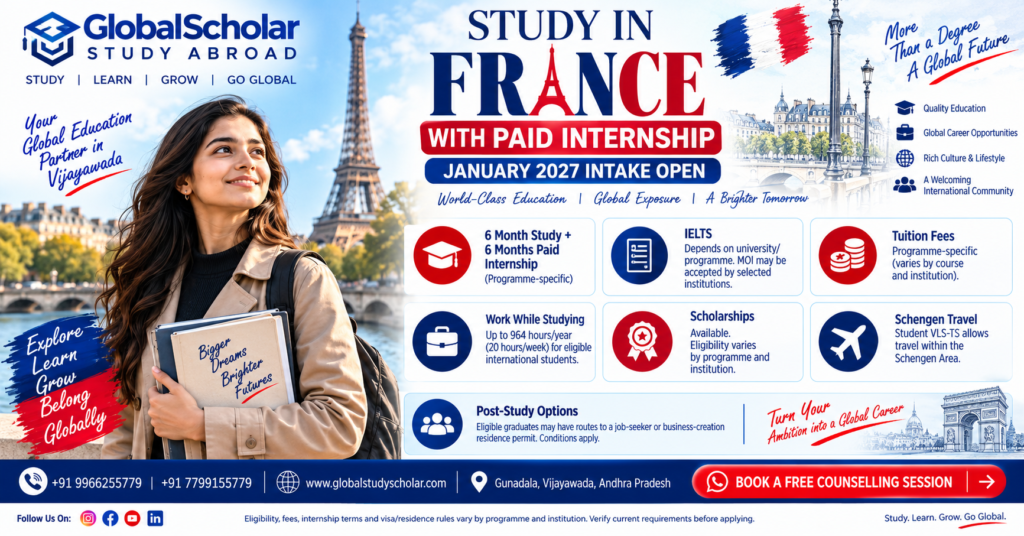
Study in France with a paid internship and explore an international education experience in Europe. For students planning to study in France in 2027, selected programmes may combine academic study with practical training or internship opportunities. The January 2027 intake can be an option for students who want to begin their studies early in the year. However, intake availability, programme duration, internship terms, tuition fees, language requirements and visa conditions depend on the institution and course. For students from Vijayawada and across India, early preparation can make the admission process easier. 6 Why Study in France in 2027? France is a popular destination for international students looking for European education and international exposure. Students can explore programmes across areas such as: In addition, France offers opportunities to experience European culture, develop international networks and gain exposure to different professional environments. January 2027 Intake in France The January 2027 intake shown in the GlobalScholar Study Abroad campaign is intended for selected programmes that have a January start date. Not every French institution offers a January intake. Therefore, students should check the exact intake date with the institution before applying. When planning for January 2027, students should consider: Early preparation is important because admission and visa processes can take time. Study in France with Paid Internship One of the key features promoted in the flyer is: 6 Months Study + 6 Months Paid Internship This structure is programme-specific. Students should not assume that every course in France follows a six-month study and six-month internship model. An internship can give students practical exposure related to their course. A programme with an internship may help students: The internship must follow the rules applicable to the specific programme and institution. Campus France explains that internships that form part of a degree programme have specific requirements, including an internship agreement. What Is a Paid Internship in France? A paid internship is an internship for which the student receives compensation when the applicable legal conditions are met. In France, internships that last more than two months generally require compensation under the applicable rules. The internship also requires an agreement between the educational institution and the organisation hosting the student. However, internship compensation should not be treated as guaranteed income for every programme. Students should check the internship agreement, duration, employer and programme terms before accepting an offer. Hotel Management and Hospitality Courses in France France can be an interesting destination for students interested in hospitality and tourism. Hospitality-related programmes may cover areas such as: Hotel Operations Students can learn about: Food and Beverage Possible subjects include: Tourism Students may study: Hospitality Business Business-focused hospitality programmes may cover: Course content varies by institution, so students should review the official programme curriculum before applying. Eligibility to Study in France Eligibility depends on the programme and institution. Students may need to meet requirements related to: For example, a postgraduate programme can have very different entry requirements from an undergraduate hospitality programme. Therefore, students should not rely on a general eligibility rule. The university or institution’s official requirements should be checked for each course. IELTS Requirements for France The flyer notes that IELTS requirements depend on the university or programme, and that MOI may be accepted by selected institutions. This is an important distinction. Some programmes may accept: However, acceptance varies. Before applying, students should confirm whether IELTS is required and whether an MOI letter is accepted for the selected programme. Can I Study in France Without IELTS? Some institutions or programmes may accept alternative proof of English proficiency, including an MOI document, where their admission policy allows it. However, “without IELTS” does not mean that every French institution accepts students without an English test. Students should verify: The final requirement depends on the selected institution and programme. Tuition Fees to Study in France Tuition fees vary significantly depending on the type of institution and programme. For public higher education institutions, Campus France lists differentiated registration fees for many non-EU students for the 2026/27 academic year at €2,902 for Licence-level programmes and €3,950 for Master’s programmes. Some students and programmes can be exempt from these differentiated fees. Private institutions can have substantially different fees. Campus France states that private higher education fees vary by institution and can be considerably higher than public university registration fees. For a January 2027 programme, check: Do not assume that the public-university fee applies to a private hospitality or business school. Scholarships in France Scholarships may be available depending on the institution, programme and student’s profile. Possible sources include: Campus France notes that certain international students can receive tuition-fee exemptions under specific circumstances, while institutions may also grant additional exemptions. Students should check scholarship deadlines separately from admission deadlines. Can International Students Work While Studying in France? Yes, eligible international students in France can work subject to the applicable rules. Campus France states that foreign students can work up to 964 hours per year, equivalent to around 20 hours per week. This work allowance is separate from a programme-required internship. Campus France explains that internships completed as part of a degree course do not count toward the 964-hour annual work limit. Important Part-time work should not be treated as a guaranteed way to pay all tuition or living expenses. Students should have sufficient funds for their education and living costs before travelling to France. Paid Internship vs Part-Time Work These two concepts are different. Paid Internship Part-Time Work Usually connected to the academic programme Separate employment Often requires an internship agreement Employment relationship Can provide course-related experience Can provide general work experience Terms depend on programme and employer Subject to student work rules May have specific compensation rules Subject to employment rules Understanding this difference is important when planning your finances and career expectations. Post-Study Options in France France has specific residence options for certain international graduates. Eligible non-EU graduates who have completed qualifying French higher education, including a Master’s or equivalent qualification, may apply for a residence card or VLS-TS for job search or
Study in France 2026: Courses, Fees, Scholarships & Career Opportunities

France is one of Europe’s well-known destinations for international education, offering a wide range of programs across business, technology, engineering, data science, hospitality, tourism, finance and other disciplines. For Indian students planning to study abroad in 2026, France can provide access to internationally oriented education, public higher education institutions, scholarship opportunities and exposure to a multicultural European environment. At GlobalScholar Study Abroad, students can receive guidance on choosing suitable programs, understanding eligibility requirements, preparing applications and navigating the France study process. Why Study in France? There are several reasons international students consider France for higher education. 1. Affordable Public Higher Education French public higher education receives substantial government funding. For the 2026/27 academic year, Campus France lists differentiated registration fees for eligible non-EU students at public institutions of: These amounts apply to the relevant public institutions and programs covered by the differentiated-fee system. Some students and programs can qualify for exemptions. Therefore, students should always check the exact tuition fee and exemption policy of their chosen institution before applying. 2. Globally Recognized Education France has universities, grandes écoles and specialized institutions offering programs in numerous academic fields. Students can choose from undergraduate, postgraduate and research-oriented programs depending on their academic background and career objectives. 3. English-Taught Programs International students can find programs taught in English, particularly at the Master’s level and in internationally oriented institutions. However, the language requirement depends on the specific university and program. Students should check the institution’s current admission requirements rather than assuming that every program is available in English. 4. Scholarship Opportunities France offers different scholarship and funding opportunities for international students. Depending on the scholarship, eligibility can be based on academic performance, nationality, level of study, institution, field of study or other criteria. Students should apply according to the specific scholarship conditions and deadlines. 5. European Exposure Studying in France provides students with an opportunity to experience French culture and a broader European environment. France’s location also makes it convenient for students to explore other European destinations during permitted travel periods. Popular Courses to Study in France The flyer highlights several popular academic areas for international students. Business & Management Business programs can cover areas such as: These programs can be suitable for students interested in corporate, consulting, management and entrepreneurial careers. Data Science & Artificial Intelligence Data-driven industries continue to create demand for skills in areas such as: Students interested in technology and analytical careers can explore relevant programs at French institutions. Computer Science & IT Computer Science programs may include: The exact modules and admission requirements vary by university. Engineering France has a strong engineering education ecosystem. Students can explore fields including: Engineering admission requirements can vary significantly between universities and specialized institutions. Hospitality & Tourism France is also relevant for students interested in: This can be particularly relevant for students planning international careers in hospitality and tourism. Finance & Marketing Students can also explore programs related to: France Tuition Fees 2026/27 One of the major attractions of French public higher education is the government subsidy supporting higher education. For the 2026/27 academic year, Campus France currently lists the following differentiated registration fees for eligible non-EU students at relevant public institutions: Study Level Annual Registration Fee Bachelor’s €2,902 Master’s €3,950 Doctorate €398 These figures should not be treated as the total cost of studying in France. Students also need to budget for accommodation, food, transportation, insurance, living expenses and other university-related costs. Private institutions can have substantially higher tuition fees. Campus France notes that private higher education institutions, particularly business schools, can commonly charge around €6,000–€18,000 or more per year, depending on the institution and program. Scholarships to Study in France Scholarships can help eligible international students manage the cost of education. The France Excellence Eiffel Scholarship is one of the major French government scholarship programs for international students. Other possibilities may include: Scholarship availability depends on the student’s nationality, academic profile, study level, institution and program. Some tuition exemptions are also available under specific conditions. Campus France states that certain French government scholarship recipients and students covered by eligible agreements can receive full tuition exemptions. Eligibility to Study in France Eligibility depends on the course and university. For Bachelor’s Programs Students generally need: For Master’s Programs Students generally need: Some programs may require relevant academic backgrounds or professional experience. Therefore, eligibility should be checked individually before submitting an application. English Language Requirements English-taught programs may require evidence of English proficiency. Depending on the university and program, accepted tests can include internationally recognized English-language examinations. Some institutions may consider previous education in English or other evidence, but this is not universal. Students should verify the exact language requirement directly with the university before relying on an IELTS or English-test exemption. How to Apply to Study in France The application process depends on the student’s nationality, academic level and selected institution. A typical process includes: Step 1: Choose Your Course Select a program based on: Step 2: Select the University Compare institutions based on program structure, tuition, location and admission requirements. Step 3: Check Eligibility Review academic, language and document requirements. Step 4: Prepare Documents Common documents may include: Step 5: Submit the Application Depending on the student’s situation and program, the application may involve the relevant French application process and/or the institution’s own application system. Step 6: Receive the Admission Decision If accepted, the student receives the relevant admission documentation. Step 7: Visa Process Students then complete the applicable student visa process and prepare the required supporting documents. Career Opportunities After Studying in France Depending on their qualification, specialization and experience, graduates can explore careers in areas such as: Career outcomes depend on the student’s qualification, skills, French-language ability, work experience, employer requirements and applicable immigration/work regulations. Why Indian Students Consider France France can be particularly interesting for Indian students looking for European higher education. Students may consider France because of: However, students should compare France with other destinations based on their course, budget, academic profile and career plans rather than