
In-Demand Courses Abroad in 2027: Best Courses for Indian Students
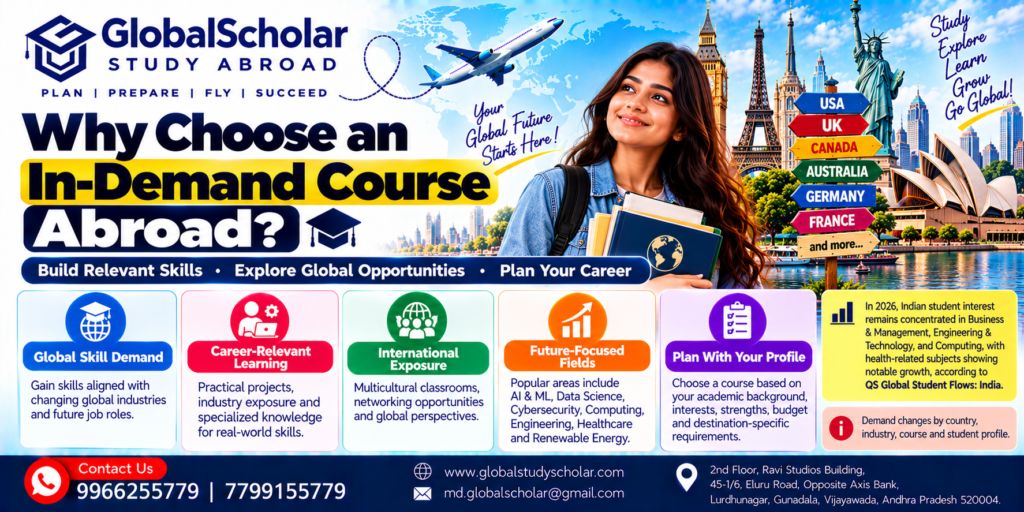
Choosing the right course is one of the most important decisions when planning to study overseas. The right programme can help students build relevant skills, gain international exposure and prepare for future career opportunities. With many universities and destinations available, understanding in-demand courses abroad can make the decision easier. For Indian students planning to study overseas in 2027, popular areas include Business and Management, Artificial Intelligence, Data Science, Cybersecurity, Computing, Engineering, Healthcare, Hospitality and Tourism, and Renewable Energy. However, course demand can vary by country, university, industry and student profile. At GlobalScholar Study Abroad, we help students compare courses, destinations, universities, eligibility requirements and application pathways before making an international education decision. Why Choose In-Demand Courses Abroad? Studying an in-demand course abroad can provide students with more than an international qualification. It can also offer opportunities to develop practical skills, experience different education systems and interact with students from different countries. However, students should not choose a course only because it is popular. A good course should match: Therefore, choosing in-demand courses abroad should be based on both market relevance and personal suitability. 1. Business and Management Business and Management remain broad study areas for international students. Students can explore programmes such as: Business programmes can be suitable for students who want to develop skills in leadership, communication, business strategy, finance, marketing and operations. Who Should Consider Business and Management? These courses may suit students who enjoy: Students should compare the curriculum, university, internship opportunities, location and career support before selecting a programme. 2. Artificial Intelligence and Machine Learning Artificial Intelligence has become an important area across technology, business and other industries. Students interested in this field can explore programmes such as: AI-related programmes may involve programming, mathematics, statistics, machine learning and data analysis. Students should carefully check the academic prerequisites because some advanced programmes may require mathematics, computing or programming experience. Career Areas Depending on qualifications and experience, graduates may explore roles related to: AI is therefore one of the important areas to consider when researching in-demand courses abroad. 3. Data Science and Business Analytics Data is increasingly important for organisations across different industries. Data-focused programmes can include: Students can learn how to collect, analyse and interpret data to support business and technical decisions. Skills You May Develop Depending on the programme, students may study: Students interested in data should check the course curriculum carefully because programmes can differ significantly in their technical depth. 4. Cybersecurity As organisations increasingly depend on digital systems, cybersecurity has become an important academic and professional area. Students can consider courses such as: A cybersecurity programme may cover areas such as network protection, security management, risk assessment and digital security. Who Can Consider Cybersecurity? Cybersecurity may be suitable for students interested in: Students should check whether the programme requires prior computing knowledge before applying. 5. Computer Science and Information Technology Computer Science continues to be a popular choice for students planning an international education. Possible programmes include: These programmes can provide students with technical and problem-solving skills. Popular Specialisations Depending on the university, students may find specialisations related to: When comparing universities, students should look beyond the course title and review the actual modules included in the programme. 6. Engineering Engineering remains a major international study area. Students can explore disciplines such as: Engineering programmes can combine theoretical knowledge with practical learning, laboratory work and project-based study, depending on the institution. Why Consider Engineering Abroad? International study can expose engineering students to different technologies, academic environments and industry practices. However, students should check professional accreditation and recognition requirements if they intend to work in a regulated engineering profession after graduation. 7. Healthcare and Life Sciences Healthcare and life sciences offer a wide range of academic pathways. Depending on the destination and university, students may explore: Students applying for regulated healthcare professions should pay particular attention to professional registration and licensing requirements in the destination country. A course that looks suitable academically may have additional professional requirements for employment. 8. Hospitality and Tourism Management Hospitality and Tourism can be an attractive option for students interested in international careers involving hotels, tourism, events and customer experience. Possible programmes include: Why Study Hospitality Abroad? Hospitality is an international industry. Studying abroad can allow students to experience different cultures and hospitality environments while developing professional skills. Depending on the programme, students may gain exposure to: For students interested in a practical and internationally oriented career, Hospitality Management can be one of the in-demand courses abroad worth researching. 9. Renewable Energy and Sustainability Sustainability and renewable energy are becoming increasingly important areas of study. Students can explore programmes related to: These courses can be particularly relevant for students interested in environmental challenges, energy systems and sustainable development. Before selecting a programme, students should review the modules and practical components carefully. How to Choose the Right Course Abroad in 2027 Choosing from many in-demand courses abroad can be confusing. Use the following process to make a better decision. Step 1: Understand Your Academic Background Start with your previous qualification. For example: 12th Grade Students May consider: Bachelor’s Degree Students May consider: Eligibility depends on the university and course. Step 2: Identify Your Career Interest Ask yourself: What type of work would I enjoy doing? For example: Technology → Computer Science, AI, Data Science or Cybersecurity Business → Management, Finance, Marketing or Business Analytics Engineering → Mechanical, Civil, Electrical or related engineering fields Hospitality → Hotel Management, Hospitality or Tourism Sustainability → Renewable Energy or Environmental Studies Your course should support your long-term career direction. Step 3: Compare Countries Different countries offer different academic systems, costs and immigration requirements. Popular destinations for Indian students include: For example, GLOBALSCHOLAR currently provides study-abroad information covering destinations including Europe, Ireland, Italy and Singapore. globalstudyscholar.com Students should compare: Why Course Selection Is More Important Than Just Choosing a Country Many students begin their study-abroad journey by asking: “Which country is best?” A better question is: “Which course and university are best for my profile
🎓 EDUCATION LOAN FOR STUDY ABROAD 2026: COMPLETE GUIDE FOR INDIAN STUDENTS

Education Loan for Study Abroad can help Indian students manage the cost of international education, including tuition fees and, depending on the lender and approved loan structure, certain education-related expenses. Studying abroad involves more than tuition fees. Students may also need to plan for accommodation, travel, books, insurance and living expenses. An education loan can be one part of a student’s overall financial plan. In this guide, we explain how education loans for study abroad generally work, what expenses may be covered, eligibility and documents, collateral considerations, loan application steps, repayment and how GlobalScholar Study Abroad can help students understand their financing options. Important: Loan approval, interest rates, collateral requirements, margins, eligible expenses and repayment terms depend on the lender, loan scheme, university/course and applicant profile. Always confirm the current terms directly with the bank or financial institution before applying. What Is an Education Loan for Study Abroad? An education loan for study abroad is financing provided by a bank or eligible financial institution to help students fund higher education outside India. Depending on the lender and approved scheme, the loan may cover some combination of: For example, SBI’s published student-loan information includes tuition fees and certain study-related expenses among eligible costs, subject to the applicable scheme and conditions. The exact amount and expenses covered should always be confirmed with the lender. Why Consider an Education Loan for Overseas Education? Studying abroad can require significant financial planning. An education loan may help families manage education costs without paying the entire amount from savings at the beginning. Potential benefits include: 1. Managing tuition expenses Tuition can represent a major part of the total study-abroad budget. Approved loan funding may help cover eligible tuition expenses. 2. Supporting other education costs Depending on the lender, certain accommodation, travel, books and other education-related costs may also be considered. 3. Preserving savings Using financing for eligible education expenses may allow families to retain some savings for emergencies and other financial commitments. 4. Structured repayment Education loans generally provide a defined repayment structure, including applicable moratorium and EMI arrangements. 5. Multiple lender options Students can compare loan products from different banks and financial institutions based on their eligibility and requirements. What Can an Education Loan Cover? The exact coverage varies between lenders, but an overseas education loan may potentially cover several categories. Tuition Fees Tuition fees are generally one of the main expenses considered under education-loan schemes. The amount financed depends on the approved loan, course, institution and lender’s terms. Accommodation and Living Expenses Some loan schemes may consider eligible hostel, accommodation or reasonable living expenses. Students should ask the lender exactly which expenses qualify before including them in their financial plan. Travel Expenses Some study-abroad loan schemes may include travel or passage expenses. For example, published SBI student-loan documentation lists travel expenses/passage money for studies abroad among eligible expenses under the relevant scheme. Books and Study Equipment Books, equipment and other academic expenses may be eligible under certain loan schemes. Other Education-Related Costs Depending on the lender, approved expenses may include additional course-related costs. The final eligible amount is determined by the lender according to its applicable rules. Education Loan Eligibility for Study Abroad Eligibility differs between banks and financial institutions. Common factors that lenders may consider include: Students should not assume that meeting one bank’s criteria means they automatically qualify with every lender. Documents Required for an Education Loan Students are generally asked to provide personal, academic, admission and financial documents. The exact list varies by lender. Student Documents Parent or Co-Applicant Documents Depending on the lender: Property Documents If collateral is required, the lender may request relevant property documents. The bank or financial institution will provide the final document checklist. Collateral-Free Education Loans for Study Abroad One of the most common questions students ask is: “Can I get an education loan without collateral?” The answer depends on the lender, loan amount, course, institution, applicant profile and applicable scheme. Some lenders may offer collateral-free options for eligible students under specific conditions, while larger loan amounts may require collateral or additional security. For example, SBI’s published student-loan terms show a nil margin up to ₹4 lakh and a 15% margin above ₹4 lakh for studies abroad under the cited student-loan scheme; other SBI products and lenders can have different conditions. Therefore, students should not assume that every overseas education loan is collateral-free. What Is a Co-Applicant? A co-applicant is commonly a parent or guardian who participates in the education-loan application. The lender may assess the co-applicant’s: The exact co-applicant requirements vary by lender. How Much Education Loan Can I Get for Study Abroad? There is no single loan amount applicable to every student. The approved amount can depend on: For example, SBI publishes different limits under different education-loan products, including a standard student-loan limit and a separate Global Ed-Vantage product for eligible overseas study. This is why students should compare the specific loan product, rather than relying on a generic maximum loan figure. Education Loan Interest Rate Interest rates vary by: Students should compare: Always ask the lender for the current applicable rate and complete terms before accepting the loan. What Is a Loan Margin? A loan margin is the portion of the eligible education cost that may need to be contributed by the student or family rather than financed by the lender. For example, SBI’s published student-loan terms state that for studies abroad, the margin is 15% for amounts above ₹4 lakh under that particular scheme. This does not mean every bank applies a 15% margin. The applicable margin depends on the lender and loan product. Education Loan Repayment and Moratorium Education loans generally include a repayment structure that allows the student to complete the course before regular repayment begins. Under the IBA Model Educational Loan Scheme information published by the Ministry of Education, the repayment holiday/moratorium is described as the course period plus one year, followed by repayment over a specified period, subject to the applicable scheme. However, students should check the