
Study in UK Without IELTS with MOI 2026: Complete Guide for International Students

Study in the UK without IELTS using a Medium of Instruction (MOI) certificate — understand eligibility, admission, visa requirements, courses, intakes, work opportunities and the Graduate visa. Study in UK Without IELTS with MOI 2026 Are you planning to study in the UK without IELTS? For many international students, English-language testing is one of the biggest concerns when applying to UK universities. However, depending on the university, course and student’s academic background, there can be alternative ways to demonstrate English-language ability. One option is a Medium of Instruction (MOI) certificate, which confirms that a student’s previous qualification was taught in English. However, an important distinction must be made: Having an MOI does not automatically mean that every UK university or the UK Student visa will waive an English-language requirement. UK immigration rules allow certain ways of demonstrating English proficiency, including a degree-level qualification taught in English. For an overseas degree, an Ecctis assessment may be required in circumstances where the qualification is being used to prove English ability. A UK higher education provider can also assess English for certain degree-level courses and state its assessment method on the CAS. Therefore, students interested in studying in the UK without IELTS with MOI should check both the university’s admission requirements and the applicable UK Student visa requirements. GlobalScholar Study Abroad, Vijayawada helps students explore suitable UK universities and understand their admission and visa requirements. What Is MOI? MOI stands for Medium of Instruction. An MOI certificate is a document issued by a student’s previous educational institution confirming the language in which the programme was taught. For example, if a student completed a Bachelor’s degree in India where the programme was taught in English, the university or college may issue an official letter confirming this. An MOI certificate may contain information such as: The exact format depends on the institution. Can You Study in the UK Without IELTS with MOI? Yes, in some cases — but it depends on the university and visa requirements. Some UK universities may accept alternative evidence of English proficiency, including previous education taught in English, subject to their own admission policies. For UK immigration purposes, the current rules also provide routes for demonstrating English through certain academic qualifications taught in English. For an overseas degree, the relevant qualification may need an Ecctis assessment confirming the required UK-equivalent qualification and English-language status. For degree-level study, the normal English requirement under the Student route is CEFR B2, unless the applicable rules provide another way of meeting the requirement. So the phrase “UK without IELTS” should be understood as: IELTS may not be required in certain cases if an accepted alternative method of demonstrating English is available. It does not mean that IELTS is universally waived for every student. How Does MOI Help with UK Admission? Universities need evidence that applicants have sufficient English-language ability to successfully complete their programme. If a university accepts previous English-medium education, an MOI certificate may be used as part of the university’s assessment. Depending on the institution, the university may: Therefore, students should confirm the requirement before applying. MOI and UK Student Visa: What You Need to Know This is one of the most important sections for students. University admission and UK visa requirements are not always the same thing. A university may accept your MOI for admission, but students still need to satisfy the UK Student visa English-language requirements where applicable. Current GOV.UK guidance says that English can be demonstrated in several ways. For an overseas degree taught in English, an Ecctis assessment can be required to confirm that the qualification is equivalent to a UK Bachelor’s degree or higher and was taught in English. For degree-level courses, a higher education provider may also assess the student’s English and record how it assessed the student on the Confirmation of Acceptance for Studies (CAS), where the rules permit this route. Therefore: MOI acceptance = university-specific Student visa English requirement = immigration-rule specific Students should verify both. Who Can Consider Studying in the UK with MOI? Students may explore this option if they have previously completed education through English-medium instruction. Potential applicants can include: Eligibility varies according to the university and programme. Study in UK Without IELTS After Bachelor’s Degree Students who have completed a Bachelor’s degree in India may explore UK Master’s programmes where the university accepts previous English-medium education as evidence of English proficiency. Popular Master’s areas include: The actual English requirement should be confirmed for each university and course. Study in UK Without IELTS After 12th Students who have completed 12th standard can also explore UK undergraduate programmes. Popular areas include: However, undergraduate applicants should pay particular attention to the university’s English-language requirements. An MOI from school may not automatically be treated in the same way as a degree-level qualification taught in English. Popular Courses to Study in the UK The UK offers a wide range of undergraduate and postgraduate programmes. Business & Management Business and management programmes are popular among international students. Potential areas include: Computer Science & IT Students interested in technology can explore: Data Analytics & Artificial Intelligence AI and analytics programmes can cover areas such as: Engineering UK universities offer engineering programmes across areas including: Healthcare Management Students interested in the management side of healthcare can explore programmes covering: MBA & Master’s Programmes UK Master’s degrees are available in many specialisations. Popular options include: UK Intakes for International Students Many UK universities offer multiple intakes. Common intakes include: January Intake The January intake can be useful for students who miss the September intake or want an alternative start date. May Intake Some universities offer May or spring/summer intakes for selected programmes. September Intake September is generally the major intake and usually has the widest range of course options. Important: Not every university or course offers all three intakes. Always check the current intake availability before applying. Eligibility to Study in UK Without IELTS Requirements depend on the university and course. Typical academic requirements may include: Undergraduate Postgraduate MOI
MSc Project Management in the UK 2026: Eligibility, Course, Jobs, Salary & Career Opportunities
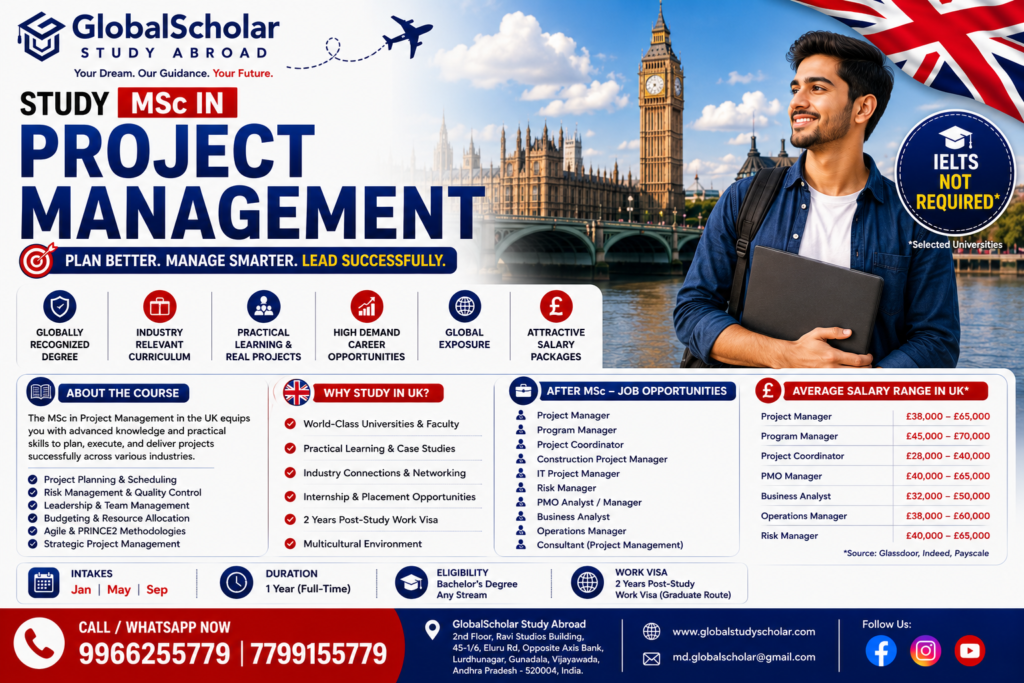
Project management is an important function across almost every industry. Businesses, technology companies, construction firms, financial organisations, healthcare providers and public-sector organisations all need professionals who can plan projects, manage resources, control risks and deliver work successfully. An MSc Project Management in the UK can be a strong postgraduate option for students who want to develop leadership, planning, communication, risk-management and project-delivery skills. For students from India, studying a Project Management Master’s in the UK can also provide international academic exposure and the opportunity to understand project management practices in a global business environment. At GlobalScholar Study Abroad, Vijayawada, we help students from Vijayawada and across Andhra Pradesh explore UK master’s programmes, understand eligibility requirements and receive guidance throughout the application process. Why Study MSc Project Management in the UK? The UK has universities offering postgraduate programmes across business, management, technology, engineering and professional disciplines. Project management skills are useful across many industries, which means graduates can potentially explore different career paths rather than being restricted to one sector. UK government careers information describes business project managers as professionals who plan tasks and organise people and resources to complete projects on time and within budget. The National Careers Service currently lists business project manager salaries from £29,000 for starters to £75,000 for experienced professionals. The UK is also continuing to invest heavily in infrastructure and digital transformation. For example, a March 2026 UK government infrastructure update identified substantial future workforce requirements across major infrastructure projects. Key benefits of studying Project Management in the UK can include: What Is an MSc Project Management? An MSc Project Management is a postgraduate qualification designed to develop advanced knowledge of planning, managing and delivering projects. The exact modules vary between universities, but students may study: The course can combine theoretical knowledge with practical case studies and project-based learning. What Will You Learn During MSc Project Management? 1. Project Planning Students learn how to define project objectives, establish timelines, allocate resources and create structured project plans. Planning is one of the most important stages of successful project delivery. 2. Project Scheduling Scheduling involves determining: Students may use project-management software and scheduling techniques as part of their studies. 3. Risk Management Every project can face risks. These may include: Students learn how to identify, assess and manage these risks. 4. Leadership & Team Management Project managers often work with people from different departments and professional backgrounds. Therefore, effective project management requires: 5. Budgeting & Resource Allocation Projects need to be delivered within available budgets and resources. Students may learn about: 6. Agile Project Management Agile methodologies are widely used in technology and other project environments. Students may explore Agile principles, Scrum and other approaches to iterative project delivery. 7. Strategic Project Management Strategic project management connects individual projects with wider organisational goals. This helps students understand how projects contribute to business growth and long-term strategy. MSc Project Management UK Eligibility Entry requirements vary from one university to another. In general, international students may need: One advantage of some Project Management master’s programmes is that applicants may come from a variety of academic backgrounds. Depending on the university, suitable backgrounds may include: However, eligibility is university-specific. Students should check the published entry requirements before applying. Can Students From Any Bachelor’s Degree Study Project Management? Potentially, yes. Project management is used across many sectors, so some universities accept applicants from a broad range of academic backgrounds. For example, a student with a bachelor’s degree in: may be able to find suitable Project Management master’s programmes. However, not every university accepts every academic background. At GlobalScholar Study Abroad, Vijayawada, we can assess your academic profile and help identify programmes where your previous qualification may meet the published entry requirements. IELTS Requirement for MSc Project Management in the UK English-language requirements vary by university and individual student profile. Some universities may require IELTS, while others may accept alternative forms of English-language evidence. For degree-level study, UK Student visa applicants generally need to meet the applicable English-language requirement, although there are circumstances where another accepted method of demonstrating English can apply. Therefore, students should not assume that: “IELTS is not required for every UK university.” Instead, the English-language requirement should be checked for the specific university and course. MSc Project Management Course Duration in the UK Many full-time MSc Project Management programmes can be completed in approximately: 1 Year A typical one-year master’s programme may include: Term/Semester 1: Core project-management modules Term/Semester 2: Advanced project-management modules Final stage: Dissertation, consultancy project or capstone project Some universities may also offer: The duration and structure depend on the university. MSc Project Management With Placement Some UK universities may offer Project Management programmes with placement or professional experience options. A placement can help students gain exposure to real workplace environments. Students may develop practical experience in areas such as: However, students should understand that a placement opportunity is not the same as a guaranteed placement. The availability of a placement may depend on: Career Opportunities After MSc Project Management An MSc Project Management can support career paths across different industries. Potential roles include: Project Manager Project managers plan and coordinate projects, manage resources and work towards delivering projects within agreed requirements. Project Coordinator Project coordinators assist project managers with documentation, scheduling, communication and administration. Programme Manager Programme managers can oversee multiple related projects and coordinate them towards broader organisational objectives. PMO Analyst / PMO Manager PMO professionals support project governance, reporting, processes and project performance. Business Analyst Business analysts examine business problems and identify opportunities for improvement. Operations Manager Operations managers focus on improving the performance and efficiency of organisational activities. Risk Manager Risk managers identify potential risks and help organisations develop strategies to manage them. IT Project Manager IT project managers coordinate technology projects such as software development, digital transformation and infrastructure projects. The UK National Careers Service currently lists IT project manager salaries at approximately £35,000 to £60,000, depending on experience. Industries Hiring Project Management Professionals One of the advantages of