
Study in Ireland 2026: Courses, Work Opportunities, Graduate Permission & Career Guide
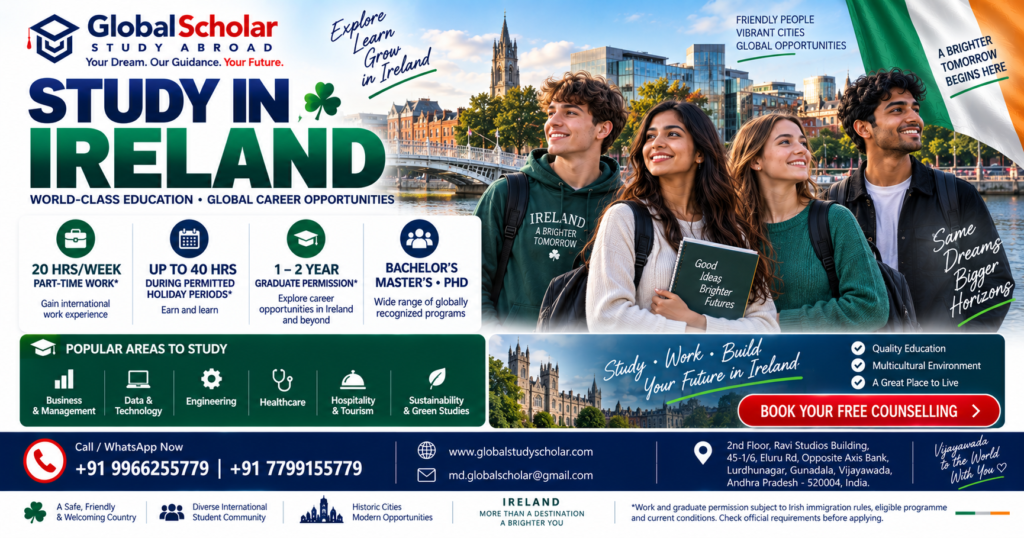
Ireland has become an increasingly attractive destination for international students looking for high-quality education, English-taught programmes, international exposure and career opportunities. For Indian students, Ireland offers programmes ranging from Bachelor’s and Master’s degrees to PhD programmes across areas such as Business, Data & Technology, Engineering, Healthcare, Hospitality & Tourism, Sustainability and Green Studies. The latest GlobalScholar Study Abroad campaign highlights Ireland as a destination where students can study, gain international work experience and build their careers. One important advantage is that eligible non-EEA students on Stamp 2 can generally work up to 20 hours per week during term time and 40 hours per week during specified vacation periods, subject to the applicable immigration conditions. Why Study in Ireland? Ireland combines internationally oriented education with a strong English-speaking environment and access to European opportunities. Some of the key reasons students consider Ireland include: For students from India, Ireland can be particularly attractive because students can study in an English-speaking European country while gaining international academic and professional exposure. Popular Areas to Study in Ireland The GlobalScholar Ireland campaign highlights several popular fields. 1. Business & Management Business remains one of the most popular areas for international students. Students can explore programmes in: A business qualification can provide career opportunities across multiple industries. 2. Data & Technology Ireland has a strong technology ecosystem, making technology-related programmes attractive to international students. Popular areas include: Students should select programmes according to their previous academic background and career objectives. 3. Engineering Ireland offers programmes across several engineering disciplines, including: Engineering students should carefully check professional recognition requirements if they intend to work in regulated engineering roles. 4. Healthcare Healthcare is another important study area. Students may explore: Professional healthcare programmes can involve additional registration requirements, so students should check the relevant Irish professional body before choosing a programme. 5. Hospitality & Tourism Ireland’s tourism sector also makes hospitality an interesting option for international students. Possible programmes include: These programmes can combine academic learning with practical industry exposure depending on the institution. 6. Sustainability & Green Studies Sustainability is another growing academic area. Students can explore: These courses can be relevant for students interested in environmental and sustainability-focused careers. Study Levels Available in Ireland International students can find programmes at different qualification levels. Bachelor’s Degrees Bachelor’s programmes commonly take several years depending on the course and institution. Master’s Degrees Ireland offers a wide range of postgraduate programmes, including many one-year Master’s options. Popular choices include: PhD Ireland also offers research-based doctoral programmes for students interested in advanced academic and research careers. Can International Students Work While Studying in Ireland? Yes, eligible non-EEA students holding Stamp 2 permission can work within specified limits. The current Irish immigration guidance states that eligible students can work: 20 hours per week during term time and 40 hours per week during specified vacation periods, currently including June, July, August and September, and from 15 December to 15 January. This can provide students with an opportunity to gain work experience while studying. However, students should not plan their entire education budget on the assumption that part-time employment will cover all tuition and living costs. Irish immigration guidance specifically requires students to demonstrate sufficient financial resources without relying on casual employment. Ireland Graduate Permission After Study One of the major attractions for international students is the Third Level Graduate Programme. Eligible graduates can receive permission to remain in Ireland after completing an eligible qualification to seek graduate-level employment and pursue an employment permit. According to current Irish immigration guidance: NFQ Level 8 Graduates with a Level 8 qualification can receive 12 months of graduate permission under the programme, subject to the applicable conditions. NFQ Level 9 or Above Graduates with a Level 9 or higher qualification may receive up to 24 months, generally in two 12-month periods, subject to the applicable conditions. During Stamp 1G graduate permission, eligible graduates can work full-time while seeking suitable employment and an employment permit. Important Graduate permission is not a permanent residence guarantee. Students who want to remain in Ireland longer generally need to qualify for another immigration permission, such as an appropriate employment permit. Ireland Student Visa Indian students generally require the appropriate Irish immigration permission to study in Ireland. The long-stay study visa process can require evidence of: Irish Immigration Service states that visa officers assess applications on their individual merits and may request additional information. Ireland Student Visa Financial Requirement Financial planning is an important part of an Irish student visa application. For academic courses beginning after 1 July 2023, Irish immigration guidance requires visa-required students to demonstrate access to at least €10,000 for a one-year course, representing the estimated cost of living for one academic year. Students must also demonstrate access to the same level of funds for each subsequent year, in addition to course fees. For courses resulting in a stay of 6–8 months, the current requirement is €833 per month, or €6,665 in total, whichever is lower. This means students should prepare their finances well before submitting their visa application. How Much Tuition Fee Must Be Paid Before an Ireland Student Visa? Irish immigration guidance states that where course fees are less than €6,000, the fees must be paid in full before applying for the visa. Where course fees are more than €6,000, at least €6,000 must generally be paid before the visa application, although the college may require full payment according to its own policy. Students should therefore obtain an official fee schedule and payment instructions from their institution. English Language Requirements for Ireland International students must demonstrate that they have sufficient English-language ability to study their chosen programme. The exact requirement depends on: Possible English tests may include: Students should not assume that one English test is accepted by every Irish university. Can I Study in Ireland Without IELTS? Some institutions may accept alternatives to IELTS, including other recognised English tests or specific forms of English-language evidence. However, “Ireland without IELTS” is not a universal rule. The university
Study in Malta 2026: Tuition Fees, 70% Tax Credit, Education Loans & Career Opportunities

Malta is becoming an attractive European study destination for international students looking for English-taught education, a multicultural environment, European exposure and career opportunities. Located in the Mediterranean, Malta combines a relatively compact lifestyle with access to the wider European environment. For Indian students, particularly those looking for business, IT, healthcare, hospitality, accounting and management programmes, Malta can be an option worth considering. The latest GlobalScholar Study Abroad campaign highlights Malta with the message “Small Island, Big Opportunities” and promotes benefits such as tuition-fee support, collateral-free education-loan options, English-language education, internships and career opportunities. However, one important point needs clarification: the advertised “70% tuition fee back” should not be understood as an automatic cash refund for every international student. Malta’s 2026 Get Qualified scheme provides an eligible person with a tax credit of up to 70% of eligible study costs, subject to the scheme’s conditions. Eligibility includes being liable to tax in Malta. Why Study in Malta? Malta offers an interesting combination of: Malta’s education sector is regulated by the Malta Further and Higher Education Authority (MFHEA). Institutions providing further or higher education in or from Malta generally require the appropriate MFHEA licence, while programmes can be accredited and mapped to the Malta Qualifications Framework (MQF). This makes checking the institution and programme before paying fees extremely important. Study in Malta in English One of Malta’s major advantages for international students is the availability of programmes delivered in English. This can make Malta particularly interesting for Indian students who want to study in Europe without having to learn a new European language before starting their academic programme. Depending on the institution and course, students can find programmes in areas such as: The exact language of instruction, admission requirements and English-language evidence should always be confirmed with the institution. Malta Tuition Fees Tuition fees in Malta vary significantly according to: The flyer promotes tuition fees starting from €6,000, but this should be treated as an indicative starting figure rather than a universal Malta tuition fee. For example, one Maltese higher-education institution currently lists 2026–27 full-time diploma and degree tuition at €6,696 per academic year, with a separate non-EU administration fee for students requiring a student visa. Therefore, students should always request the latest official fee structure for their selected programme. Can Students Get 70% of Their Tuition Fees Back? This is one of the most important points in the latest Malta campaign. Malta’s Get Qualified Scheme Malta’s Get Qualified 2026 scheme provides eligible applicants with a tax credit of up to 70% of eligible costs, including certain registration, tuition, educational and examination expenses. The 2026 scheme states that eligible individuals can use the tax credit over a period of up to 15 fiscal years, subject to the applicable rules. But there is an important condition The official eligibility requirement says applicants must be persons liable to tax in Malta and must have commenced a relevant course of study after the age of 16. Therefore, an Indian student arriving in Malta should not assume that 70% will automatically be refunded after paying tuition fees. A student may need to meet the applicable conditions, successfully complete the relevant programme and have the necessary Maltese tax position to benefit. Some Maltese institutions also specifically explain that the scheme can benefit international students who subsequently work and pay tax in Malta. For example, MCAST states that eligible students may apply for a 70% tuition-fee refund in the form of a tax rebate after successful course completion, with reimbursement available to students paying tax in Malta. So the correct SEO-friendly claim is: “Eligible students may benefit from up to 70% through Malta’s Get Qualified tax-credit scheme, subject to eligibility and conditions.” That is much safer and more accurate than saying “everyone gets 70% tuition fees back.” Is Malta Education Loan Available Without Collateral? Education financing can be another important part of planning your Malta studies. Depending on the student’s profile, university and lender, students may explore: However, loan approval is never automatic. The lender may evaluate: GlobalScholar Study Abroad can help students understand available financing options before proceeding with their admission. Work While Studying in Malta International students may be able to work part-time in Malta, but specific immigration and employment conditions apply. According to Malta’s Identità, third-country nationals pursuing qualifying full-time higher-education courses recognised by MQRIC may work for a maximum of 20 hours per week, subject to the relevant work-permit conditions. Identità also states that students need the appropriate employment authorisation and that conditions can change. Therefore: Study first + permitted part-time employment = possible but Student visa = unrestricted full-time employment is not correct. Students should follow their residence permit and employment-permit conditions. Internships and Career Opportunities in Malta Malta’s economy includes sectors such as: Depending on the programme, students may have opportunities for: However, internship or employment is not guaranteed by simply enrolling in a course. Students should select programmes that provide relevant industry exposure and carefully check what internship or placement support is actually included. Popular Courses to Study in Malta 1. Business & Management Business programmes can suit students interested in: These programmes can lead to careers across multiple industries. 2. Accounting & Finance Malta’s financial-services environment makes accounting and finance an interesting area for students. Possible study areas include: 3. Information Technology Technology programmes can include: Students should verify the MQF level and accreditation of the programme before enrolling. 4. Healthcare & Nursing Healthcare-related programmes are another important study area. Students can explore: Professional healthcare programmes can have additional regulatory and registration requirements, so course recognition should be checked carefully. 5. Hospitality & Tourism Malta’s tourism industry creates a natural connection with: For students interested in international hospitality careers, Malta can provide European cultural and industry exposure. Schengen Access and European Travel Malta is part of the Schengen Area. This makes Malta particularly attractive to students who want European travel opportunities. However, students should understand the distinction between: Studying and residing in Malta and having unrestricted rights to live