
Data Science & Big Data Analytics in the UK 2026 | Courses, Jobs & Salaries
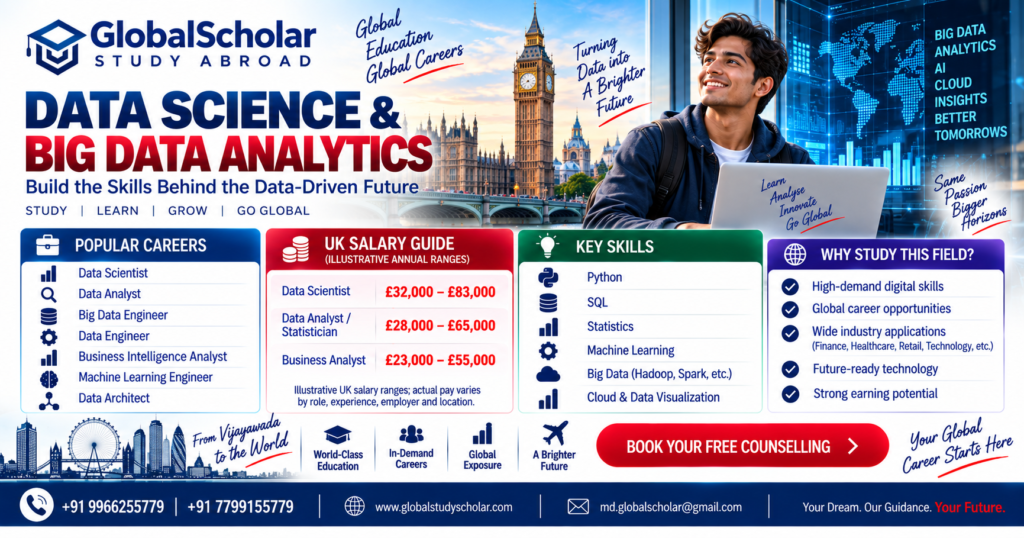
Data Science & Big Data Analytics in the UK 2026 Data has become one of the most important resources for modern businesses. Companies across finance, healthcare, retail, technology, manufacturing, logistics and other industries increasingly use data to understand customers, improve operations and make informed decisions. For students who enjoy technology, statistics, programming and problem-solving, studying Data Science and Big Data Analytics in the UK can provide a pathway into a wide range of data-focused careers. The UK’s National Careers Service describes data scientists as professionals who use software, AI and machine learning to analyse and interpret large amounts of data. It currently lists a salary range of £32,000 for starters to £83,000 for experienced professionals for the data scientist occupation. At the same time, UK government research highlights continuing demand for data and AI-related capabilities, including data management, programming and data analytics/statistics. GlobalScholar Study Abroad, Vijayawada helps Indian students explore suitable UK data science, analytics and related postgraduate programmes based on their academic profile, budget and career goals. What Is Data Science? Data Science combines several disciplines to extract useful information and insights from data. It can involve: A Data Scientist may work with large datasets to identify patterns, develop models, answer business questions and support decision-making. What Is Big Data Analytics? Big Data Analytics focuses on processing and analysing very large, complex or rapidly generated datasets. Modern organisations can collect information from: Big Data technologies help organisations process this information and turn it into useful insights. Why Study Data Science in the UK? 1. Strong Digital Skills Environment The UK continues to invest in digital, data and AI capabilities. The UK government’s AI Labour Market Survey found that 97% of surveyed organisations identified at least one AI-related skills gap. Among the technical gaps identified were data management, programming and data analytics/statistics. This demonstrates why students with strong data and analytical foundations can be relevant to an evolving technology labour market. 2. Multiple Career Pathways Data science isn’t limited to one job title. Graduates can explore roles such as: 3. Cross-Industry Applications Data skills can be applied across many industries. Finance Healthcare Retail Technology Manufacturing Logistics Popular Data Science Courses in the UK Students can choose programmes according to their academic background and career plans. MSc Data Science A broad postgraduate pathway covering areas such as: MSc Big Data Analytics Focuses on analysing large and complex datasets using modern technologies. MSc Data Analytics More focused on extracting insights from data and supporting business decision-making. MSc Business Analytics Combines data analytics with business strategy. MSc Artificial Intelligence & Data Science Combines AI, machine learning and data science. MSc Data Science & Machine Learning A more technical pathway combining statistical methods, programming and machine learning. Key Skills You Can Build The flyer highlights several important technical skills. Python Python is widely used for: SQL SQL is essential for working with relational databases and extracting information from structured data. Statistics Statistics provides the foundation for: Machine Learning Machine learning enables systems to learn patterns from data and make predictions or classifications. Big Data Students may encounter technologies and frameworks used to process large datasets, such as Hadoop and Spark. Cloud & Data Visualisation Modern data professionals may also work with cloud platforms and visualisation tools to store, process and communicate data. Data Science Career Opportunities in the UK Data Scientist Data Scientists analyse data, develop models and generate insights to support business or research decisions. The UK’s National Careers Service currently lists £32,000 to £83,000 as the salary range for the data scientist occupation. Data Analyst Data Analysts collect, clean, analyse and interpret information to help organisations understand performance and make decisions. Big Data Engineer Big Data Engineers develop and maintain systems that process large volumes of data. Data Engineer Data Engineers build and maintain the infrastructure required to collect, transform and store data. Business Intelligence Analyst BI Analysts turn business data into reports, dashboards and insights. Machine Learning Engineer Machine Learning Engineers develop and deploy machine-learning systems and models. Data Architect Data Architects design the structure and infrastructure used to store, organise and manage organisational data. Data Science Salary in the UK The flyer includes these illustrative salary ranges: Role Illustrative Annual Salary Data Scientist £32,000 – £83,000 Data Analyst / Statistician £28,000 – £65,000 Business Analyst £23,000 – £55,000 For Data Scientist, the £32,000–£83,000 range aligns with the current UK National Careers Service information. However, salary figures for other roles can vary considerably according to occupation, employer, location, experience and specialisation. These figures should not be treated as guaranteed graduate salaries. Data Science vs Data Analytics These terms are related but are not exactly the same. Data Science Data Analytics Broader technical field More focused on analysing data Machine learning Reporting and analysis Statistical modelling Business insights Predictive modelling Descriptive analysis Programming Data interpretation AI applications Dashboards and reporting There is significant overlap between the two fields, and the exact distinction varies between universities and employers. Data Science vs Big Data Analytics Data Science Often focuses on: Big Data Analytics More heavily focuses on: A student interested in highly technical data systems may prefer Big Data, while someone interested in modelling and predictive analytics may prefer Data Science. Eligibility for Data Science Courses in the UK Requirements vary by university and programme. For a Master’s degree, universities may consider applicants with bachelor’s degrees in fields such as: Some universities may also consider applicants from non-computing backgrounds if they demonstrate appropriate mathematical or analytical preparation. Typical application documents can include: Always check the exact requirements of the university and course. Do I Need Programming for Data Science? Programming is highly useful for technical Data Science programmes. Common programming skills include: Students who are new to programming should check whether their chosen course expects prior programming experience. Some programmes are designed as conversion courses, while others expect a stronger technical background. Is Data Science a Good Career? Data Science can be a strong option for students who enjoy: It can also provide
Artificial Intelligence & Machine Learning in the UK 2026 | Courses, Jobs & Salaries
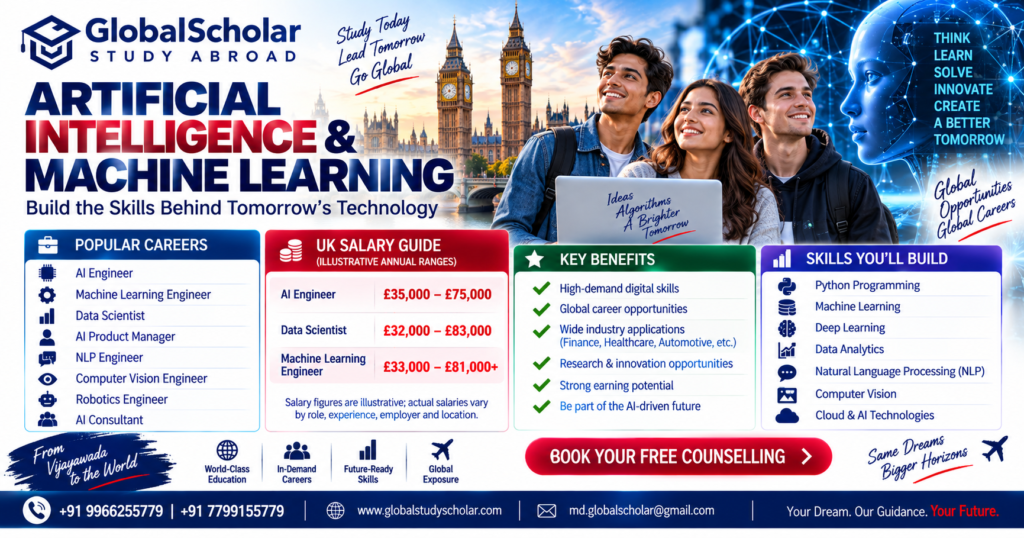
Artificial Intelligence & Machine Learning in the UK 2026 Artificial Intelligence (AI) and Machine Learning (ML) are transforming the way organisations develop products, analyse information, automate processes and make decisions. For students interested in technology, programming, data and innovation, studying Artificial Intelligence and Machine Learning in the UK can provide an opportunity to develop technical and analytical skills while studying in a major international education and technology market. UK government research published in 2026 identified significant AI skills gaps. In the 2025 AI Labour Market Survey, 97% of surveyed organisations identified at least one AI skills gap, with gaps particularly evident in understanding AI concepts and algorithms, data management, programming and data analytics. This makes AI and Machine Learning an important area for students considering technology-focused careers. Why Study AI & Machine Learning in the UK? 1. Growing Demand for AI Skills AI adoption is changing job roles and the skills employers need. Skills England’s 2026 assessment says demand is increasingly shifting toward AI-related capabilities, alongside skills such as judgement, problem-solving, collaboration and responsible use of AI. Students who develop both technical AI skills and broader problem-solving abilities can be better positioned to adapt as technology evolves. 2. International Education Experience Studying AI in the UK can provide exposure to: Students can explore how AI is applied across different industries rather than studying technology in isolation. 3. Multiple Industry Applications AI and Machine Learning are used across sectors including: This means an AI qualification does not necessarily limit graduates to one industry. Popular AI & Machine Learning Courses in the UK Students can choose different programmes depending on their academic background and career goals. Artificial Intelligence Covers areas such as: Machine Learning Focuses more deeply on: Artificial Intelligence & Machine Learning A combined pathway covering both AI theory and practical machine-learning applications. Data Science & AI Combines: Computer Science with AI Can be suitable for students wanting a broader computing foundation alongside AI specialisation. AI & Robotics Combines AI with robotics, automation, perception and intelligent systems. Skills You Can Build A strong AI and Machine Learning programme can help students develop skills in several areas. Python Programming Python is widely used for: Machine Learning Students can learn how algorithms identify patterns and make predictions from data. Deep Learning Deep learning involves neural-network approaches used in areas such as computer vision, language processing and other AI applications. Data Analytics Students learn to analyse and interpret data to support decisions and build models. Natural Language Processing NLP enables computers to process and work with human language. Applications include: Computer Vision Computer vision enables systems to interpret images and video. Applications include: Cloud & AI Technologies Modern AI systems often rely on cloud infrastructure for: Popular AI Career Opportunities An AI and Machine Learning qualification can lead to different technology and business roles. AI Engineer AI engineers develop and deploy artificial-intelligence systems. Typical areas include: Machine Learning Engineer Machine Learning Engineers develop, train and deploy machine-learning models. Data Scientist Data Scientists use statistics, programming and analytical techniques to extract insights from data. AI Product Manager AI Product Managers connect technology, business requirements and user needs to develop AI-enabled products. NLP Engineer NLP professionals work on systems that process and understand human language. Computer Vision Engineer Computer Vision Engineers develop systems that analyse and interpret visual information. Robotics Engineer Robotics professionals combine software, AI, sensors and engineering to develop intelligent machines. AI Consultant AI consultants can help organisations identify opportunities to implement AI and improve processes. AI Jobs in the UK The UK AI labour market is developing rapidly, but students should understand that high demand does not mean every graduate is guaranteed a job. The UK’s 2026 AI Labour Market Survey reported substantial skills shortages, including gaps in AI concepts and algorithms, programming, data analytics and data management. The report also found that 57% of surveyed organisations planned to adopt agentic AI within the following three years, suggesting that AI capabilities will continue to evolve. At the same time, Skills England notes that the effect of AI on future employment remains uncertain and that roles are changing rather than simply disappearing. For students, this means the best approach is to build strong fundamentals + practical experience + adaptable skills. AI Salary Guide in the UK Your flyer provides the following illustrative annual salary ranges: Career Illustrative Salary AI Engineer £35,000 – £75,000 Data Scientist £32,000 – £83,000 Machine Learning Engineer £33,000 – £81,000+ These are illustrative ranges, not guaranteed salaries. Actual salary can vary depending on: Students should check current salary information for their specific occupation before making financial or career decisions. AI & Machine Learning Across Industries One of the biggest advantages of AI is its wide range of applications. Finance AI can support: Healthcare AI applications can include: Automotive AI is used in: Retail AI can support: Cybersecurity AI can help identify: AI & Machine Learning Eligibility Eligibility depends on the university and course. For many postgraduate AI or Machine Learning programmes, applicants may need a relevant bachelor’s degree in areas such as: Some universities may accept students from other academic backgrounds if they can demonstrate appropriate mathematical, programming or analytical preparation. For undergraduate programmes, students generally apply after completing their secondary or higher-secondary education, subject to the university’s specific requirements. Always check the exact entry requirements for the selected university and course. English Language Requirements International students normally need to meet the university’s English-language requirements. Depending on the university, accepted evidence may include: Requirements and minimum scores vary by university and programme. Students should verify the current English-language requirements before applying. Tuition Fees and Living Costs The cost of studying AI in the UK varies significantly. Your overall budget can include: Tuition Fees Fees depend on: Living Costs Students should budget for: Additional Costs You may also need to consider: Do not assume that all UK AI programmes have the same tuition fees. Is Artificial Intelligence a Good Career Choice? AI can be an attractive career field for students
Master’s in Aviation in the UK 2026 | Courses, Fees, Jobs & Salaries
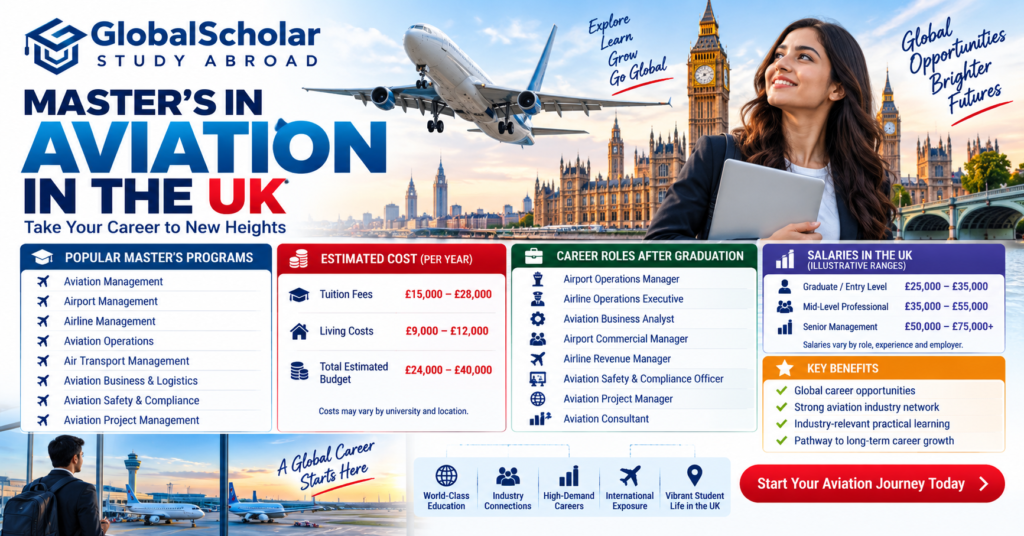
Master’s in Aviation in the UK 2026 The aviation industry offers career opportunities far beyond becoming a pilot. Airports, airlines, cargo companies, aviation consultancies and air transport organisations require professionals who understand operations, management, commercial strategy, safety, logistics and business development. For graduates interested in this side of the industry, studying a Master’s in Aviation in the UK can provide an opportunity to develop advanced business and aviation knowledge in one of the world’s major aviation markets. UK postgraduate options include programmes in Aviation Management, Air Transport Management, Aviation Operations and Management, Airport Management and International Tourism & Aviation Management. Current 2026 listings include one-year and longer postgraduate options, depending on the university and study mode. GlobalScholar Study Abroad, Vijayawada helps Indian students explore suitable UK aviation programmes according to their academic background, budget and career objectives. What Is a Master’s in Aviation? A Master’s in Aviation is a postgraduate qualification focusing on the management, operational and commercial aspects of the aviation industry. Depending on the university, students may study: For example, current UK aviation programmes cover areas such as airline operations, airport management, aviation law, safety regulations, finance, marketing, project management and aviation analytics. Why Study Aviation in the UK? 1. International Aviation Environment The UK has a well-established aviation ecosystem involving airports, airlines, logistics companies, regulators, consultancies and related businesses. Students can study aviation from an international perspective and understand how different parts of the air transport industry operate. 2. One-Year Master’s Options Many UK postgraduate programmes can be completed in approximately one year, although the duration varies by university and programme. For example, the University of Surrey currently lists its MSc Air Transport Management as a one-year full-time programme for 2026/27. Buckinghamshire New University also lists a one-year full-time MSc in Aviation Operations and Management. Other programmes, particularly those including internships or specific study structures, may take longer. 3. Industry-Focused Learning Aviation programmes can include: For example, Coventry University’s aviation-management programme highlights simulations, industry data and projects, while BNU’s aviation programme includes practical learning, case studies and real-world projects. 4. Global Career Perspective Aviation is an international industry. Skills developed through aviation management can potentially be relevant to airports, airlines, cargo operations, aviation consultancies and other air-transport organisations. Popular Master’s Programmes in Aviation Students do not necessarily need to choose a programme with exactly the title “Master’s in Aviation.” MSc Aviation Management Focuses on the business and management side of aviation. MSc Air Transport Management Focuses on the wider air transport industry, including airline and airport management, commercial planning and strategy. The University of Surrey’s current MSc Air Transport Management, for example, focuses on specialist knowledge and skills for the evolving air-transport business and provides exposure to commercial aviation-analysis tools. MSc Aviation Operations and Management Combines aviation operations with strategic and leadership skills. BNU’s 2026 programme is designed around aviation operations, management and leadership and is offered as a one-year full-time distance-learning MSc. Airport Management Suitable for students interested in: Airline Management Can cover: International Tourism & Aviation Management Combines aviation with tourism and service-industry management. The University of West London currently lists a 2026/27 postgraduate programme in International Tourism and Aviation Management, including an option with an internship. Estimated Cost of Studying Aviation in the UK The flyer provides an indicative annual budget of: Expense Indicative Amount Tuition fees £15,000 – £28,000 Living costs £9,000 – £12,000 Total estimated budget £24,000 – £40,000 These figures should be treated as planning estimates, not fixed UK-wide costs. Actual costs depend on: For example, published 2026/27 international fees vary between UK aviation-related programmes. University College Birmingham lists an international fee of £17,500 for its MSc Aviation Management, while other universities have different fee structures. Your actual budget should include: Tuition + Accommodation + Food + Transport + Visa Costs + Travel + Insurance/health-related costs + Personal Expenses Students should obtain the latest fee information directly from their chosen university before making financial plans. Master’s in Aviation UK Eligibility Entry requirements vary between universities. A typical postgraduate applicant may need: For example, University College Birmingham currently lists a 2:2 degree or international equivalent for its MSc Aviation Management, while some programmes may have different academic requirements or consider relevant professional experience. Some specialised programmes may also have additional requirements. Always check the exact entry criteria for your chosen university. English Language Requirements International students normally need to satisfy the university’s English-language requirement. The accepted test and required score can vary by university and course. For example, the University of West London’s 2026 International Tourism and Aviation Management listing specifies IELTS 6.5 or above, with 6.5 in each component, for international applicants. Students should therefore avoid assuming that the same IELTS requirement applies to every UK aviation programme. Career Opportunities After a Master’s in Aviation A Master’s in Aviation or Aviation Management can prepare graduates for a range of aviation-related business and operational roles. Airport Operations Manager Responsible for supporting and coordinating airport operational activities. Airline Operations Executive Works with airline operational processes, coordination and planning. Aviation Business Analyst Analyses operational and commercial information to support aviation-business decisions. Airport Commercial Manager Works with commercial activities, business development and revenue-related areas within an airport. Airline Revenue Manager Works with demand, pricing, revenue and commercial analysis. Aviation Project Manager Manages projects involving airports, airlines, aviation businesses or related organisations. Aviation Safety & Compliance Officer Works on safety, compliance and regulatory requirements, subject to the relevant role-specific qualifications. Aviation Consultant Provides research, analysis and strategic advice to aviation organisations. Aviation Jobs in the UK The aviation sector includes opportunities across: The University of Westminster’s Air Transport Planning and Management programme, for example, identifies potential career areas across airlines, airports, government departments and aviation-related businesses such as aircraft manufacturing, finance and consultancy. Aviation Salaries in the UK The flyer provides the following illustrative salary ranges: Career Level Illustrative Salary Graduate / Entry Level £25,000 – £35,000 Mid-Level Professional £35,000 – £55,000 Senior Management £50,000 – £75,000+ These figures are illustrative only and are not
Master’s in Aviation Management in the UK 2026 | Courses, Jobs & Salaries
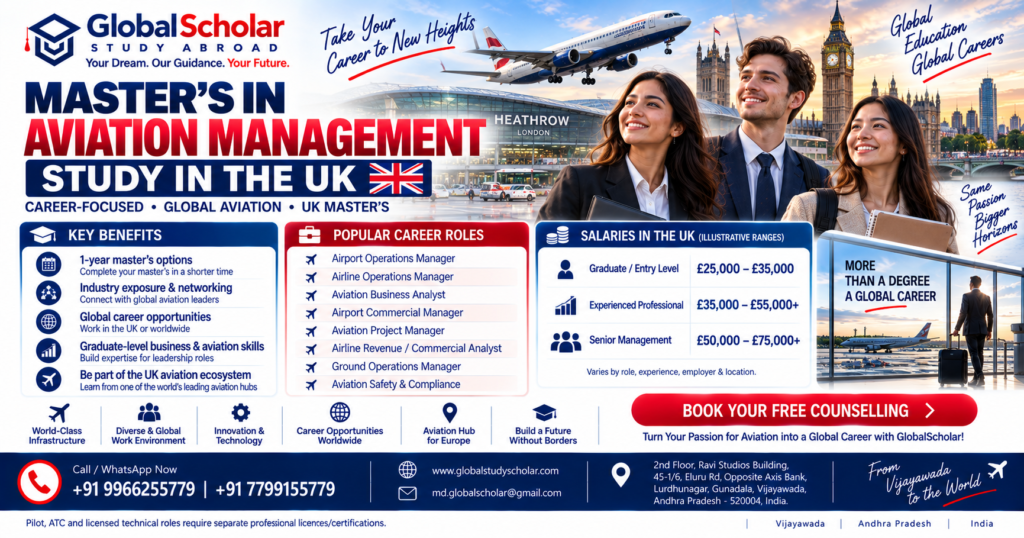
Master’s in Aviation Management in the UK 2026 The aviation industry is much more than flying aircraft. Behind every airport, airline and air transport network are thousands of professionals managing operations, commercial strategy, passenger services, logistics, safety, revenue and business development. For graduates interested in combining aviation with management and business, a Master’s in Aviation Management in the UK can be an attractive postgraduate study option. The UK has a long-established aviation sector and offers postgraduate programmes covering areas such as aviation management, air transport management and international tourism and aviation management. Current 2026/27 course listings include programmes at universities such as Teesside University, University College Birmingham, Coventry University and the University of Westminster. GlobalScholar Study Abroad, Vijayawada helps students explore suitable UK universities and aviation-management programmes based on their academic background, budget and career goals. What Is a Master’s in Aviation Management? A Master’s in Aviation Management is a postgraduate programme designed for students who want to understand the business, operational and strategic side of aviation. Depending on the university, the curriculum may cover: For example, the University of Westminster’s MSc Air Transport Planning and Management is designed around management, operations and commercial planning within airlines, airports, government departments and aviation-related businesses. Why Study Aviation Management in the UK? 1. One-Year Master’s Options One of the major attractions for international students is that many UK master’s programmes can be completed in one year. For example: This can allow students to gain a postgraduate qualification in a relatively short period compared with some other international destinations. 2. Aviation Industry Exposure The UK has a significant aviation ecosystem, with major airports, airlines, aviation businesses, logistics companies and related service providers. A UK aviation-management course can give students opportunities to study real-world aviation challenges through: For example, University College Birmingham’s MSc Aviation Management includes an international live industry project and an optional work-placement component. 3. Global Career Perspective Aviation is inherently international. Professionals may work with organisations operating across multiple countries, making knowledge of international aviation markets, business strategy and operations particularly relevant. Popular Master’s Courses in Aviation Students don’t have to choose a programme literally called “MSc Aviation Management.” Related programmes include: MSc Aviation Management Focuses on management and business within the aviation industry. MSc Air Transport Management Focuses on the wider air transportation system, including airlines, airports, policy, sustainability and commercial operations. Coventry University currently offers an MSc Air Transport Management with a professional-placement option. MSc Airport Management Focuses on airport operations, passenger services, commercial activities and airport strategy. MA/MSc International Tourism and Aviation Management Combines aviation with tourism and destination management. Aviation Business Management Suitable for students interested in the commercial and strategic side of aviation. Aviation Engineering and Management A more technical pathway combining aviation engineering with management. This is different from a purely business-focused aviation-management master’s. UK Universities Offering Aviation-Related Master’s Courses Course availability, fees and intakes change, so students should verify the latest information directly with the university. Some current examples include: Teesside University MSc Aviation Management For 2026/27, Teesside lists an international tuition fee of £17,000 and a January or September start. University College Birmingham MSc Aviation Management For 2026/27, the listed international tuition fee is £17,500. The programme includes optional placement opportunities and an international live industry project. Coventry University MSc Air Transport Management The 2026/27 programme is available as a one-year full-time course, with an option extending to two years with professional placement. University of Westminster MSc Air Transport Planning and Management The 2026/27 listing shows a one-year full-time option with an international fee of £18,000. Sheffield Hallam University MSc International Tourism and Aviation Management The 2026/27 international fee for the standard full-time programme is listed at £18,600. These figures demonstrate why students should compare universities rather than assuming that every UK aviation master’s has the same tuition fee. Tuition Fees for Aviation Management in the UK The flyer highlights UK aviation-management master’s programmes as a career-focused postgraduate option. For 2026/27, examples of published international tuition fees include: University Programme Indicative International Fee Teesside University MSc Aviation Management £17,000 University College Birmingham MSc Aviation Management £17,500 University of Westminster MSc Air Transport Planning & Management £18,000 Sheffield Hallam University MSc International Tourism & Aviation Management £18,600 Important: Fees are university- and programme-specific and can change for future intakes. Students should also budget for: Eligibility for a Master’s in Aviation Management Eligibility depends on the university and programme. Many UK aviation-management master’s courses expect applicants to hold a recognised bachelor’s degree. For example, University College Birmingham states that its MSc Aviation Management normally requires a 2:2 degree classification or international equivalent, while also considering certain applicants with relevant managerial experience. Sheffield Hallam’s MSc International Tourism and Aviation Management normally requires an honours degree at 2:2 or equivalent, although it may consider applicants with substantial management experience in some circumstances. Typical application documents may include: Requirements vary, so students should check the exact university requirements before applying. English Language Requirements International students normally need to demonstrate their English-language ability according to the university and UK visa requirements. Some universities may accept IELTS or other approved evidence, while individual institutions may have their own accepted alternatives. For a UK Student visa, degree-level study generally requires English ability equivalent to CEFR B2, although a Higher Education Provider may assess English itself in permitted circumstances. Therefore, students should not assume that one English-test rule applies to every university. Career Opportunities After Aviation Management A Master’s in Aviation Management can prepare students for business and operational roles across the aviation sector. Potential career areas include: ✈️ Airport Operations Manager Responsible for coordinating airport operational activities. ✈️ Airline Operations Manager Works with airline operational planning and coordination. 📊 Aviation Business Analyst Analyses business, operational and commercial information to support decision-making. 🏢 Airport Commercial Manager Works with commercial activities and revenue-generating areas within an airport. 📋 Aviation Project Manager Manages projects involving aviation businesses, airports, airlines or related organisations. 💰 Airline Revenue / Commercial Analyst Works with revenue, demand, pricing
Study in UK Without IELTS with MOI 2026: Complete Guide for International Students

Study in the UK without IELTS using a Medium of Instruction (MOI) certificate — understand eligibility, admission, visa requirements, courses, intakes, work opportunities and the Graduate visa. Study in UK Without IELTS with MOI 2026 Are you planning to study in the UK without IELTS? For many international students, English-language testing is one of the biggest concerns when applying to UK universities. However, depending on the university, course and student’s academic background, there can be alternative ways to demonstrate English-language ability. One option is a Medium of Instruction (MOI) certificate, which confirms that a student’s previous qualification was taught in English. However, an important distinction must be made: Having an MOI does not automatically mean that every UK university or the UK Student visa will waive an English-language requirement. UK immigration rules allow certain ways of demonstrating English proficiency, including a degree-level qualification taught in English. For an overseas degree, an Ecctis assessment may be required in circumstances where the qualification is being used to prove English ability. A UK higher education provider can also assess English for certain degree-level courses and state its assessment method on the CAS. Therefore, students interested in studying in the UK without IELTS with MOI should check both the university’s admission requirements and the applicable UK Student visa requirements. GlobalScholar Study Abroad, Vijayawada helps students explore suitable UK universities and understand their admission and visa requirements. What Is MOI? MOI stands for Medium of Instruction. An MOI certificate is a document issued by a student’s previous educational institution confirming the language in which the programme was taught. For example, if a student completed a Bachelor’s degree in India where the programme was taught in English, the university or college may issue an official letter confirming this. An MOI certificate may contain information such as: The exact format depends on the institution. Can You Study in the UK Without IELTS with MOI? Yes, in some cases — but it depends on the university and visa requirements. Some UK universities may accept alternative evidence of English proficiency, including previous education taught in English, subject to their own admission policies. For UK immigration purposes, the current rules also provide routes for demonstrating English through certain academic qualifications taught in English. For an overseas degree, the relevant qualification may need an Ecctis assessment confirming the required UK-equivalent qualification and English-language status. For degree-level study, the normal English requirement under the Student route is CEFR B2, unless the applicable rules provide another way of meeting the requirement. So the phrase “UK without IELTS” should be understood as: IELTS may not be required in certain cases if an accepted alternative method of demonstrating English is available. It does not mean that IELTS is universally waived for every student. How Does MOI Help with UK Admission? Universities need evidence that applicants have sufficient English-language ability to successfully complete their programme. If a university accepts previous English-medium education, an MOI certificate may be used as part of the university’s assessment. Depending on the institution, the university may: Therefore, students should confirm the requirement before applying. MOI and UK Student Visa: What You Need to Know This is one of the most important sections for students. University admission and UK visa requirements are not always the same thing. A university may accept your MOI for admission, but students still need to satisfy the UK Student visa English-language requirements where applicable. Current GOV.UK guidance says that English can be demonstrated in several ways. For an overseas degree taught in English, an Ecctis assessment can be required to confirm that the qualification is equivalent to a UK Bachelor’s degree or higher and was taught in English. For degree-level courses, a higher education provider may also assess the student’s English and record how it assessed the student on the Confirmation of Acceptance for Studies (CAS), where the rules permit this route. Therefore: MOI acceptance = university-specific Student visa English requirement = immigration-rule specific Students should verify both. Who Can Consider Studying in the UK with MOI? Students may explore this option if they have previously completed education through English-medium instruction. Potential applicants can include: Eligibility varies according to the university and programme. Study in UK Without IELTS After Bachelor’s Degree Students who have completed a Bachelor’s degree in India may explore UK Master’s programmes where the university accepts previous English-medium education as evidence of English proficiency. Popular Master’s areas include: The actual English requirement should be confirmed for each university and course. Study in UK Without IELTS After 12th Students who have completed 12th standard can also explore UK undergraduate programmes. Popular areas include: However, undergraduate applicants should pay particular attention to the university’s English-language requirements. An MOI from school may not automatically be treated in the same way as a degree-level qualification taught in English. Popular Courses to Study in the UK The UK offers a wide range of undergraduate and postgraduate programmes. Business & Management Business and management programmes are popular among international students. Potential areas include: Computer Science & IT Students interested in technology can explore: Data Analytics & Artificial Intelligence AI and analytics programmes can cover areas such as: Engineering UK universities offer engineering programmes across areas including: Healthcare Management Students interested in the management side of healthcare can explore programmes covering: MBA & Master’s Programmes UK Master’s degrees are available in many specialisations. Popular options include: UK Intakes for International Students Many UK universities offer multiple intakes. Common intakes include: January Intake The January intake can be useful for students who miss the September intake or want an alternative start date. May Intake Some universities offer May or spring/summer intakes for selected programmes. September Intake September is generally the major intake and usually has the widest range of course options. Important: Not every university or course offers all three intakes. Always check the current intake availability before applying. Eligibility to Study in UK Without IELTS Requirements depend on the university and course. Typical academic requirements may include: Undergraduate Postgraduate MOI
International Business Management in the UK 2026: Universities, Eligibility, Fees & Career Opportunities
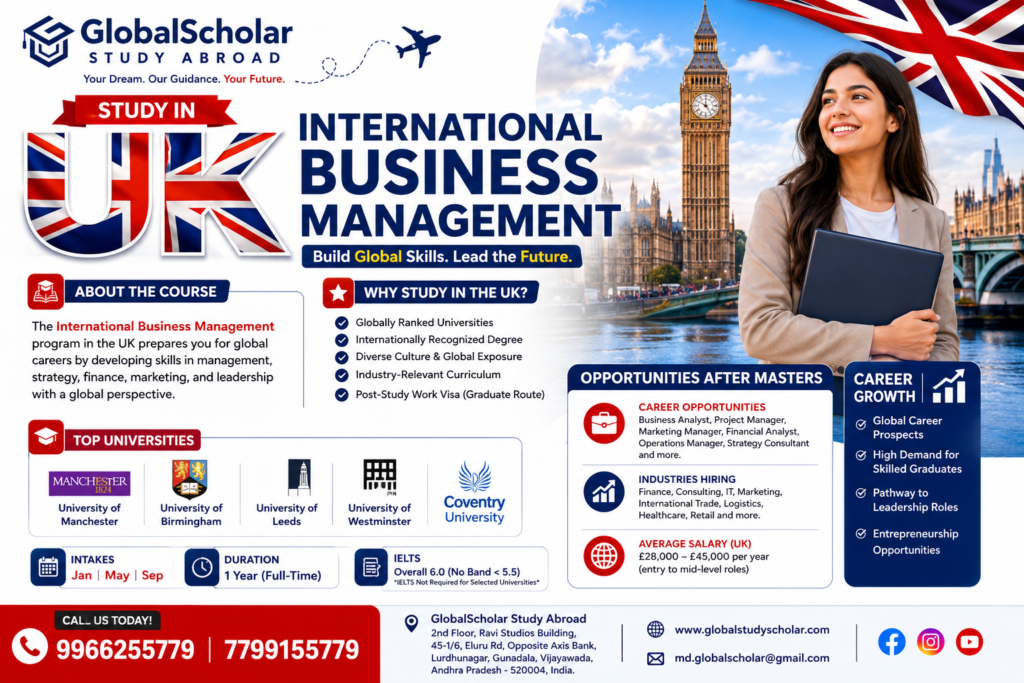
International Business Management in the UK is an attractive option for students who want to develop skills in global strategy, marketing, finance, leadership, operations and international trade. UK universities offer one-year master’s programmes that combine academic learning with practical business knowledge and exposure to a multicultural environment. For Indian students looking to build an international career, studying MSc International Business Management in the UK can provide an opportunity to learn how businesses operate across different markets, cultures and regulatory environments. At GlobalScholar Study Abroad, Vijayawada, we help students explore suitable UK universities, understand admission requirements, prepare applications and receive guidance throughout the study-abroad process. Why Study International Business Management in the UK? The UK is home to universities with strong business and management programmes and a large international student community. Studying in the UK can expose students to different business cultures while allowing them to develop skills relevant to multinational companies and international organisations. An International Business Management programme can help students understand: The exact modules depend on the university and programme. For example, the University of Birmingham’s 2026 MSc International Business includes areas such as international strategy, global operations, governance, entrepreneurship and international business, with students also completing a substantial dissertation. What Is MSc International Business Management? An MSc International Business Management UK programme is generally designed to develop advanced knowledge of how organisations operate internationally. Instead of focusing only on one functional area such as accounting or marketing, international business programmes can provide a broader understanding of how different business functions work together in international markets. Students may study topics such as: 1. International Business Strategy Students learn how companies enter new markets, compete internationally and develop strategies for global growth. 2. International Marketing This area focuses on understanding customers across different countries, developing international marketing strategies and adapting products and communication to different markets. 3. Global Operations Students can learn how international organisations manage suppliers, production, logistics and operations across multiple countries. 4. Leadership and Management International businesses require managers who can work with people from different cultural and professional backgrounds. Leadership and communication therefore form an important part of many programmes. 5. International Finance Students may gain an understanding of financial decision-making within multinational organisations and international markets. 6. Entrepreneurship International business programmes may also cover innovation, entrepreneurship and opportunities for developing businesses in international markets. Top UK Universities for International Business The right university depends on your academic profile, budget, preferred location, entry requirements and career goals. Some universities featured in the GlobalScholar Study Abroad programme information include: University of Manchester The University of Manchester offers an MSc International Business and Management for 2026 entry. The programme is listed as a one-year, full-time, in-person master’s programme, with a staged admissions process because of high demand. University of Birmingham The University of Birmingham offers a one-year full-time MSc International Business. For 2026 entry, the university lists September 2026 and January 2027 starts, with specific academic entry requirements. University of Leeds The University of Leeds offers a 12-month full-time MSc International Business for 2026 entry. Its published entry requirement includes a bachelor’s degree at 2:1 level, while the university lists IELTS 6.5 overall with no component below 6.0 for this programme. University of Westminster The University of Westminster offers a one-year MSc International Business and Management in Central London. The programme covers areas including economics, finance, international trade, branding, marketing, leadership and digital communication. Coventry University Coventry University offers an International Business Management MSc for the 2026–27 academic year. The university lists it as a one-year full-time postgraduate programme and provides multiple potential start dates, subject to availability. Important: Course availability, tuition fees, intakes and entry requirements can change. Students should verify the latest university information before applying. International Business Management UK Eligibility Eligibility varies by university. For many master’s programmes, students generally need: Some programmes may accept students from different academic backgrounds, while others may prefer a relevant business or management degree. For example, the University of Leeds states that its MSc International Business requires a bachelor’s degree with a 2:1 equivalent and does not require previous qualifications specifically in international business. Therefore, students should not assume that every UK university has the same eligibility criteria. IELTS Requirement for International Business Management in UK English-language requirements vary considerably between universities. For example, the University of Leeds currently lists IELTS 6.5 overall with no component below 6.0 for its MSc International Business. Other universities may have different IELTS requirements or accept alternative English-language qualifications depending on the student’s circumstances. Therefore, if you are searching for: “MSc International Business Management UK without IELTS” do not assume that every university will waive IELTS. Instead, GlobalScholar Study Abroad can help you check the English-language requirements of individual universities based on your academic profile. Duration of International Business Management Courses in UK One major advantage of UK master’s education is that many taught master’s programmes can be completed in one year of full-time study. Examples include: However, some universities also offer programmes with professional experience or placement components that can have a longer duration. For example, the University of Westminster lists a two-year International Business and Management MSc with Professional Experience, which includes an extended professional-practice component. International Business Management UK Fees Tuition fees depend on the university, course, intake and student nationality. For example, current published international fees include: University Programme Published International Fee University of Birmingham MSc International Business Check current university fee schedule University of Leeds MSc International Business £32,500 University of Westminster MSc International Business and Management £18,000 Coventry University International Business Management MSc Check current fee schedule University of Manchester MSc International Business and Management Check current university fee schedule The University of Leeds currently lists £32,500 for its 2026 MSc International Business, while Westminster lists £18,000 for its 2026–27 International Business and Management MSc. Always check the university’s latest fee before making financial decisions, because tuition fees and scholarships can change. Scholarships for International Business Management in UK Some UK universities offer scholarships or
Hotel Management Courses in the UK 2026: Top Universities, Fees, Eligibility & Career Opportunities

Planning to study Hotel Management in the UK in 2026? The United Kingdom is a popular destination for students who want to build an international career in hospitality, hotel management, tourism, events, food and beverage, and luxury hospitality. For students from Vijayawada, Andhra Pradesh, studying Hotel Management in the UK can provide access to internationally recognised qualifications, practical learning opportunities and exposure to the UK’s hospitality and tourism industry. GlobalScholar Study Abroad, Vijayawada helps students explore suitable UK hospitality programmes, understand eligibility, prepare applications and receive guidance with the student visa process. 🇬🇧 Why Study Hotel Management in the UK? The UK has a well-developed hospitality and tourism sector, with hotels, restaurants, resorts, cruise companies, event businesses and international hospitality brands. A UK qualification can help students develop both academic knowledge and practical skills relevant to the international hospitality industry. Key benefits include: For example, the University of Surrey’s BSc International Hospitality Management includes opportunities for professional training placements in the UK or abroad and prepares students for careers across hospitality sectors. 🎓 Hotel Management Courses in the UK Students can choose from a variety of hospitality-related programmes depending on their academic background. Common study areas include: Hotel Management Hotel management programmes can cover: Hospitality Management Hospitality management provides a broader understanding of the industry, including hotels, restaurants, tourism, events and customer experience. International Hospitality Management These programmes focus on preparing students for careers in an international hospitality environment. Tourism Management Tourism programmes can cover destination management, travel operations, tourism marketing and customer experience. Food & Beverage Management Students interested in restaurants, hotels and luxury dining can explore food and beverage-related programmes. Event Management Event and hospitality programmes can lead toward areas such as conferences, exhibitions, sports events and entertainment. 🏫 Top Universities for Hotel Management in the UK The UK has a number of universities offering hospitality, tourism and related programmes. When selecting a university, students should compare: One example is the University of Surrey, whose International Hospitality Management BSc is listed for the 2026 intake and includes professional training placement opportunities. Students should not choose a university only because it appears in an advertisement or ranking. Always check the current programme details directly with the institution. 🎓 Hotel Management Eligibility in the UK Eligibility depends on the university and programme. Undergraduate Courses Students who have completed: may be eligible for undergraduate programmes, subject to university requirements. Typical requirements can include: Master’s Courses Students applying for postgraduate hospitality programmes generally need: There is no single eligibility requirement for every UK university. 🇬🇧 English Language Requirements Most international students need to demonstrate their English-language ability unless they meet an applicable exemption or alternative requirement. Depending on the university and course, accepted evidence may include: The required score can vary by university, programme and applicant profile. Students should check the exact English-language requirement before applying. 💷 UK Hotel Management Course Fees Tuition fees vary significantly between universities and programmes. The total cost can depend on: Students should also budget for living expenses such as: Don’t compare universities only by tuition fees. A lower tuition fee does not necessarily mean a better overall option. Students should compare the course quality, location, placement opportunities, university support and total cost of study. 💼 Practical Training & Industry Experience Practical experience can be extremely valuable in hospitality. Depending on the programme, students may have opportunities for: For example, the University of Surrey highlights professional training placements in the UK or abroad for its International Hospitality Management course. However, students should check whether a placement is: Placement opportunities are not automatically guaranteed for every student. 👨💼 Career Opportunities After Hotel Management in the UK Hotel Management graduates can explore career opportunities across different parts of the hospitality industry. 🏨 Hotels Potential roles include: 🍽️ Food & Beverage Career areas may include: ✈️ Tourism Graduates can explore: 🎪 Events Students interested in events may explore: 🚢 International Hospitality Hospitality graduates can also explore opportunities with: Career opportunities depend on qualifications, experience, skills, employer requirements and applicable UK immigration rules. 🛂 UK Student Visa for Hotel Management International students who want to study an eligible course in the UK generally need a Student visa. GOV.UK states that applicants need an offer from a licensed student sponsor, sufficient funds for the course and living costs, and the required English-language ability. A student normally needs a Confirmation of Acceptance for Studies (CAS) from the education provider before applying for the Student visa. The general process is: Students applying from outside the UK can generally apply for a Student visa up to 6 months before their course begins. GOV.UK currently states that applications made from outside the UK usually receive a decision within 3 weeks, although processing can vary. 💰 UK Student Visa Financial Requirements Students need to demonstrate that they have enough funds to support themselves and pay for their course where required. The amount depends on circumstances, including where the student will study. Because UK immigration requirements can change, students should always check the latest requirements before submitting their visa application. GlobalScholar Study Abroad, Vijayawada can help students understand the documentation needed for their application, but the final visa decision is made by the UK authorities. 👨🎓 Can Students Work While Studying in the UK? Some Student visa holders can work, but the permitted hours depend on the type and level of course and the student’s sponsor. For example, current UK sponsor guidance states that eligible full-time degree-level students at higher education providers with a track record of compliance can generally work up to 20 hours per week during term time and full-time during vacations. Students should check the exact work conditions attached to their own visa. Part-time work should not be treated as a guaranteed way to fund the entire cost of studying in the UK. 🎓 UK Graduate Visa After Hotel Management One of the attractions for eligible international graduates is the UK’s Graduate visa. The current rules are important for students planning a 2026 intake.