Public Universities in Italy 2026 | Low Tuition Fees & Scholarships
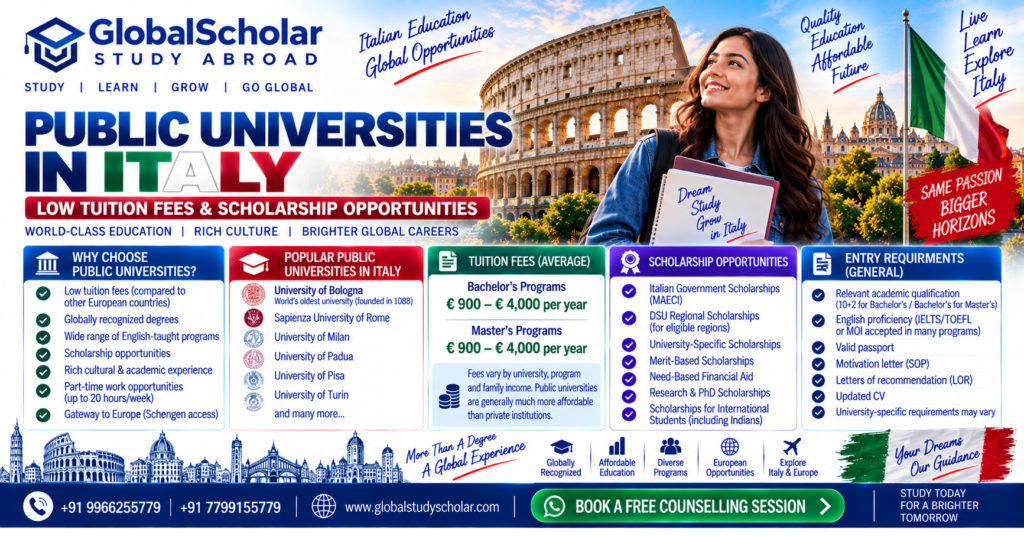
Thinking about studying in Italy at an affordable public university? Italy offers international students the opportunity to study at established public universities, access a wide range of academic programs, apply for scholarships and experience European culture and education. For Indian students planning to study abroad in 2026, public universities in Italy can be an option worth exploring because tuition fees can be influenced by the university, programme and family-income assessment. Italian universities and regional authorities also offer different scholarships, fee reductions and student-support benefits for eligible students. At GlobalScholar Study Abroad, we help students understand university options, course requirements, documentation, applications and the Italy study process. Why Choose Public Universities in Italy? Public universities in Italy are part of the country’s established higher-education system and offer programmes across fields such as business, engineering, computer science, data science, architecture, healthcare, humanities and more. Some important reasons international students consider public universities in Italy include: 1. Affordable Tuition Options Tuition at Italian universities varies according to the institution, programme and other factors. Official Italian guidance states that public universities generally charge lower fees than private universities, while some institutions may provide exemptions or reductions based on eligibility. The tuition range shown in the GlobalScholar flyer is approximately €900–€4,000 per year for selected Bachelor’s and Master’s programmes. This should be treated as an indicative range rather than a universal fee for every Italian public university. Always check the exact fee structure of your selected university and programme before applying. 2. Globally Recognized Degrees Italian universities offer Bachelor’s, Master’s and doctoral-level programmes across a wide range of academic disciplines. Italy is also part of the European higher-education system, making it attractive to students looking for an international academic experience. 3. English-Taught Programmes A growing number of Italian universities offer programmes taught fully or partly in English, particularly at Master’s and postgraduate levels. Students should check the individual programme page carefully because language requirements, teaching language and admission conditions can vary between programmes. 4. Scholarship Opportunities International students may be able to apply for scholarships and financial support offered by: Universitaly provides information about regional scholarship bodies and university-specific scholarships. Eligibility and application deadlines vary. 5. Cultural and Academic Experience Italy combines university education with a rich cultural environment. Students can experience historic cities, museums, architecture, food, art and European lifestyle while completing their studies. 6. Part-Time Work Opportunities According to Italy’s Ministry of Foreign Affairs, a study residence permit allows international students to work part-time for up to 20 hours per week, with a maximum of 1,040 hours per year. Part-time employment should be considered supplementary support and not treated as a guaranteed source of funding for tuition or living expenses. Popular Public Universities in Italy Italy has many public universities across different regions and academic disciplines. The GlobalScholar flyer highlights several well-known institutions, including: University of Bologna The University of Bologna is one of Italy’s historic universities and offers programmes across numerous academic fields. Sapienza University of Rome Located in Rome, Sapienza offers a broad range of Bachelor’s, Master’s and research programmes across multiple disciplines. University of Milan The University of Milan offers programmes covering areas including science, humanities, economics, healthcare and other academic fields. University of Padua The University of Padua is another established Italian university with a wide range of academic and research programmes. University of Pisa The University of Pisa offers programmes in areas including science, engineering, humanities and other disciplines. University of Turin The University of Turin provides a broad academic portfolio covering areas such as business, economics, science, medicine, humanities and social sciences. These are examples rather than a ranking. Students should compare individual programmes, admission requirements, tuition fees, location, teaching language and scholarship opportunities before selecting a university. You can use the official Universitaly portal to explore Italian higher-education institutions and individual programmes. Tuition Fees at Public Universities in Italy One of the most important questions for international students is: How much does it cost to study at a public university in Italy? There is no single tuition fee applicable to every public university. According to official Study in Italy information, university tuition depends on factors such as: Public universities generally have lower fees than private universities. Some universities can also provide exemptions or reductions according to their regulations. Indicative Tuition Range The GlobalScholar flyer presents the following indicative range: Programme Indicative Tuition Bachelor’s Programmes €900 – €4,000 per year Master’s Programmes €900 – €4,000 per year Important: These figures are not a universal national fee. Actual tuition can be higher or lower depending on the university, programme and student’s circumstances. Before paying any amount, students should obtain the official fee information from the selected university. Scholarships at Public Universities in Italy Scholarships can significantly reduce the overall cost of studying abroad for eligible students. Italy has several types of scholarship and financial-support opportunities. 1. Regional Scholarships Regional authorities in Italy provide student-support schemes through regional right-to-study organisations. Depending on the specific regional programme and eligibility, benefits may include financial assistance, accommodation, meals or other student services. Universitaly provides a region-by-region overview of right-to-study organisations. 2. University-Specific Scholarships Individual universities may provide their own scholarships, tuition reductions or other benefits. Eligibility can depend on: Students should check the official scholarship page of their selected university. 3. Merit-Based Scholarships Some institutions offer financial support based on academic performance or other merit criteria. The requirements can vary significantly, so students should check each scholarship announcement before applying. 4. Need-Based Financial Aid Financial circumstances can also be considered under certain Italian scholarship and fee-support systems. For international students, documentation relating to family income may be required. Universitaly notes that international students may need an ISEE Parificato for certain benefits. 5. Research and PhD Scholarships Students applying for doctoral programmes may find university-funded or other research-related scholarships. Universitaly currently notes that doctoral scholarships are available for eligible students, including international students holding the required second-cycle qualification. 6. Italian Government Scholarships Italy also offers government scholarship programmes for eligible international students.
Study in Italy Without IELTS 2026: MOI, Courses, Eligibility & Admission Guide
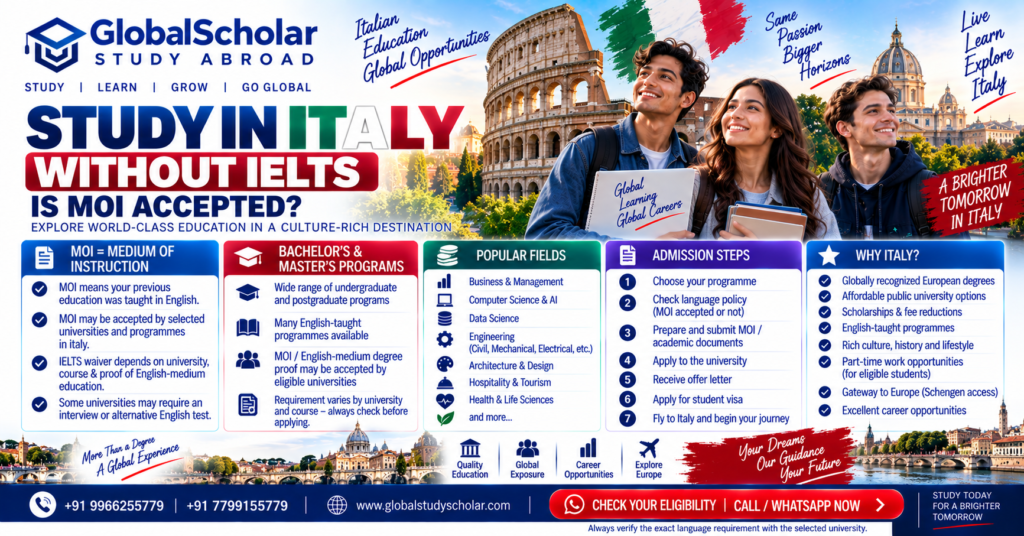
Study in Italy Without IELTS is a popular search topic among Indian students planning to pursue higher education in Europe. Some Italian universities and programs may accept alternative evidence of English proficiency, including proof that previous education was taught in English, but IELTS is not automatically waived across all Italian universities or courses. The exact language requirement depends on the university, program and level of study. Italian higher-education institutions are responsible for verifying language proficiency according to the language in which the chosen course is delivered. This guide explains how MOI (Medium of Instruction) can work, what students should check, popular courses, admission steps, scholarships and the Italy student visa process for 2026. What Does “Study in Italy Without IELTS” Mean? “Without IELTS” does not mean that every student can study in Italy without proving English proficiency. Instead, it can mean that a particular university or program accepts an alternative form of English-language evidence instead of an IELTS certificate. One possible form of evidence is an MOI certificate. MOI means Medium of Instruction An MOI certificate generally confirms that your previous education was conducted in English. For example, a student who completed their Bachelor’s degree through English-medium instruction may be able to submit documentation confirming this, if the selected university accepts it. The university may still ask for another form of language assessment, interview or recognized language certificate. Therefore, students should always confirm the university’s current language policy before applying. Is IELTS Mandatory for Italy? There is no single IELTS rule that applies to every Italian university and every course. Universitaly states that higher-education institutions determine entry requirements for individual programs, including language skills according to the language of the course. For an English-taught program, the university may require evidence of English proficiency. Depending on the institution, acceptable evidence may include: The important point is that acceptance of MOI is university- and course-specific. Can Indian Students Study in Italy Without IELTS Using MOI? In some cases, an Indian student may be able to use an English-medium education certificate/MOI if the selected university and program accept it. The process can look like this: Previous English-medium education → MOI certificate → University assessment → Admission decision However, MOI acceptance should be confirmed before submitting the application. Students should check: This is important because university admission requirements and visa requirements are separate considerations. MOI for Italy: What Is It? An MOI – Medium of Instruction certificate is a document issued by an educational institution confirming the language used for teaching a student’s previous qualification. A typical MOI may mention: The medium of instruction for the student’s program was English. The exact wording and format can vary. Students should obtain an official document from their previous institution and check whether the Italian university accepts it. Bachelor’s and Master’s Programs in Italy The flyer highlights Bachelor’s and Master’s study options. Bachelor’s Programs Students who have completed their required secondary education can explore first-cycle Bachelor’s programs. Universitaly describes first-cycle Bachelor’s programs as generally three years, although some single-cycle programs, such as certain professional disciplines, have longer durations. Possible fields include: Master’s Programs Students who already hold a Bachelor’s degree can explore second-cycle Master’s programs. Universitaly generally describes second-cycle Master’s programs as two years. Popular fields include: The specific academic background required depends on the university and program. Popular Courses to Study in Italy Without IELTS 1. Business & Management Business programs may include: Students should check whether the selected course is taught entirely in English and what language evidence is required. 2. Computer Science & Artificial Intelligence Technology programs can include: These programs may be suitable for students with relevant academic backgrounds and an interest in technology careers. 3. Data Science Data-focused programs may cover: Admission requirements vary according to the curriculum and academic prerequisites. 4. Engineering Italy offers programs across engineering disciplines such as: Some programs can have specific mathematics, science or subject requirements. 5. Architecture & Design Students can explore: Some architecture and design programs may have entrance examinations, portfolios or other selection procedures. 6. Hospitality & Tourism Italy can also be considered by students interested in: The language and admission requirements depend on the selected institution. 7. Health & Life Sciences Possible areas include: Some health programs are regulated or have limited places and may involve specific admission tests. How MOI-Based Admission Works If you want to study in Italy without IELTS using MOI, follow a careful process. Step 1: Select an English-Taught Program Start by identifying an English-taught course that matches your academic background. Step 2: Check the University’s Language Policy Look specifically for information about: Step 3: Obtain Your MOI Request an official Medium of Instruction certificate from your previous educational institution. Step 4: Submit Your Academic Documents Depending on the university, this may include: Step 5: Complete Any Interview or Assessment Some universities may conduct an interview or another English-language assessment. Step 6: Receive the Admission Decision The university evaluates your academic and language documentation. Step 7: Complete the Required Pre-Enrolment Process For visa-required Bachelor’s and Master’s applicants, pre-enrolment is handled through the Universitaly portal after the relevant university process. Step 8: Apply for the Student Visa After the applicable pre-enrolment validation, students can proceed with the visa application process. Important: MOI Does Not Automatically Guarantee a Visa This is one of the most important points for students considering Italy without IELTS. Even if a university accepts your MOI and grants admission, this does not automatically guarantee a student visa. The current Italian international-student procedures state that the final decision on a study visa belongs to the competent diplomatic-consular authority. University validation or pre-enrolment does not constitute a guarantee of visa issuance. Students should therefore prepare all required visa documentation carefully. Italy Admission Requirements Requirements vary by university and course. Common documents can include: Universitaly confirms that individual institutions can set requirements relating to previous qualifications, subjects, grades, admission tests, interviews and language skills. Italy Tuition Fees There is no single tuition fee for all Italian universities. Fees can
Study in Italy 2026: Courses, Fees, Scholarships & Admission Guide
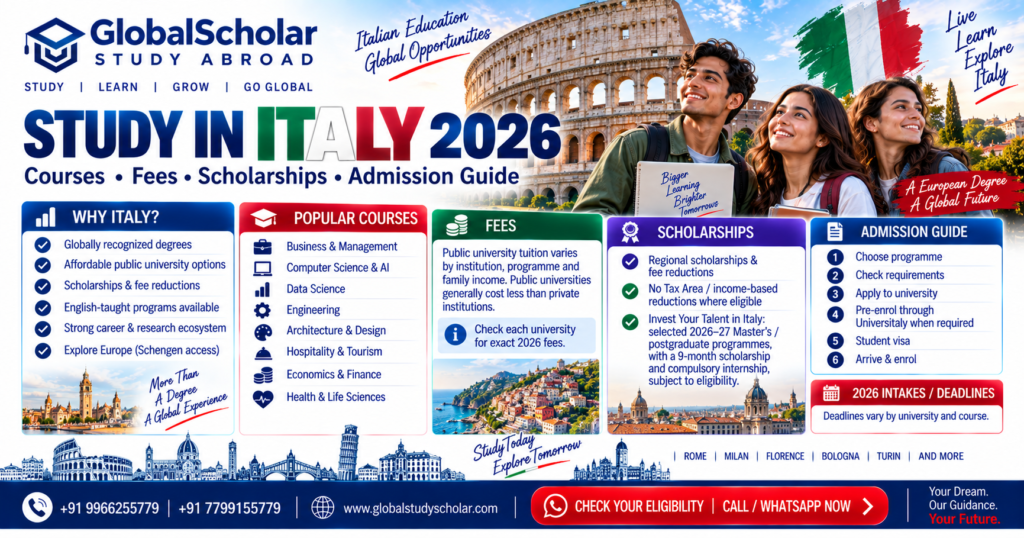
Study in Italy 2026 is an attractive option for international students looking for European higher education, internationally oriented programs and scholarship or tuition-reduction opportunities. Italy offers public and private universities across fields such as business, computer science, artificial intelligence, data science, engineering, architecture, hospitality, finance and health sciences. For students from India, the application process requires careful planning because admission requirements, tuition fees, scholarship eligibility and visa procedures can vary by university and course. This guide explains the major points students should know before planning to study in Italy in 2026. Why Study in Italy? Italy combines a long-established higher education system with universities and institutions across many academic disciplines. The official Universitaly portal allows students to search courses, compare institutions and access information about admission, tuition fees, scholarships and entry procedures. 1. Recognized European Education Italian universities offer Bachelor’s, Master’s, single-cycle and doctoral programs across a wide range of subjects. A standard first-cycle Bachelor’s degree generally lasts three years, while a second-cycle Master’s degree generally lasts two years. Some single-cycle programs have longer durations, such as five or six years. 2. Public University Options Italy has a large public university sector. Public universities generally have different fee structures from private institutions, and tuition can depend on factors such as the institution, degree program and family-income information. This makes it important to evaluate the actual fee structure of each university rather than assuming one fixed tuition amount for all students. 3. Scholarships and Fee Reductions International students may find several forms of financial support, including: Universitaly notes that regional bodies and higher-education institutions offer scholarships and benefits subject to their respective eligibility requirements. International students may need an ISEE-equivalent assessment (ISEE Parificato) for certain income-based benefits. 4. English-Taught Programs Students can find English-taught programs in areas such as: However, the language of instruction and required English or Italian proficiency must be checked for each individual course. 5. European Student Experience Studying in Italy gives students an opportunity to experience Italian culture, cities, history and a wider European environment while completing their higher education. Popular Courses to Study in Italy The GlobalScholar flyer highlights several popular academic areas. Business & Management Business-related programs can include: These courses can prepare students for careers in management, consulting, business development, marketing and related fields. Computer Science & Artificial Intelligence Technology-focused programs can include: Students interested in technology should compare the curriculum, programming requirements, specialization and practical components of each course. Data Science Data-focused programs may cover: These programs can be relevant for students planning careers in technology, analytics and data-driven business roles. Engineering Italy offers engineering programs across multiple disciplines, including: Admission requirements vary according to the university and program. Architecture & Design Students interested in creative and technical disciplines can explore: Some programs may have portfolios, entrance tests or other specific admission requirements. Hospitality & Tourism Italy is also an important destination to consider for students interested in: The exact programs and entry requirements differ by institution. Economics & Finance Students can explore programs in: Health & Life Sciences Depending on academic background and admission requirements, students can explore areas such as: Some health programs, particularly regulated or limited-enrolment courses, have additional admission procedures. Italy Tuition Fees 2026 One of the most important points when planning to study in Italy is that there is no single nationwide tuition fee for all international students. According to the official Study in Italy information, tuition at Italian universities depends on several factors, including whether the institution is public or private, the degree course and declared family income. Some universities also provide exemptions or reductions under their own rules. Public Universities Public university fees can be influenced by: Private Universities Private institutions generally have their own fee structures, which can differ considerably from public universities. Therefore, students should obtain the exact 2026/27 fee information from their selected university and program before making financial decisions. Scholarships to Study in Italy Scholarships are an important part of the Italy study-abroad process. Students may find funding through regional authorities, universities and the Italian government. Regional Scholarships Italian regions have organizations responsible for student welfare and financial support. Depending on the region and scholarship scheme, support can involve financial assistance and other student benefits. Eligibility conditions vary. University Scholarships Individual universities may offer: The conditions and application deadlines are university-specific. MAECI Scholarships The Italian Ministry of Foreign Affairs and International Cooperation (MAECI) also offers scholarships for eligible foreign students and Italian citizens residing abroad under its annual calls. For the 2026/27 call, the official Study in Italy information specifies eligible study categories and scholarship conditions. Applying for a MAECI scholarship is separate from applying for university admission. Students should always check the current official call for: No Tax Area and Tuition Reductions Some Italian universities and regional systems provide tuition reductions or exemptions based on family economic circumstances. Universitaly describes the No Tax Area as a mechanism through which eligible students from lower-income households can receive reductions or, depending on the applicable rules, potentially have university fees reduced to zero. International students may need an ISEE Parificato or other documentation to establish their economic circumstances. This means students should not assume that every international student automatically receives free tuition. Eligibility and documentation requirements apply. Eligibility to Study in Italy Admission requirements depend on the university, course and level of study. Bachelor’s Degree Students applying for a first-cycle program generally need a secondary-school qualification that is comparable to the qualification required for entry into higher education in Italy. Universitaly states that higher education institutions establish specific requirements, which can include previous qualifications, subjects and grades, admission tests, interviews and language skills. Typical Documents Students may be asked for: Master’s Degree Students normally need a relevant Bachelor’s degree or comparable qualification. Depending on the course, universities may assess: Some programs may require an interview or entrance assessment. English Language Requirements The language requirement depends on the language of instruction. For an English-taught program, the university may require evidence of English proficiency. For
Study in Italy 2026: Universities, Courses, Fees, Scholarships & Career Opportunities
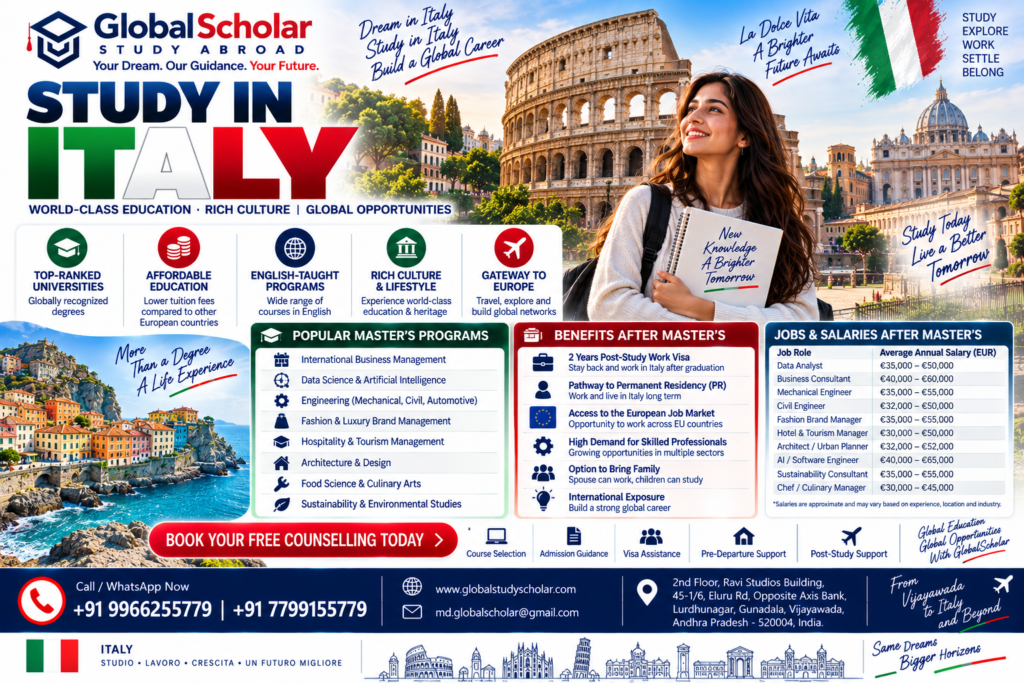
Italy is becoming an attractive destination for international students looking for quality European education, English-taught programmes, scholarship opportunities and international career exposure. From Business and Management to Data Science, Artificial Intelligence, Engineering, Fashion, Hospitality and Sustainability, students can choose from a wide range of programmes across Italian universities and higher-education institutions. For Indian students, Study in Italy 2026 can be an opportunity to combine education with international exposure and potential employment opportunities after graduation. GlobalScholar Study Abroad, Vijayawada helps students with course selection, university applications, scholarship guidance, education-loan planning and visa documentation. Why Study in Italy in 2026? Italy offers a combination of academic opportunities, culture and international exposure. Key advantages include: The Italian Ministry of Foreign Affairs confirms that international students can work part-time while studying, subject to the applicable limit of 20 hours per week and 1,040 hours per year. Popular Master’s Programmes in Italy Italy offers postgraduate programmes across many fields. 1. International Business Management Students interested in global business can explore Master’s programmes covering: These programmes can help students develop knowledge relevant to multinational companies and international business environments. 2. Data Science & Artificial Intelligence Technology is one of the most popular areas for international students. Potential specialisations include: Students should compare curriculum, technical requirements and career outcomes before selecting a programme. 3. Engineering Italy has a long-standing reputation in engineering and industrial education. Popular areas include: Students interested in engineering careers should check whether their qualification will require professional recognition or registration in Italy or another country where they plan to work. 4. Fashion & Luxury Brand Management Italy is particularly well known for fashion and luxury industries. Students can explore programmes related to: Cities such as Milan are particularly relevant to students interested in fashion and luxury industries. 5. Hospitality & Tourism Management Italy’s tourism sector makes it an interesting destination for students interested in hospitality. Possible programmes include: Students can combine academic learning with exposure to Italy’s tourism and hospitality environment. 6. Architecture & Design Italy’s architectural and design heritage makes it attractive for students interested in creative disciplines. Popular areas include: 7. Food Science & Culinary Arts Italy’s global reputation for food and gastronomy creates opportunities for students interested in: 8. Sustainability & Environmental Studies Sustainability is another growing academic area. Students can explore: Scholarships in Italy Scholarships are one of the major reasons international students consider Italy. However, scholarships are not automatically available to every student. Financial support can come from: Universitaly provides information on regional and university-level scholarships and benefits, with eligibility depending on the applicable rules and annual calls. The Italian Ministry of Foreign Affairs also offers MAECI scholarships for eligible foreign students under specific annual calls. For academic year 2026–27, the official deadline was 26 March 2026, so students planning future intakes should check the next official call rather than relying on an old deadline. Affordable Education in Italy Italy can offer comparatively affordable study options, particularly when students explore public universities and applicable tuition reductions. But there is no universal “free education” rule for all international students. Tuition depends on factors such as: Students should calculate their total budget before accepting an offer. Can International Students Work While Studying in Italy? Yes. According to the Italian Ministry of Foreign Affairs, a study residence permit allows eligible international students to work part-time for up to 20 hours per week, with a maximum of 1,040 hours per year. This can help students gain: However, part-time employment should not be treated as a guaranteed way to fund the entire cost of studying in Italy. What Happens After a Master’s in Italy? This is an important question for Indian students. The pathway depends on the student’s circumstances and immigration status. If an international student graduates and already has a suitable job offer, Italy’s official guidance states that a valid study permit can be converted to an appropriate work permit, subject to the applicable requirements. There are also provisions for graduates who need time to seek employment or start an eligible business activity consistent with their completed education. Official immigration guidance describes a job-search residence permit of 9 to 12 months for eligible graduates. A simplified pathway can look like: Study in Italy → Graduate → Find Suitable Employment → Work Residence Status → Long-Term Residence Eligibility This is a potential pathway, not a guaranteed PR route. Is There a 2-Year Post-Study Work Visa in Italy? This claim needs to be handled carefully. The flyer mentions “2 Years Post-Study Work Visa.” For website content, I recommend not advertising this as a universal two-year benefit. Italy’s official guidance instead describes different routes depending on the student’s qualification, residence permit and employment situation. A graduate may be able to convert a valid study permit to work status, while eligible graduates can have a job-search residence route of 9–12 months. Therefore, students should check their specific situation before making immigration decisions. Career Opportunities After Studying in Italy Career opportunities depend on the student’s qualification, skills, Italian-language ability, work experience, employer and current labour-market conditions. Potential areas include: Business Data & Technology Engineering Fashion Hospitality Sustainability Salary depends heavily on experience, city, industry, employer and qualifications, so the figures shown in promotional material should be treated as indicative rather than guaranteed. Do I Need to Know Italian? Not necessarily for every programme. There are English-taught courses in Italy, particularly at the Master’s level. However, learning Italian can be highly beneficial for: If your goal is to build a career in Italy after graduation, learning Italian can significantly improve your ability to interact with employers and the wider community. Italy Student Visa for Indian Students Students from India generally need the appropriate visa and residence documentation for long-term study in Italy. The process can involve: Students entering Italy for higher education must follow the current procedures published by Italian authorities and the relevant Italian mission. Italy Study Visa & Residence Permit After entering Italy for a qualifying long-term study purpose, international students generally need to complete